Cookiebot is the best CCPA consent management platform in 2026, scoring 4.3 on our US/CCPA-fit composite (global 4.0). It is the only platform here that honors the Global Privacy Control signal automatically, without any configuration required.
We scored 10 CMPs by re-weighting our methodology for US privacy law, with GPC signal detection and multi-state coverage as decisive factors. Below: a score-ranked quick list, a comparison table, the US privacy criteria, and a scored section per CMP.
Disclosure: Consently publishes this guide and appears at rank 10 of 10 by its US/CCPA-fit score of 3.2.
What Are the Best CCPA Consent Management Platforms?
Cookiebot, Clym, and Enzuzo lead this list for US privacy. Cookiebot earns the top spot with automatic GPC honoring out of the box, the highest US/CCPA-fit composite (4.3) that clears the decisive GPC gate. Clym ties on the composite (4.3) with the deepest multi-state US breadth. Enzuzo places third (4.1) with GPC plus DSAR at SMB pricing.
-
Cookiebot – Best automatic GPC honoring for CCPA out of the box. US/CCPA-fit 4.3
-
Clym – Best US multi-state breadth (HIPAA, VPPA, and wiretapping consent). US/CCPA-fit 4.3
-
Enzuzo – Best US privacy with DSAR and Microsoft Consent Mode. US/CCPA-fit 4.1
-
Osano – Best US-privacy program with a no-fines pledge. US/CCPA-fit 4.0
-
Secure Privacy – Best audit-grade CCPA with SOC 2 governance. US/CCPA-fit 3.9
-
OneTrust – Best enterprise US-privacy suite for CCPA and 50-state coverage. US/CCPA-fit 3.9
-
Termly – Best budget CCPA tool with an automatic Do-Not-Sell link. US/CCPA-fit 3.9
-
ConsentManager – Best CCPA option for ad-supported US publishers. US/CCPA-fit 3.7
-
CookieYes – Best easy CCPA banner for small US sites. US/CCPA-fit 3.6
-
Consently – Best value flat-priced CCPA opt-out banner (without GPC). US/CCPA-fit 3.2
This list is ranked by the US/CCPA-fit score, not the global overall. That score re-weights our seven standard category scores for US privacy (Compliance 24%, Scanning 12%, Banner 8%, Setup 8%, Pricing 8%, Performance 4%, Support 6%). It then adds two decisive sub-factors: CCPA/CPRA opt-out plus GPC signal handling at 22%, and multi-state US coverage plus Do-Not-Sell/Share at 8%. The global overall score is shown alongside each product but does not govern the ranking here. How we score every CMP.
What Is a CCPA Consent Management Platform, and How Is US Privacy Different?
A CCPA consent management platform is software that serves an opt-out consent experience for US visitors. It generates a “Do Not Sell or Share My Personal Information” mechanism. It also keeps an auditable record of choices under California’s CCPA/CPRA and related US state laws.
The key difference from GDPR: CCPA/CPRA does not require prior opt-in consent for most cookies. It requires three things instead. You must offer an opt-out of the sale or sharing of personal information and surface a Do-Not-Sell link.
Under CPRA, you must also honor browser-level opt-out preference signals like the Global Privacy Control. A GDPR opt-in banner is not a CCPA compliance tool. The US regime is opt-out first: visitors can use the site while keeping the right to stop data sale, rather than EU-style consent before processing.
One nuance is worth flagging. A 2025 Debevoise analysis notes the California Privacy Protection Agency reads the CPRA “symmetry of choice” rule to require opt-in for some third-party tracking. The dominant model is still opt-out, but the safest US banners now support both flows by region.
What Should You Look for in a CMP for CCPA and US Privacy?
Five criteria separate a genuine CCPA/US-privacy CMP from a GDPR banner with a CCPA label. They are the opt-out consent model, GPC signal handling, a Do-Not-Sell link, multi-state coverage, and certifications. See how to choose a consent management platform for the full evaluation framework.
CCPA and CPRA opt-out consent (not GDPR opt-in)
CCPA/CPRA requires you to let California visitors opt out of the sale or sharing of their personal information. It does not require prior consent before placing cookies. A banner that blocks all cookies until a user clicks “Accept” is GDPR-style opt-in behavior. For most US sites, cookies can load by default, and the user must get a clear, accessible mechanism to stop data sale. Look for a CMP that serves an opt-out banner, not an opt-in gate, and maps it to the CCPA “sale and sharing” opt-out category specifically.
Global Privacy Control (GPC) signal handling
The Global Privacy Control is a browser-level opt-out preference signal. CPRA took effect in January 2023, and several state laws now treat GPC as binding, including Virginia’s VCDPA and Colorado’s CPA. A business that detects a GPC signal must treat it as a valid opt-out and stop selling or sharing that person’s data. Automatic GPC honoring means the banner suppresses itself and records the opt-out without the user clicking anything.
This is not a theoretical requirement. In September 2025, California, Colorado, and Connecticut announced a joint investigative sweep targeting businesses that fail to honor GPC. They sent letters demanding immediate compliance. GPC handling is now an enforcement priority, not a nice-to-have.
Support splits the field cleanly. Cookiebot honors GPC out of the box, with no configuration. Osano, Secure Privacy, and Termly respect GPC once you enable it. CookieYes and CookieHub gate GPC to a paid tier. Consently does not support GPC at all. For any US site that takes CPRA seriously, automatic or at-minimum configurable GPC support is the decisive capability.
A “Do Not Sell or Share My Personal Information” link
CCPA/CPRA requires California-facing sites to provide a clear “Do Not Sell or Share My Personal Information” link, typically in the site footer. Some CMPs auto-generate and inject that link for you. Termly does this automatically for CCPA-covered sites.
Consentmo also auto-generates it on the free plan. Most CCPA-ready CMPs surface the opt-out via the banner itself and let you add the footer link manually using their provided URL.
Multi-state US coverage (Virginia, Colorado, Connecticut, and more)
California’s CCPA/CPRA was only the beginning. As of 2026, over 15 US states have enacted comprehensive privacy laws. They include Virginia (VCDPA), Colorado (CPA), Connecticut (CTDPA), Texas (TDPSA), and Florida (FDBR). A CMP that handles only California leaves you exposed everywhere else.
The strongest multi-state tools apply the correct opt-in or opt-out model by geolocation, so a Colorado visitor sees a different experience from a European one. Osano covers 95+ regulations, OneTrust covers all 50 states, and Clym adds HIPAA, VPPA, and wiretapping consent under 150+ regulations.
Certifications and ad-tech signals you can stand behind
For US sites running advertising, look for a Google-certified CMP with Consent Mode v2, which Google Ads requires for signal recovery. US publishers with programmatic revenue also need IAB GPP / MSPA support. Regulated US clients in healthcare, finance, or legal need certifications to give procurement a defensible story.
Look for SOC 2 Type II (Secure Privacy, OneTrust) or ISO 27001/27701 (Cookiebot). A CMP that lacks certifications is not necessarily non-compliant, but your legal team will ask.
How Do the Best CCPA Consent Platforms Compare?
The table below ranks all 10 platforms by their US/CCPA-fit composite. The “Score” column is the global overall (the Layer-1 PT14 review score, unchanged). “US/CCPA-fit” is the Layer-2 composite this list is ranked by.
| Rank | Product | Score | US/CCPA-fit | CCPA/CPRA + GPC | Multi-state + Do-Not-Sell | Entry price | Best for (US privacy) |
|---|---|---|---|---|---|---|---|
| 1 | Cookiebot | 4.0 | 4.3 | Automatic GPC honoring, out of the box | CCPA opt-out by geo; 50+ regions | Free; $8 to $96/mo per domain | Automatic GPC for CCPA |
| 2 | Clym | 3.8 | 4.3 | GPC + GPP + Microsoft Consent Mode | HIPAA, VPPA, wiretapping, 150+ regs | No free tier; $49/mo per property | US multi-state breadth |
| 3 | Enzuzo | 3.9 | 4.1 | GPC + Microsoft Consent Mode | CCPA/CPRA, CIPA, 30+ regs; DSAR | Free; $9/mo (Agency $99/yr) | US privacy with DSAR |
| 4 | Osano | 3.9 | 4.0 | GPC respected when enabled | 50+ countries, 95+ regs; no-fines pledge | Free Solo; $199/mo (3 domains) | US-privacy program + pledge |
| 5 | Secure Privacy | 3.9 | 3.9 | GPC documented (off by default) | CCPA opt-out by geo; SOC 2 governance | Free; $15/mo per domain | Audit-grade CCPA |
| 6 | OneTrust | 3.6 | 3.9 | GPC + universal opt-out (enterprise) | CCPA + 50-state + HIPAA; DSAR | Quote only (~$10k+/yr) | Enterprise 50-state |
| 7 | Termly | 3.8 | 3.9 | GPC respected when enabled | Auto Do-Not-Sell link; Virginia CDPA | Free; $10 to $15/mo per site | Budget Do-Not-Sell link |
| 8 | ConsentManager | 3.9 | 3.7 | GPP + geo CCPA/CPRA opt-out | CCPA/CPRA + LGPD by geo (docs thinner) | Free; EUR23/mo | Ad-supported US publishers |
| 9 | CookieYes | 3.8 | 3.6 | GPC on the Pro plan ($25/mo) | CCPA opt-out out of the box | Free; $10 to $55/mo per domain | Easy CCPA banner, small sites |
| 10 | Consently | 4.0 | 3.2 | No GPC support | CCPA/US opt-out template + country-code loading | 14-day trial; $99 to $499/yr (1 to 10 domains) | Flat-priced CCPA opt-out (no GPC) |
1. Cookiebot: Best Automatic GPC Honoring for CCPA Out of the Box
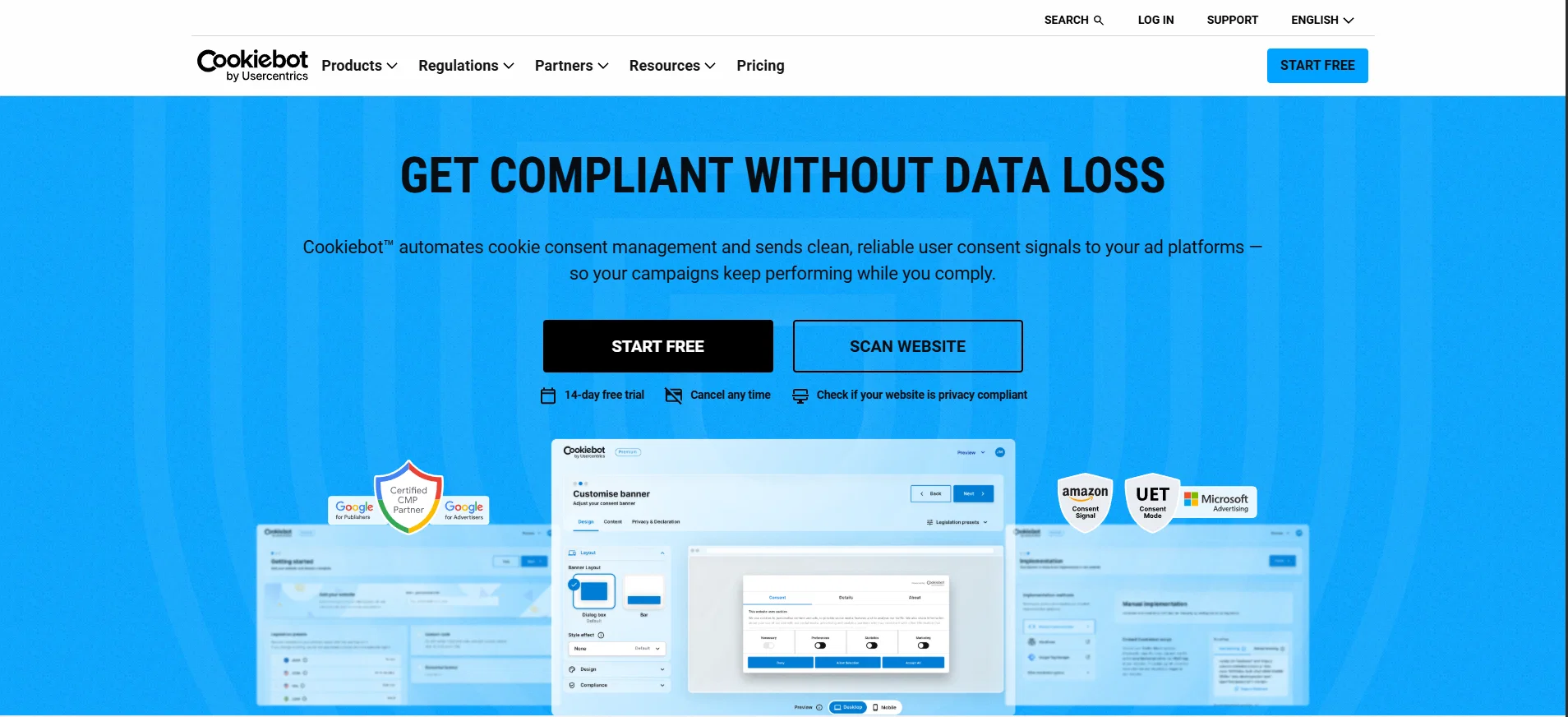
Cookiebot scores 4.0 out of 5 globally and 4.3 on our US/CCPA-fit score, making it the top pick here. It is the only platform in this list that honors the Global Privacy Control signal automatically, with no configuration. That automatic GPC handling earns it a 5.0 on the decisive sub-factor and the number-one position on both the composite and the GPC gate.
Key Features
Cookiebot leads on scanning depth and certification breadth, the two things large US publishers lean on most.
-
Certified cookie scanner with a 13,000+ cookie repository and auto-categorization
-
Google Consent Mode v2 Gold Tier certification; IAB TCF v2.3
-
Automatic GPC honoring: the consent banner is suppressed for GPC-enabled browsers, the opt-out is recorded server-side, and the platform has been CCPA-ready since January 1, 2026
-
Geo-based opt-in/opt-out switching (EU opt-in, US opt-out, configurable per region)
-
47+ banner languages; ISO 27001/27701 certified; owned by Usercentrics
Pros
Cookiebot’s strengths cluster around compliance confidence: the GPC automation, the scanner, and a long market track record.
-
Automatic out-of-box GPC honoring is the strongest US/CCPA-decisive feature in this set; no other platform here matches it without configuration
-
Scanner depth and certification breadth give large US publishers and regulated clients the paper trail they need
-
14 years in market and 600,000+ customer installs; G2 reviewers say they “no longer have to worry about compliance” after switching
-
The free tier (50 subpages, 1 domain) is genuinely functional for small US sites testing compliance
Cons
The trade-offs are cost at scale and a thin policy-generator story.
-
Per-domain billing with subdomains billed separately; G2 and Trustpilot reviews note it “can become expensive when dealing with multiple domains,” which stacks fast for US multi-site owners
-
Banner templates are functional but rarely distinctive; customization requires CSS knowledge
-
No terms and conditions generator or privacy policy generator; you need a separate tool
Pricing
Cookiebot prices per domain, with subdomains counted separately above the free-tier limit. See the Cookiebot pricing page for current rates.
-
Free (1 domain, 50 subpages)
-
Premium Lite $8/mo, Small $16 to $34/mo, Medium $34/mo, Large $56/mo, XLarge $96/mo per domain
What Users Say
G2 reviewers consistently praise the certified scanning depth and the compliance confidence Cookiebot delivers. The recurring criticism is cost at scale: multi-domain US owners see the per-domain fee compound quickly, especially for agencies or e-commerce brands with regional subdomains. Read the full Cookiebot review or compare Cookiebot alternatives.
2. Clym: Best US Multi-State Breadth (HIPAA, VPPA, and Wiretapping Consent)
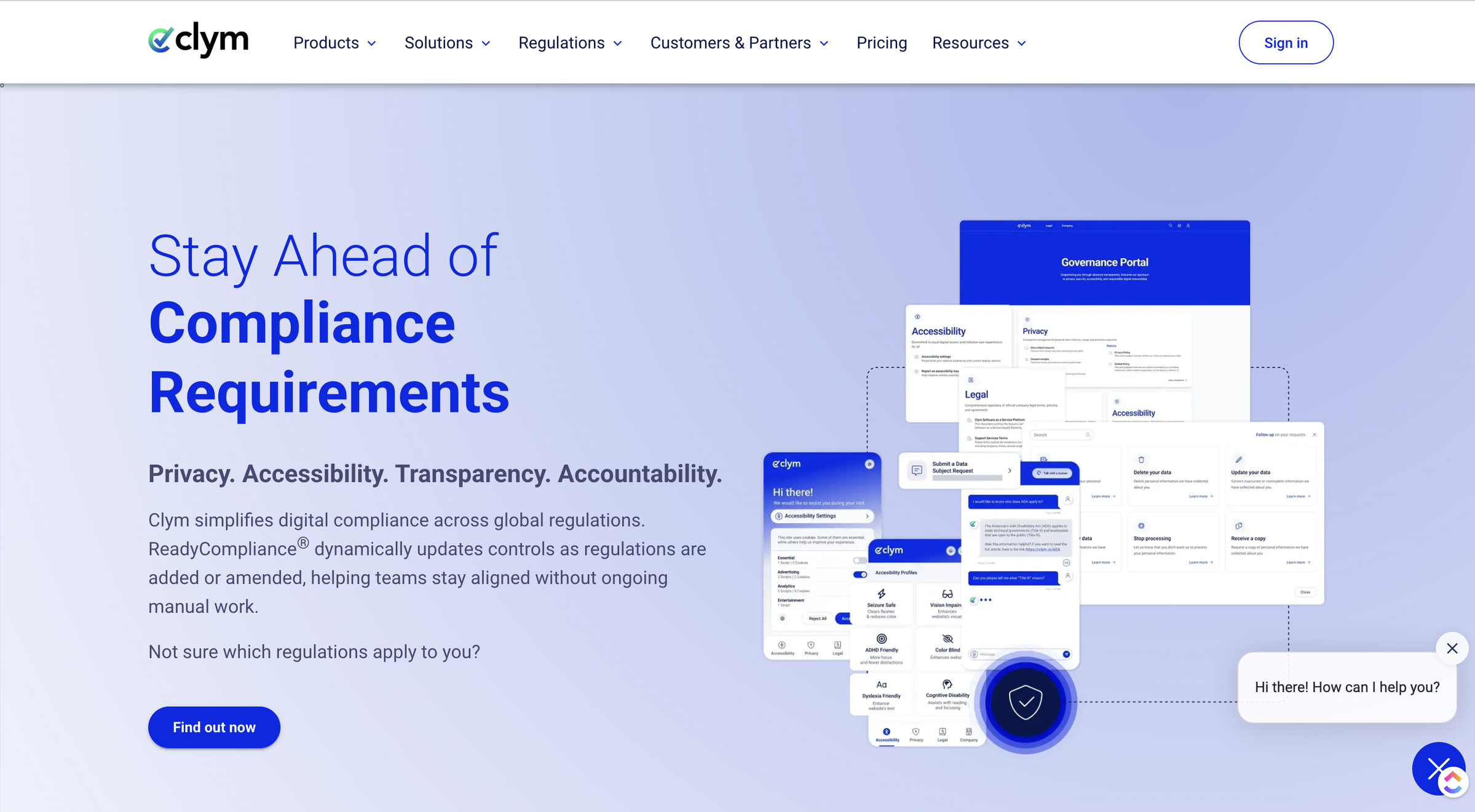
Clym scores 3.8 out of 5 globally and 4.3 on our US/CCPA-fit score, second here and the broadest US multi-state pick in the set. It ties Cookiebot on the composite but is a hair behind on the raw score (4.27 vs 4.31), earning the second position on the tie-break.
Key Features
Clym’s feature set is built for breadth, covering ad-tech signals and US laws most CMPs skip.
-
GPC + GPP + Google Consent Mode v2 + Microsoft Consent Mode + IAB TCF 2.2
-
HIPAA authorization banners, VPPA consent, and wiretapping consent notice under a “150+ regulations” by-region coverage model
-
DSAR (data subject access requests) and a governance portal
-
Free cookie scanner; geo-based regulation switching
Pros
Clym wins on regulatory coverage and review sentiment, especially for regulated US verticals.
-
The only platform in this set with HIPAA, VPPA, and wiretapping consent as named, documented features – critical for US healthcare sites, video publishers, and businesses operating in call-recording states
-
Both decisive sub-factors score 5.0 (automatic GPC support + the deepest multi-state and Do-Not-Sell coverage in the set)
-
4.9 out of 5 on G2 across 43 reviews; support and ease of setup are the top praise categories
Cons
The friction points are the lack of a free tier and a steep jump for multi-site owners.
-
No freemium tier: the entry plan is $49/mo per property with a 14-day trial
-
The Start and Grow plans each cap at one digital property, so multi-site owners jump directly to the Enterprise tier (from $449/mo)
-
Clym’s own blog acknowledges that an accessibility overlay “is not a safeguard” for ADA compliance – worth noting for US sites under accessibility scrutiny
Pricing
Clym charges per digital property, with no freemium tier and a 14-day no-credit-card trial. See Clym pricing for current rates.
-
Start $49/mo (1 property, 50k pageviews)
-
Grow $149/mo (1 property, 1.5M pageviews)
-
Enterprise from $449/mo (multi-property)
What Users Say
G2 reviewers highlight the breadth and the onboarding support. The honest limitation is the per-property cap: the Enterprise jump is steep for a small agency managing multiple US client domains. Read the full Clym review or browse Clym alternatives.
3. Enzuzo: Best US Privacy With DSAR and Microsoft Consent Mode
Enzuzo scores 3.9 out of 5 globally and 4.1 on our US/CCPA-fit score, placing third here. It lands at 4.5 on the decisive GPC sub-factor because it supports both GPC and Microsoft Consent Mode at SMB pricing. Most tools reserve that combination for a higher tier.
Key Features
Enzuzo packs enterprise-style privacy tooling, including real DSAR, into an SMB-priced product.
-
Google Consent Mode v2 certified; GPC support; Microsoft Consent Mode
-
End-to-end DSAR workflow with California 45-day and EU 30-day deadlines visible in the product
-
Covers CCPA/CPRA, CIPA, and 30+ regulations; native Shopify and Webflow apps
-
Six legal-policy generators; certified banner and scanner
Pros
Enzuzo’s edge is US-privacy features per dollar, anchored by DSAR automation.
-
GPC plus Microsoft Consent Mode plus real DSAR in one dashboard at $9/mo to $29/mo – the best US-privacy-features-per-dollar ratio in this set
-
DSAR automation covers the California 45-day deadline out of the box, which enterprise tools charge thousands for
-
Shopify app has 4.7/5 from 95 reviews; CCPA/CPRA and CIPA coverage is documented
Cons
The recurring complaint is upgrade friction as visitor counts grow.
-
Visitor caps force tier upgrades: geo-targeting requires the Growth plan at $29/mo, and the free tier is 5,000 visitors
-
White-label branding is gated to the Agency plan ($99/yr for 20 domains)
-
Shopify reviews tab rates it 3.6/5 from 33 reviews, below the main Shopify app score, with upgrade friction as the recurring complaint
Pricing
Enzuzo prices per domain, with a genuinely usable free tier for small US sites. See Enzuzo pricing for current rates.
-
Free ($0, 1 domain, 5k visitors, 3 DSAR requests)
-
Starter $9/mo, Growth $29/mo, Pro $79/mo per domain
-
Agency $99/yr (20 domains)
What Users Say
G2 and Shopify reviewers consistently praise the DSAR depth and the breadth of policy generators. The friction point is the visitor cap: a mid-traffic US site can exhaust the Growth plan faster than expected. Read the full Enzuzo review or see Enzuzo alternatives.
4. Osano: Best US-Privacy Program With a No-Fines Pledge
Osano scores 3.9 out of 5 globally and 4.0 on our US/CCPA-fit score. It is the SERP’s recurring pick for US privacy law coverage. It is also the only platform here that pairs a full consent product with a financial guarantee.
Key Features
Osano is a full privacy program, not just a banner, with consent, DSAR, and vendor risk under one login.
-
Certified Google CMP with Consent Mode v2; IAB TCF + GPP; GPC (respected when enabled)
-
DSAR, data mapping, and vendor risk management
-
50+ countries, 95+ regulations; the “No Fines, No Penalties” pledge up to $500k
-
Public benefit corporation (PBC) legal structure; $25M Series B
Pros
Osano’s strengths are program breadth, real community trust, and a unique financial guarantee.
-
A full US-privacy program, not just a banner: consent, DSAR, vendor risk, and data mapping under one login
-
“Legitimately good for sub-$1M ARR … handles GDPR and CCPA adequately,” per a r/webdev founder’s comment verified in the Osano PT14 review
-
The no-fines pledge differentiates Osano from every other tool in this set; up to $500k in coverage is a meaningful trust signal for US legal and compliance teams
Cons
The catch is price and the fine print on that headline pledge.
-
The no-fines pledge excludes the free Solo plan and self-serve Plus buyers, the audience most drawn to it; enterprise and above qualify
-
$199/mo is a steep entry for a site that only needs a consent banner; the free Solo plan caps at 5,000 visitors and 1 domain
-
Console complexity; G2 reviewers note the dashboard takes learning relative to the banner-only tools
Pricing
Osano offers a free Solo tier, then jumps to a program-level price that suits buyers who want more than a banner. See the Osano CCPA pricing details.
-
Free Solo ($0, 1 domain, 5k visitors)
-
Plus $199/mo (3 domains, 30k visitors)
-
Basic Privacy and enterprise custom pricing
What Users Say
G2 and Capterra reviewers praise the privacy expertise and responsive support. The consistent criticism is the price-to-banner ratio: buyers using Osano purely for a consent banner find the Plus jump expensive. See Consently vs Osano for a side-by-side, or read the full Osano review.
5. Secure Privacy: Best Audit-Grade CCPA With SOC 2 Governance
Secure Privacy scores 3.9 out of 5 globally and 3.9 on our US/CCPA-fit score, the highest governance-and-certification depth in this set. SOC 2 Type II and Google CMP Gold Tier put it in a short list for regulated US clients.
Key Features
Secure Privacy leads on governance and certifications, the things a regulated US procurement team checks first.
-
Pre-consent script blocking with a tamper-proof consent log
-
SOC 2 Type II certification; Google CMP Gold Tier; IAB TCF 2.3
-
Governance suite: DSAR, DPIA, RoPA, and vendor risk management
-
GPC documented and configurable (off by default; you enable it in settings); CCPA opt-out by geo
-
70+ banner languages; Capterra 5.0/82, G2 4.9/115
Pros
The standout is an audit-grade evidence package backed by strong review scores.
-
SOC 2 + governance depth for regulated US clients – healthcare, finance, and legal teams get an evidence package that most CMPs cannot match
-
“Cookie consent management is painless and it helps with GDPR and CCPA,” per a verified Capterra review
-
Accurate scanner; strong aggregate review scores across both major platforms
Cons
The weak spots are the default-off GPC setting and a pricing gap mid-range.
-
GPC is documented but off by default, which is why the decisive sub-factor scores 3.5 rather than 5.0; a CPRA-serious US site must remember to enable it
-
Per-domain billing stacks; the $59-to-$249/mo jump between tiers leaves a pricing gap for mid-size US sites
-
English-only dashboard limits usability for multilingual US teams
Pricing
Secure Privacy prices per domain and starts with a usable free tier. See Secure Privacy pricing for current rates.
-
Free (10 domains, 500 consents)
-
Small $15/mo, Business $59/mo, Advanced $249/mo per domain
What Users Say
Capterra reviewers highlight the painless setup and the CCPA/GDPR coverage. G2 reviewers flag per-domain cost compounding and the gap between the Business and Advanced tiers. Read the full Secure Privacy review or compare Secure Privacy alternatives.
6. OneTrust: Best Enterprise US-Privacy Suite for CCPA and 50-State Coverage
OneTrust scores 3.6 out of 5 globally but 3.9 on our US/CCPA-fit score. Its cookie product alone rates lower, at 3.5/5 on G2. The decisive sub-factors pull the composite up, because CCPA, 50-state, HIPAA, and DSAR automation are all documented, verified capabilities.
Key Features
OneTrust’s feature set is enterprise-grade, spanning consent, governance, and the deepest US multi-state coverage here.
-
Certified scanning; universal consent and preference management
-
GPC and universal opt-out signals; CCPA/CPRA + 50-state + HIPAA coverage
-
DSAR automation; full privacy and governance suite
-
Named in all six CCPA-specific SERP listicles reviewed for this article
Pros
OneTrust’s case is breadth and enterprise credibility that smaller tools cannot match.
-
The US-privacy SERP default: OneTrust appears in every scored CCPA/US roundup we checked, including Enzuzo, Cookiebot, Scytale, and Reform
-
Deepest multi-state + DSAR at the enterprise level; marquee customers include Samsung, Adobe, and Aetna
-
50-state coverage and HIPAA make it the only option for large regulated US enterprises that cannot segment their CMP stack
Cons
The drawbacks are cost, renewal unpredictability, and a cookie module that trails its own suite.
-
Quote-only pricing with a floor around $10,000/yr and a median closer to $11,500/yr (Vendr data); no free trial
-
G2 reviewers report renewal-price increases of “275% and 468%” in verified reviews
-
The Consent and Preferences module rates 3.5/5 on G2, below its governance counterparts (4.1 to 4.4); the cookie banner is not OneTrust’s strongest suit
Pricing
OneTrust is quote-only, with no free tier and no self-serve trial. Expect roughly a $10,000/yr floor and a median near $11,500/yr, per the Vendr marketplace data cited above.
What Users Say
Enterprise buyers consistently praise OneTrust’s capability breadth and legal coverage. The universal criticism across G2 and independent reviews is renewal pricing and the lower satisfaction of the cookie-specific module versus the broader platform. Read the full OneTrust review or see OneTrust alternatives.
7. Termly: Best Budget CCPA Tool With an Automatic Do-Not-Sell Link
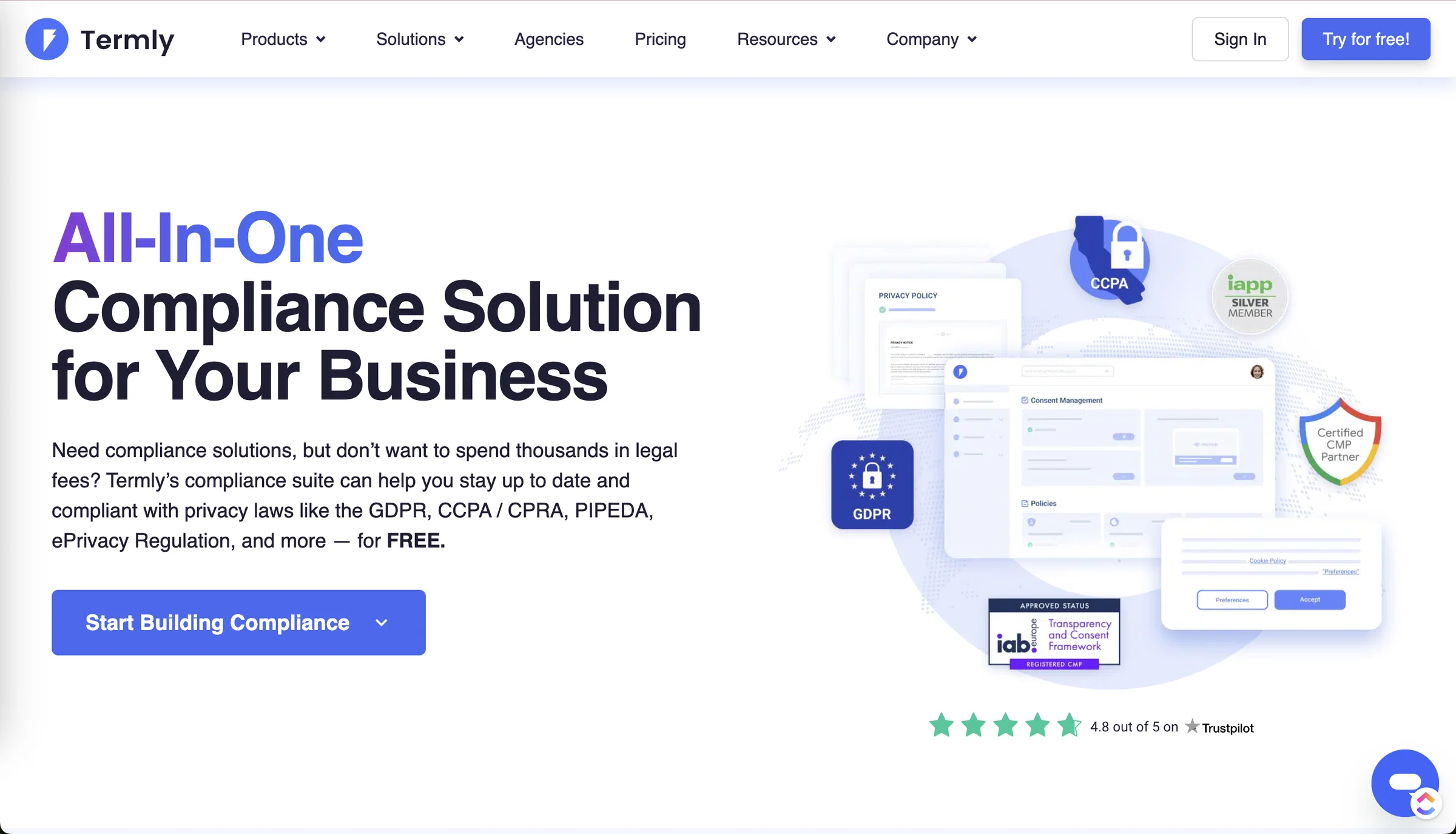
Termly scores 3.8 out of 5 globally and 3.9 on our US/CCPA-fit score. It scores 3.5 on the GPC sub-factor, the same as Osano and Secure Privacy, because it honors GPC once you enable it. It also earns a 4.5 on the multi-state sub-factor. It auto-generates the “Do Not Sell or Share My Personal Information” footer link that most small US sites overlook.
Key Features
Termly pairs a wide policy-generator library with a certified banner and an auto Do-Not-Sell link.
-
Ten legal-policy generators including privacy policy, cookie policy, and terms
-
Google Consent Mode v2 certified; IAB TCF 2.3 (Pro+ tier)
-
Automatic “Do Not Sell or Share My Personal Information” link injection
-
GPC honoring once enabled in banner settings; Virginia CDPA + California coverage; embeddable DSAR form (free plan)
Pros
Termly’s strength is budget US-privacy coverage with the Do-Not-Sell link few rivals automate.
-
Auto Do-Not-Sell link at the Starter tier ($10/mo) – no other tool in this set generates and injects it automatically at that price point
-
“Very reasonable” pricing (G2); Trustpilot 4.7/571 with support rated “unparalleled”
-
Free plan with a DSAR form is a rare value-add for budget-conscious US sites
Cons
The trade-offs are tier-gated essentials and per-site licensing friction.
-
GPC is supported but off by default. You enable “Respect GPC signal” in the banner settings, so the GPC sub-factor scores 3.5, the same as Osano and Secure Privacy, not the 5.0 Cookiebot earns for out-of-the-box automation
-
Consent logs, IAB TCF compliance, and multi-language banners are gated to the Pro+ tier at $15/mo
-
Per-website licensing: G2 reviewers note “confusion around adding a second domain” and the cost multiplication for agencies
Pricing
Termly licenses per site, with a free GDPR-only tier and an Agency plan by quote. See the Termly CMP page for current rates.
-
Free ($0, 1 site, basic GDPR, watermark, DSAR form)
-
Starter $10/mo, Pro+ $15/mo per site; Agency custom
What Users Say
G2 reviewers highlight the Do-Not-Sell automation and the reasonable price-to-feature ratio. Capterra feedback flags the per-site gating as a friction point for multi-domain US teams. Read the full Termly review or browse Termly alternatives.
8. ConsentManager: Best CCPA Option for Ad-Supported US Publishers
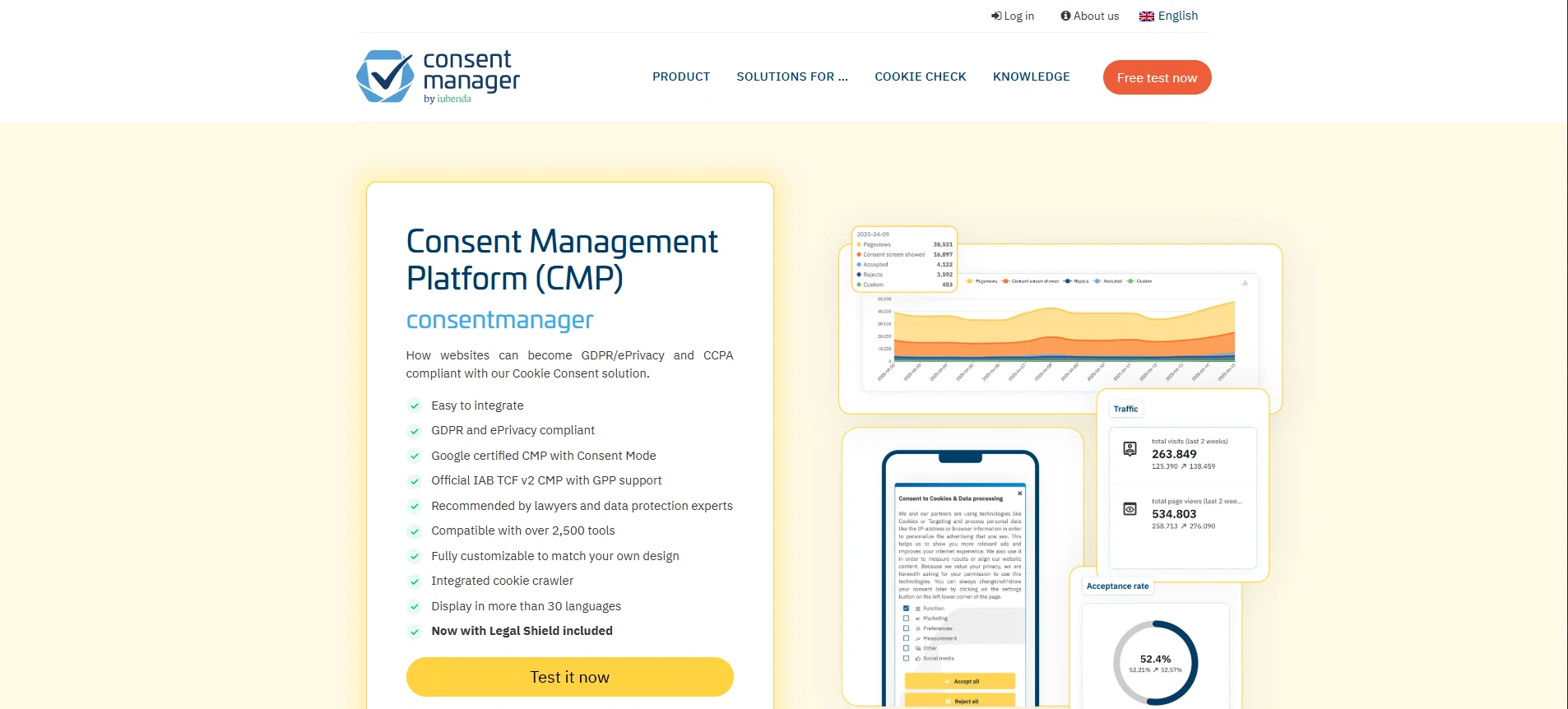
ConsentManager scores 3.9 out of 5 globally and 3.7 on our US/CCPA-fit score. The 3.0 decisive score reflects an honest limitation. ConsentManager’s own CCPA and LGPD documentation is noticeably thinner than its GDPR guidance, so US-specific setup requires more manual work.
Key Features
ConsentManager is built for ad-supported publishers, with the deepest ad-tech signal coverage in this set.
-
Dual IAB TCF v2.2 and v2.3 certification; Global Privacy Platform (GPP) support
-
Google Consent Mode v2; geo-switching CCPA/CPRA and LGPD opt-out banners
-
Cookie Crawler with a 3M+ database; built-in A/B testing
-
Mobile and CTV SDKs; EU data residency
Pros
The wins are programmatic ad-tech depth and conversion tooling at a mid-market price.
-
The deepest ad-tech signal coverage in this set (dual TCF + GPP) for US publishers monetizing via programmatic advertising
-
A/B banner testing at mid-market pricing gives US publishers the conversion optimization most CMPs reserve for enterprise tiers
-
Capterra reviewers praise the SDK integration and responsive support
Cons
The gaps are thin US documentation and EU-focused lower tiers.
-
ConsentManager’s own CCPA and LGPD docs are “noticeably thinner” than its GDPR guidance; non-EU setup involves more manual configuration than comparable tools
-
One Capterra reviewer reported the React Native SDK “never worked” – a concern for US app publishers
-
IAB TCF and A/B testing require the EUR59/mo Essential tier; the free and Starter tiers are EU-focused
Pricing
ConsentManager prices in euros, with a free tier and per-view scaling. See ConsentManager pricing for current rates.
-
Free (EUR0, 1 site, 3k monthly views)
-
Starter EUR23/mo, Essential EUR59/mo (3 domains), Professional EUR219/mo (20 domains), Ultimate custom
What Users Say
Capterra reviewers commend the SDK breadth and the GPP support for publisher clients. The recurring gap is US-specific documentation depth: ad agencies running US campaigns may need to configure opt-out banners manually against their own legal counsel’s guidance. Read the full ConsentManager review or compare Consently vs ConsentManager.
9. CookieYes: Best Easy CCPA Banner for Small US Sites
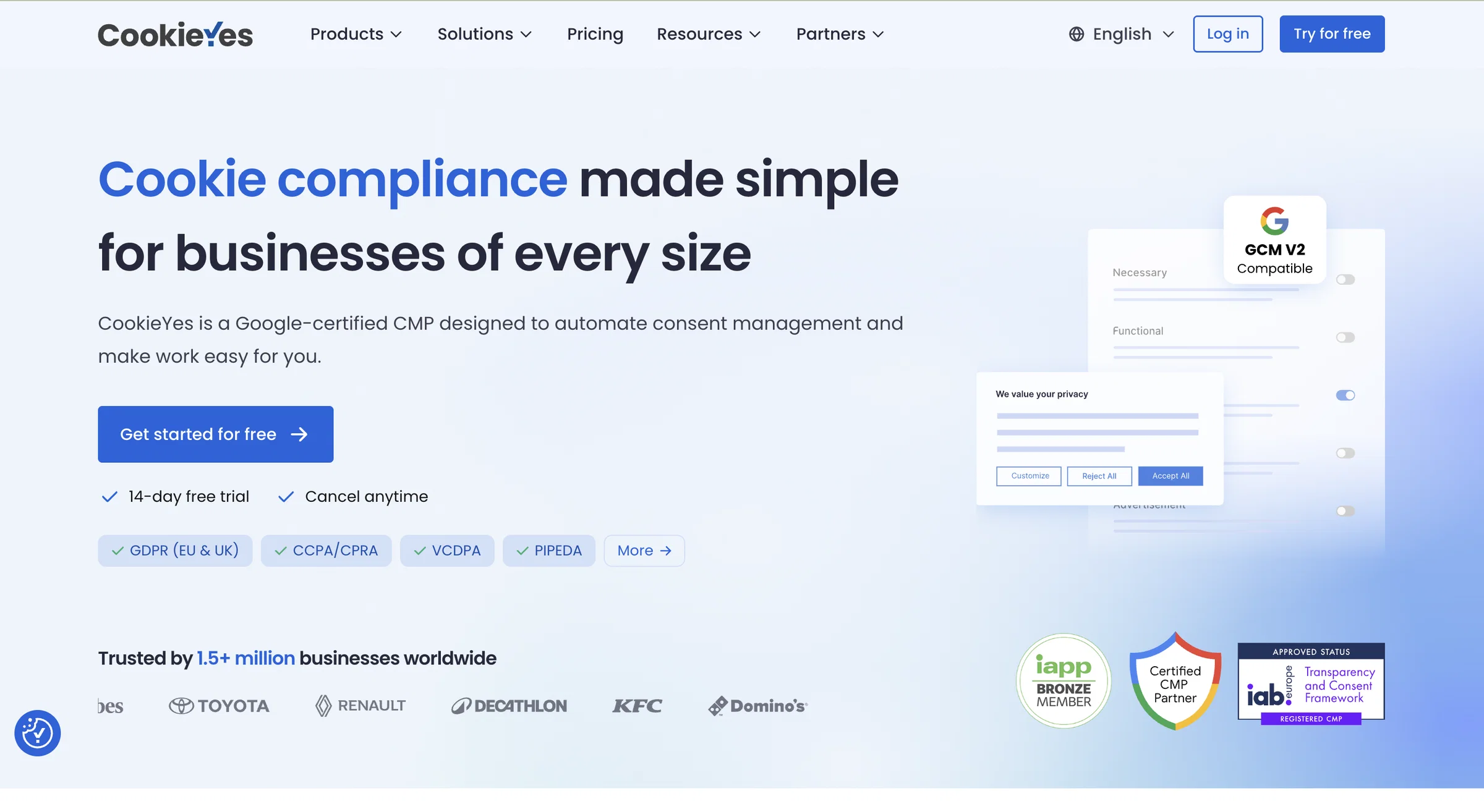
CookieYes scores 3.8 out of 5 globally and 3.6 on our US/CCPA-fit score. CCPA opt-out works on the free plan, making it genuinely accessible for small US sites with straightforward needs. The decisive score is 3.0 because GPC is gated to the $25/mo Pro plan.
Key Features
CookieYes optimizes for fast, no-code setup, with CCPA opt-out available even on the free plan.
-
Google-certified Consent Mode v2; cookie scanner with a 100,000+ database
-
CCPA opt-out banner out of the box on every plan, including free
-
Auto-blocking on every plan; GPC + IAB TCF v2.3 + geo-targeting on the Pro plan
-
Two policy generators; one-line, WordPress, Shopify, and Wix installation options
Pros
The appeal is ease of use, broad install base, and strong support sentiment.
-
Easiest setup in this set: one line of code and a visual banner editor with no technical knowledge required
-
CCPA opt-out is available on the free plan, which is a practical differentiator for US SMBs
-
Outstanding support (Trustpilot 4.8); 1.5M+ installs across platforms
Cons
The drawbacks center on GPC paywalling and per-domain cost growth.
-
GPC is gated to the Pro plan at $25/mo per domain, so a CPRA-covered site pays for a mandatory compliance feature
-
Per-domain pricing plus pageview overage compounds for US multi-site owners; an agency running 10 client domains pays $250/mo just for Pro
-
The free tier was narrowed in early 2026; a February 2026 verified review described the updated free plan as “useless” and noted the reviewer pulled it from client sites
Pricing
CookieYes prices per domain, with pageview overage on top. See CookieYes pricing for current rates.
-
Free ($0, 5,000 pageviews/mo, 1 domain)
-
Basic $10/mo, Pro $25/mo, Ultimate $55/mo per domain
What Users Say
Trustpilot and G2 reviewers praise the support speed and the easy setup. WordPress.org reviews from early 2026 flag the free-tier tightening and the GPC paywall as the two sources of recent dissatisfaction. Read the full CookieYes review or compare CookieYes alternatives.
10. Consently: Best Value Flat-Priced CCPA Opt-Out Banner (Without GPC)
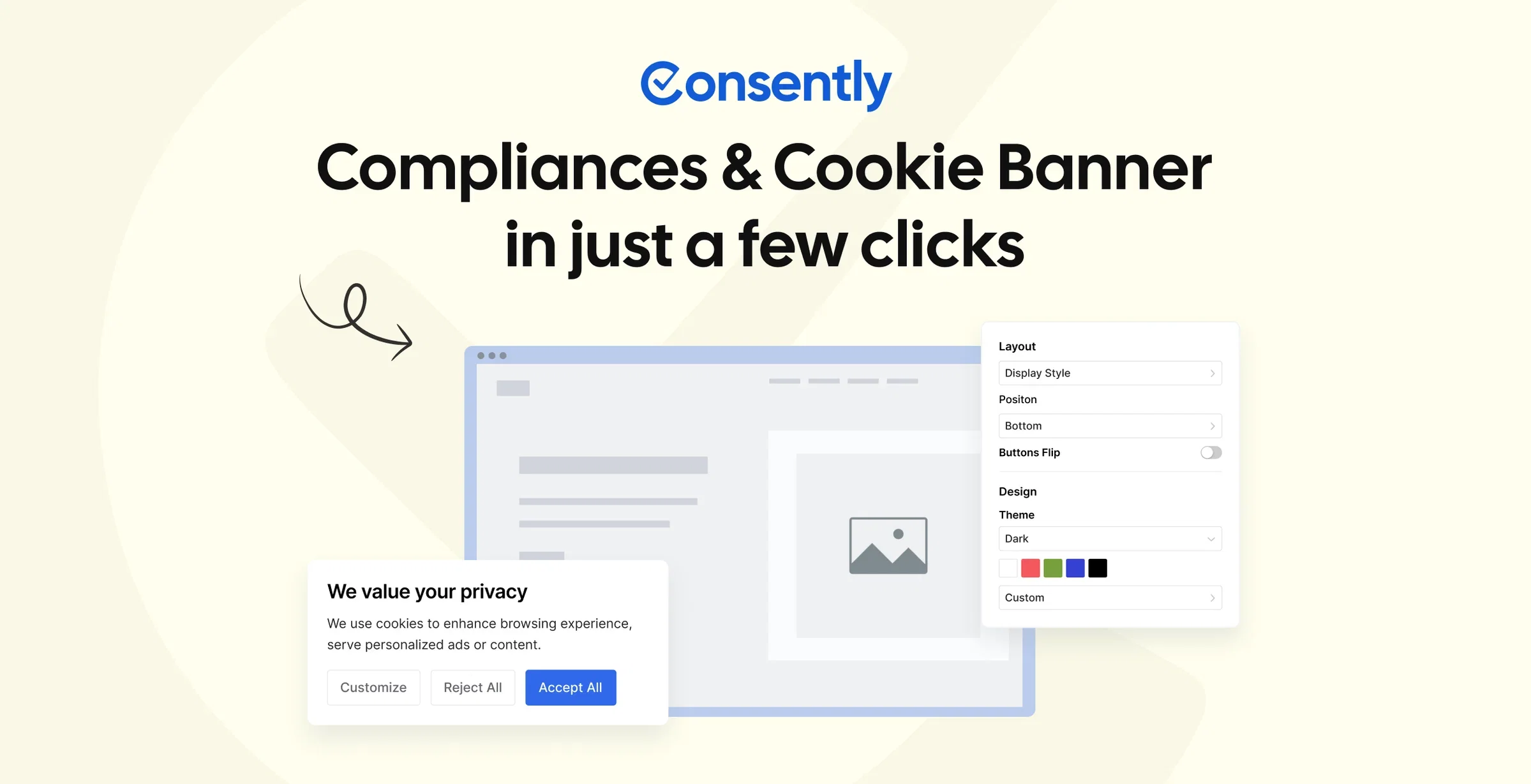
Consently scores 4.0 out of 5 globally and 3.2 on our US/CCPA-fit score, the lowest of the ten here. It is our own product, and we rank it by the same US/CCPA-fit method, not first.
Consently does not detect the Global Privacy Control signal at all. It scores 1.0 on that decisive sub-factor, which by our own scoring rule keeps it off the number-one spot. Its composite also places it last on the math. Be honest about this before reading further.
Why Consently Fits Budget Multi-Site US Owners
The case for Consently in a US context rests entirely on price packaging, not US-privacy depth. Basic is $59 one-time (lifetime) for 1 domain, Premium is $199 for 5 domains, and Enterprise is $349 for 10 domains. The same tiers are $99, $199, and $499 per year on a subscription if you prefer. Those are flat prices with no overage and no auto-upgrade. Pageviews are pooled across all domains on the Premium and Enterprise plans.
Picture an agency or founder running 5 to 10 US client sites that each need a competent CCPA opt-out banner. The need is a dismiss button, a country-code-gated script loader, a consent log, and a policy generator. Consently’s pricing beats per-domain rivals by a wide margin here.
At $199 one-time for 5 domains, that is $40/domain paid once, against $120/domain/yr for CookieYes Basic or $600+/domain/yr for Clym’s entry plan. Every feature is on every plan: the CCPA opt-out template, the three policy generators, the scanner, and the multi-site dashboard are not tiered away.
This is the right framing: Consently is a strong flat-priced value for simple CCPA opt-out needs. It is not a US-privacy specialist, and US sites that need GPC, DSAR, or multi-state governance should use Cookiebot, Clym, Osano, or OneTrust instead.
Key Features
Consently bundles the full CCPA opt-out toolkit on every plan, with no feature gating by tier.
-
CCPA/US opt-out template with a dismiss button and country-code-based script loading
-
Banner with four styles, deep visual customization, 35 languages, and WCAG 2.2 AA accessibility
-
Cookie scanner and auto-blocking; consent logs and analytics with export
-
Three policy generators (privacy policy, cookie policy, terms and conditions)
-
Google Consent Mode v2 (automatic) + IAB TCF 2.3 + AC v2; multi-site dashboard with config cloning
-
EU (Frankfurt) data hosting; live chat support on all plans
-
See every feature on every plan for the full breakdown
Best Use Cases for US Privacy
Consently fits three US-site profiles, all defined by flat-price multi-domain value rather than US-privacy depth.
-
A US small business or solo founder that needs a clean CCPA opt-out banner, a privacy policy, and consent logs, and does not run advertising or serve California visitors at scale
-
An agency managing 5 to 10 US client domains on one plan, where GPC and DSAR are not requirements and the value is flat-priced coverage without per-domain stacking
-
A multi-site e-commerce operator who wants all features without per-tier upsells, does not need a Google CMP Partner badge yet, and is willing to add GPC support when Consently ships it
Consently is not the right tool yet for US sites that must honor GPC signals, run DSAR workflows, or cover Virginia, Colorado, or Connecticut. Read what a consent management platform does for the broader picture.
Pros
Consently’s real strengths are pricing economics and feature parity across every plan.
-
Flat multi-domain pricing beats per-domain rivals at US scale: 5 domains for $199 one-time (lifetime), 10 for $349, no overage
-
Every feature on every plan: the CCPA/US opt-out template, country-code script loading, three policy generators, and the multi-site dashboard are not gated
-
Fast one-line, GTM, official WordPress.org plugin, and native Shopify App Store app setup; EU hosting and WCAG 2.2 AA compliance out of the box
-
Live chat support on all plans, including the $99/yr Basic tier
-
AppSumo reviewers rate the interface “clean, easy to use” and note auto-scanning “saves me so much time”
Cons
Consently’s limitations are exactly why it ranks last on US/CCPA fit, and we state them plainly.
-
No Global Privacy Control (GPC) signal detection at all. This is the single most important automated CCPA/CPRA opt-out capability. Consently’s own review and product-details confirm GPC is not supported in any plan. CPRA-covered US sites need to use another tool if GPC compliance is required.
-
GDPR-first, not US-first: Consently was built around the EU opt-in model. US/CCPA is handled as an opt-out template and a country-code-gated dismiss button, which is competent but is not a US-privacy specialization. The full Google CMP Partner listing is also still pending.
-
Maturing scanner: Consently’s scan depth is adequate for typical SMB use cases but has not been independently benchmarked at the scale of Cookiebot’s 13,000+ cookie repository
-
No ISO 27001 or SOC 2 certification, which regulated US clients in healthcare, finance, or legal may require
-
No permanently free tier: the 14-day trial is the only no-cost entry point
Read the full Consently review for the detailed seven-dimension scorecard.
Pricing
Consently’s headline is a one-time lifetime price per tier, with monthly and yearly subscriptions also available and pageviews pooled across all domains. See Consently pricing for the full breakdown.
-
Basic: $99/yr (1 domain, 100,000 pageviews/mo)
-
Premium: $199/yr (5 domains, 1,000,000 pageviews/mo, multi-site dashboard, priority support)
-
Enterprise: $499/yr (10 domains, 3,000,000 pageviews/mo)
Pageviews are shared across domains on the Premium and Enterprise plans. No overage charges. No auto-upgrade. 14-day free trial, no credit card required.
Start a free 14-day Consently trial and set up a CCPA opt-out banner in under 15 minutes.
What Users Say
AppSumo shows about 4.04 out of 5 across 28 reviews. Positive themes are the clean interface and the auto-scanning time savings. The honest caveat: the independent review base is young and thin.
US buyers who want a long track record backed by hundreds of G2 or Capterra reviews should weigh that gap. Consently is an October 2025 product; the review volume will grow, but it is not comparable to a 10-year-old platform today.
What Is the Best CCPA Consent Management Platform?
Cookiebot is the best CCPA consent management platform for most US sites in 2026, scoring 4.3 on our US/CCPA-fit composite (global 4.0). Automatic GPC honoring out of the box is the decisive capability under CPRA, and no other platform in this set matches it without configuration.
For different US-privacy needs, the best alternatives are:
-
Clym (US/CCPA-fit 4.3) for US multi-state breadth including HIPAA, VPPA, and wiretapping consent – the pick for healthcare, media, and call-recording sites
-
Osano (4.0) for a full US-privacy program with DSAR, data mapping, and a no-fines pledge
-
Termly (3.9) for the most affordable automatic Do-Not-Sell link generation with a multi-state start
-
OneTrust (3.9) for enterprise US compliance requiring 50-state coverage, HIPAA, and a governance platform
Consently fills one specific niche here. It offers the best flat-price value in this set for budget-conscious US owners managing multiple domains without needing GPC, DSAR, or multi-state governance. That is $99 to $499 per year on a subscription, for 1 to 10 domains with every feature included.
For the broader landscape, see the best consent management platforms or compare all best cookie consent tools.
FAQs
What is the best consent management platform for CCPA?
Cookiebot tops our US/CCPA-fit ranking at 4.3 for automatic GPC honoring out of the box. Clym also scores 4.3 and leads on US multi-state breadth including HIPAA and VPPA. Osano (4.0) offers a full US-privacy program with a no-fines pledge. The right pick depends on whether you need automatic GPC, multi-state governance, or budget flat pricing.
Does CCPA require cookie consent or an opt-out?
CCPA/CPRA does not require prior opt-in consent for most cookies. It requires an opt-out of the sale or sharing of personal information and a clear “Do Not Sell or Share My Personal Information” mechanism. A GDPR-style opt-in banner is not a substitute: it blocks cookies before consent rather than serving the US opt-out model.
Which CMP honors the Global Privacy Control (GPC) signal?
Cookiebot honors GPC automatically out of the box, with no configuration required. Enzuzo, Osano, Secure Privacy, and Termly support GPC once you enable it in settings. CookieYes and CookieHub gate GPC to a paid tier. Consently does not support GPC at all, which is why it ranks last on our US/CCPA-fit score.
What is a “Do Not Sell or Share My Personal Information” link?
It is the CCPA/CPRA opt-out link required for California-facing sites that sell or share personal information. Under CCPA, this link must appear in the site footer or be clearly accessible. Termly auto-generates and injects this link for covered sites. Most other CCPA-ready CMPs surface the opt-out through the banner and provide a URL you can add to your footer manually.
Do I need a CMP for state privacy laws beyond California?
Likely yes. Virginia (VCDPA), Colorado (CPA), Connecticut (CTDPA), Texas (TDPSA), and 15+ other states have enacted comprehensive privacy laws with opt-out requirements. A CMP that handles only California leaves you exposed in those states. Osano (95+ regulations), OneTrust (50-state), and Clym (150+ regulations) apply the right model by geolocation, so each visitor gets the banner model their state requires.
Is a GDPR cookie banner enough for CCPA?
No. GDPR is an opt-in regime requiring explicit consent before cookies load. CCPA/CPRA is an opt-out regime: cookies may load by default, but users must be able to stop the sale or sharing of their data. They increasingly expect GPC signals honored automatically too. A banner built for EU opt-in does not serve the US opt-out model and does not generate a Do-Not-Sell link.
Does Consently support CCPA and GPC?
Consently supports a CCPA/US opt-out template with a dismiss button and country-code-based script loading. That covers the basic opt-out banner and consent logging. It does not detect or honor the Global Privacy Control signal, which our own product documentation confirms. That gap is why Consently scores 1.0 on the GPC sub-factor and ranks last on our US/CCPA-fit composite.