Consently is an all-in-one consent management platform (CMP) built by Dorik, the website-builder company. It scores 3.7 out of 5 in our review. It is a sharply-priced, feature-complete young tool that wins on flat multi-domain pricing and fast setup. It trails the category on scanning maturity, certifications, and track record.
This is a first-party review, scored on the same public rubric we apply to every CMP.
Below, we cover Consently's features, setup, live pricing, pros, cons, user sentiment, and whether it is worth it.
Consently Review: Our Verdict and Scorecard
Consently scores 3.7 out of 5: an excellent-value, easy-to-run multi-site CMP. It is held back by a maturing scanner, pending certifications, and a thin track record. It is a strong buy for cost-conscious site owners and agencies, and a poor fit for regulated enterprises.
| Dimension (weight) | Score /5 |
|---|---|
| Compliance and framework coverage (25%) | 3.5 |
| Cookie scanning and auto-blocking (20%) | 3.0 |
| Banner and consent experience (15%) | 4.0 |
| Ease of setup and integrations (15%) | 4.0 |
| Pricing and value (15%) | 4.5 |
| Performance and reliability (5%) | 3.5 |
| Support and reputation (5%) | 3.0 |
| Overall | 3.7 |
Consently is our own product. We scored it on the same public 7-dimension rubric we apply to every competitor we review. We did not exempt it, and we did not place it first by default. We rate each dimension from current documentation, the live pricing page, hands-on product use, and verified user reviews. See how we score every CMP for the full weighting and evidence procedure.
You can test every feature on a 14-day free trial with no credit card before paying.
What Is Consently?
Consently is an all-in-one consent management platform that bundles a cookie banner, automatic scanning and auto-blocking, consent logs, and three policy generators into one tool. It is built by Dorik, Inc., a profitable website-builder company operating since 2020, which is the main legitimacy signal.
It targets cost-conscious site owners, agencies, and developers. Its core idea is to include every feature on every plan and price by capacity, not by feature unlocks.
The product launched in October 2025, so it is young. It first reached the market through an AppSumo lifetime deal, which is now sold out. Acquisition today runs through the public Consently consent management platform subscription.
Consently competes in a crowded category. Its genuine wedge is price packaging and multi-domain economics rather than a technical moat.
Who Consently Is For
Consently fits several buyer profiles well, each specific and evidenced.
-
Cost-conscious SMBs and single-site owners who want a compliant banner, scanning, and policies in one purchase
-
Web agencies, freelancers, and developers managing 5 to 10 client domains from one dashboard
-
Bootstrappers who prefer flat, predictable pricing over per-domain bills that climb with each site
-
E-commerce stores and publishers that need Google Consent Mode v2 and IAB TCF on a budget
-
International site owners who need multilingual banners and region-based opt-in or opt-out consent
Who Consently Is Not For
Consently is the wrong tool when your needs sit outside its SMB-and-agency design.
-
Large or regulated enterprises that need a full governance, risk, and DSAR suite, which Consently does not offer
-
Ad-tech teams needing deep IAB GPP and MSPA support, or CTV and OTT consent
-
Mobile-first teams needing a native app consent SDK, which is not available
-
Agencies needing true white-label, separate client logins, or per-client dashboards
-
Teams that want built-in banner A/B testing to optimize accept rates
-
Deep-Shopify stores that want a native Shopify app rather than a script install
What Are Consently's Key Features?
Consently covers six core capabilities, evaluated below on what each does, how well it does it, and where it stops.
-
A customizable cookie banner with deep styling control
-
Automatic cookie scanning with auto-blocking
-
Consent logs and analytics
-
Three policy generators (cookie, privacy, terms)
-
Multi-site management with multi-domain pricing
-
Google Consent Mode v2 and IAB TCF support
Cookie consent banner and customization
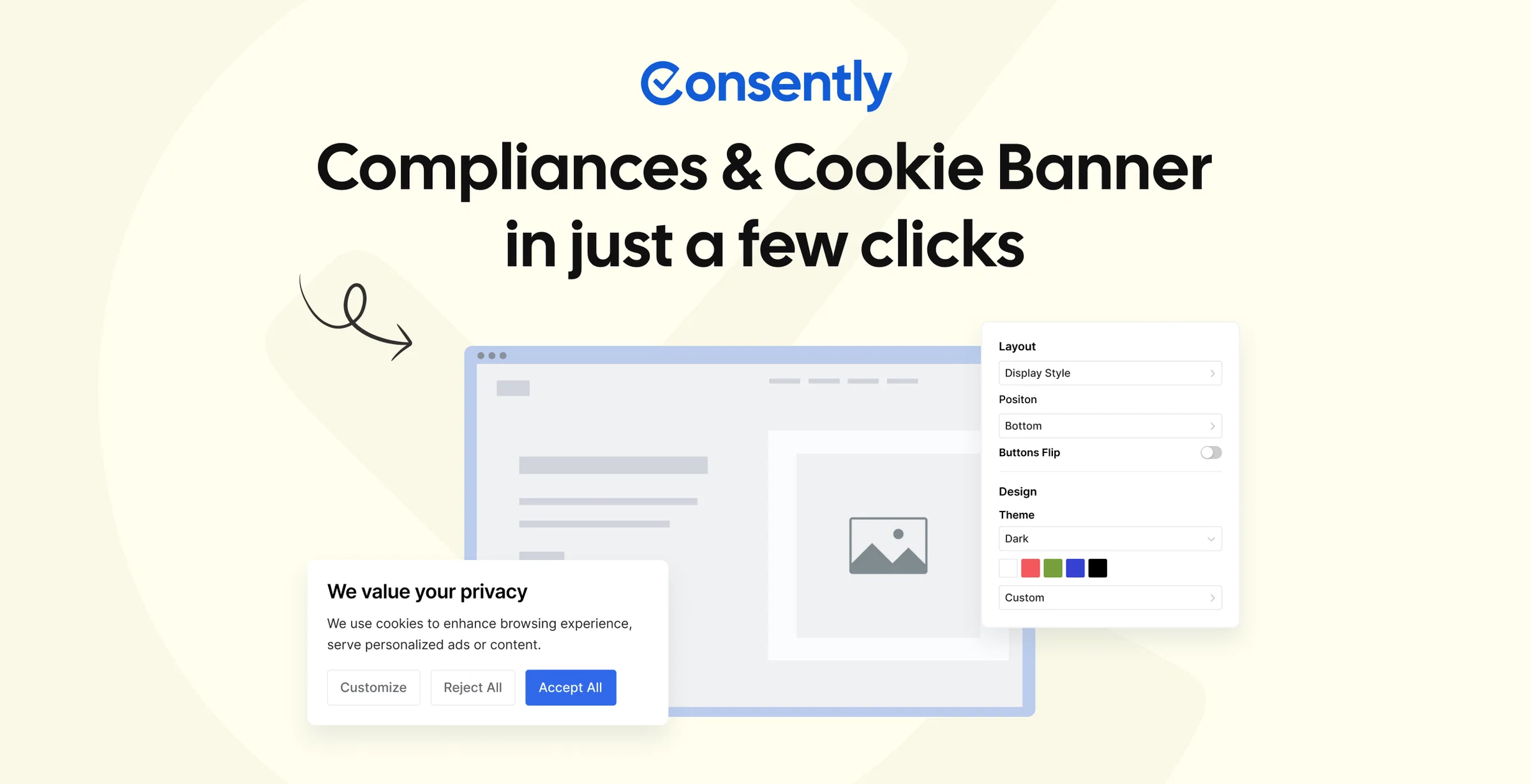
Consently's banner is one of its strongest areas. It offers four display styles (bar, box, popup, and full-screen) with top, bottom, center, and side positions. Customization runs deep: colors, fonts, custom CSS, font inheritance, custom policy titles, a preference center, and a floating revisit button.
Matching the banner to a brand was a recurring point of praise from AppSumo buyers. Our own setup matched that, with clear controls and an immediate live preview.
Banner content supports 35 languages with automatic language detection from the page's HTML lang attribute. Banners are built to WCAG 2.2 AA accessibility.
One design choice to know: Consently supports explicit consent only, with no scroll or implied consent, because implied consent is not GDPR-valid.
Cookie scanning and auto-blocking
Scanning is functional, but the weakest of Consently's core features, and it is where the 3.0 score comes from. The scanner runs automatic full-site, weekly scheduled, and on-demand scans. It detects cookies, trackers, scripts, and iframes, then sorts them into categories. Auto-blocking covers cookies, scripts, and iframes before consent.
Consent logs and analytics
Consent records are solid and audit-ready. Consently stores each visitor's consent choice with a timestamp, country, and status, and it exports the consent log from the dashboard. It adds consent analytics and a consent-response ratio so you can see accept-versus-reject trends.
Consent persists across pages and supported subdomains, so the banner does not reappear after a valid choice. The main refinement users have asked for is richer filtering of the consent log, a polish item rather than a missing capability.
Policy generators (cookie, privacy, terms)
Consently ships three policy generators: cookie policy, privacy policy, and a terms and conditions generator. The terms generator is a genuine edge, because several direct competitors generate cookie and privacy policies but not terms.
Each generator runs from a guided workflow, supports 10-plus languages, allows rich-text editing, and embeds directly on the site. The honest limit is depth: one user called the generator too basic and missing some legal elements, and policy generation requires a connected domain.
Generated policies are editable and can be regenerated, but they do not auto-update per visitor location.
Multi-site management and multi-domain pricing
Multi-site management is Consently's agency wedge. Premium and Enterprise add a multi-site dashboard and a site selector, so one account manages 5 or 10 domains. You can also clone a banner configuration across domains instead of rebuilding it. The pricing math is the real draw, and we cover it in the pricing section below.
The honest limit is the account model. Consently's own feedback board confirms there are no separate client logins, sub-accounts, or per-client dashboards yet, so agencies run every client from a single account.
On the upside, the pricing page confirms subdomains fall under their root domain slot, so a domain and all its subdomains count as one.
Google Consent Mode v2 and IAB TCF
Consently handles the Google and ad-tech consent signals most sites need. Google Consent Mode v2 is enabled by default and manages ad_storage, analytics_storage, ad_user_data, and ad_personalization without manual gtag code. Consently is a Google-certified CMP for Additional Consent (AC v2), and it supports the latest IAB TCF v2.3 for programmatic advertising.
One honest caveat applies. The full Google CMP Partner listing is still pending approval, not granted, per Consently's own homepage. Global Privacy Control signal detection is not supported.
How Easy Is Consently to Set Up?
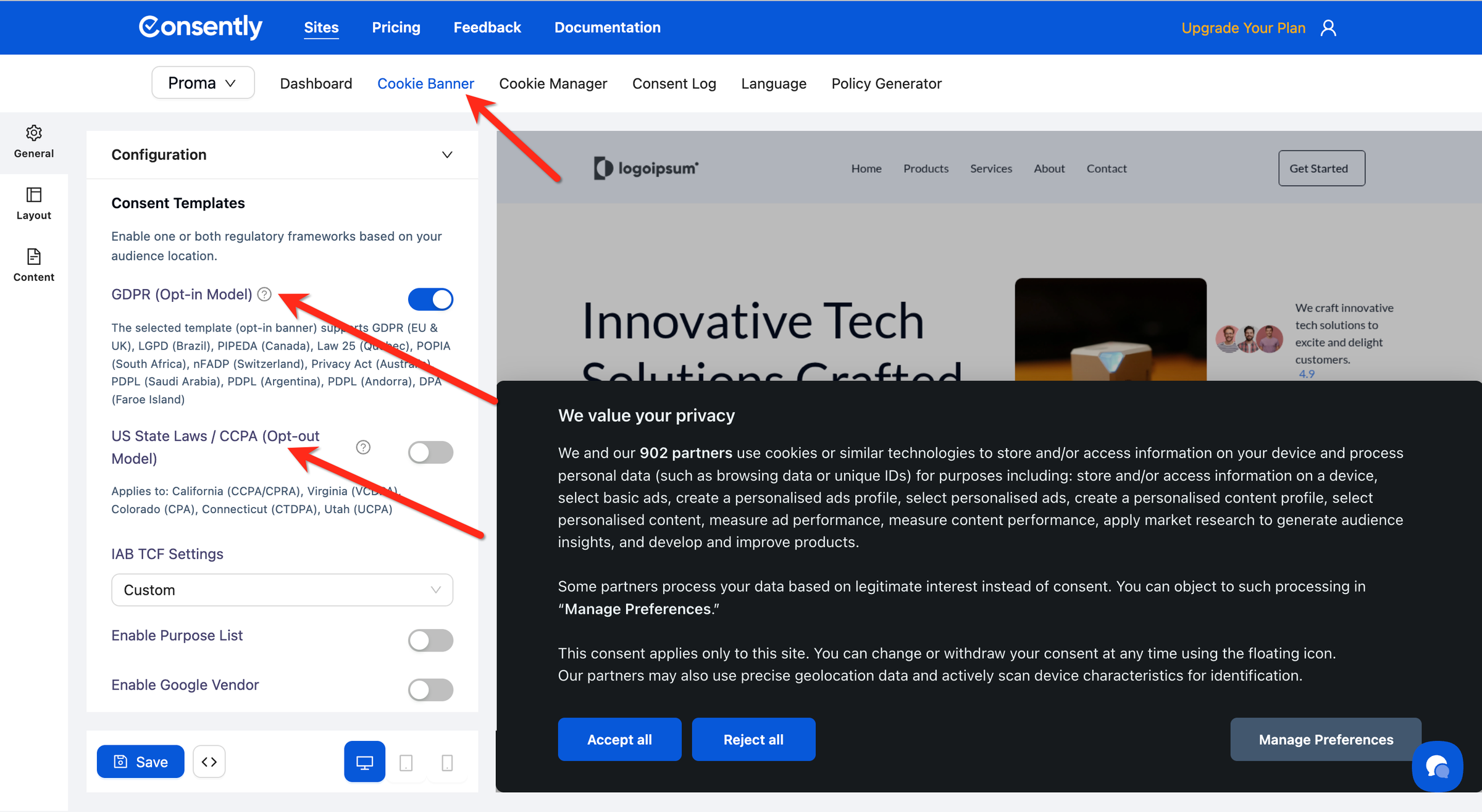
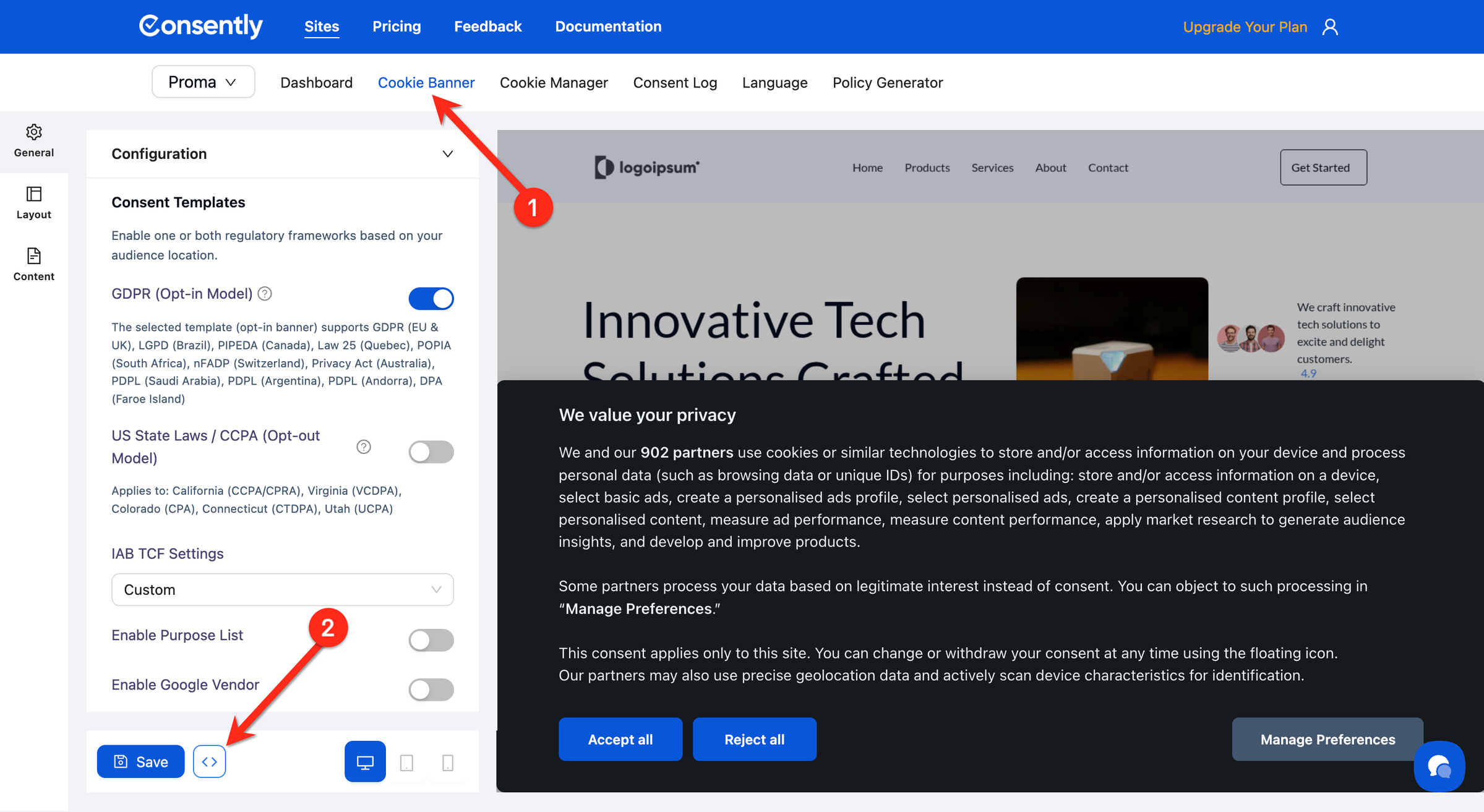
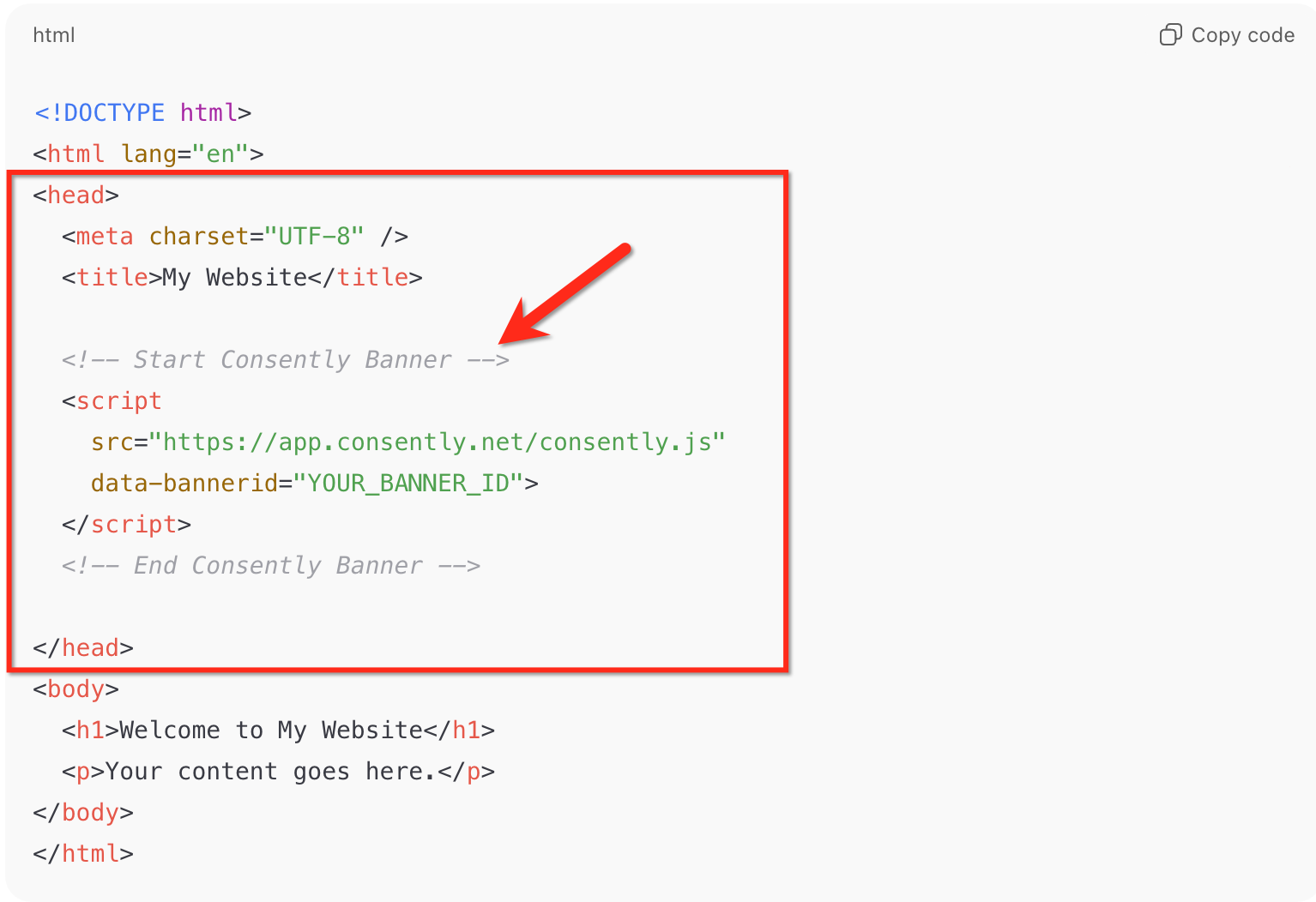
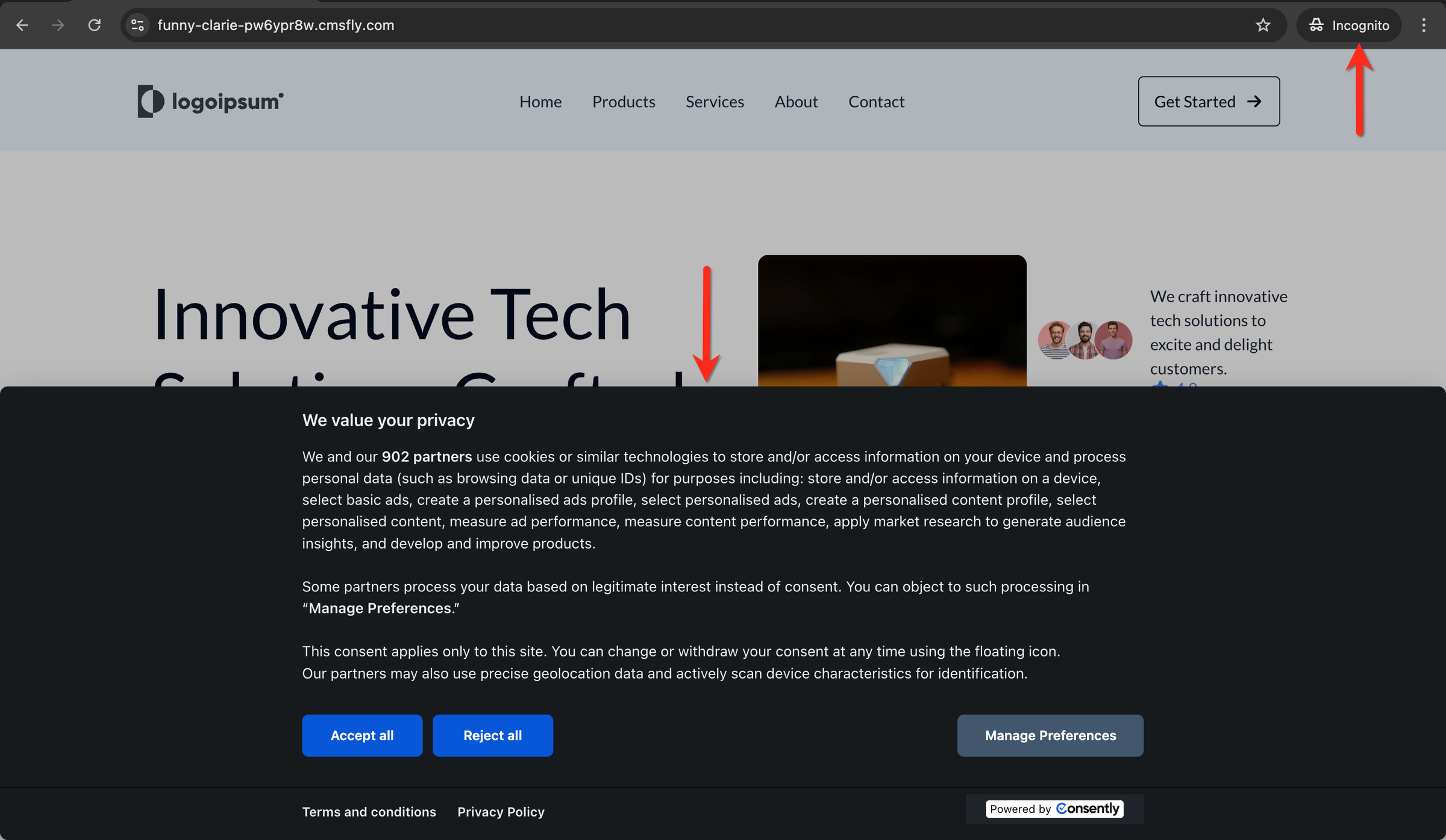
Getting live takes five documented steps. Most users are compliant in well under an hour, and one affiliate reviewer reported going live in under 30 minutes.
1. Add your website to the Consently dashboard.
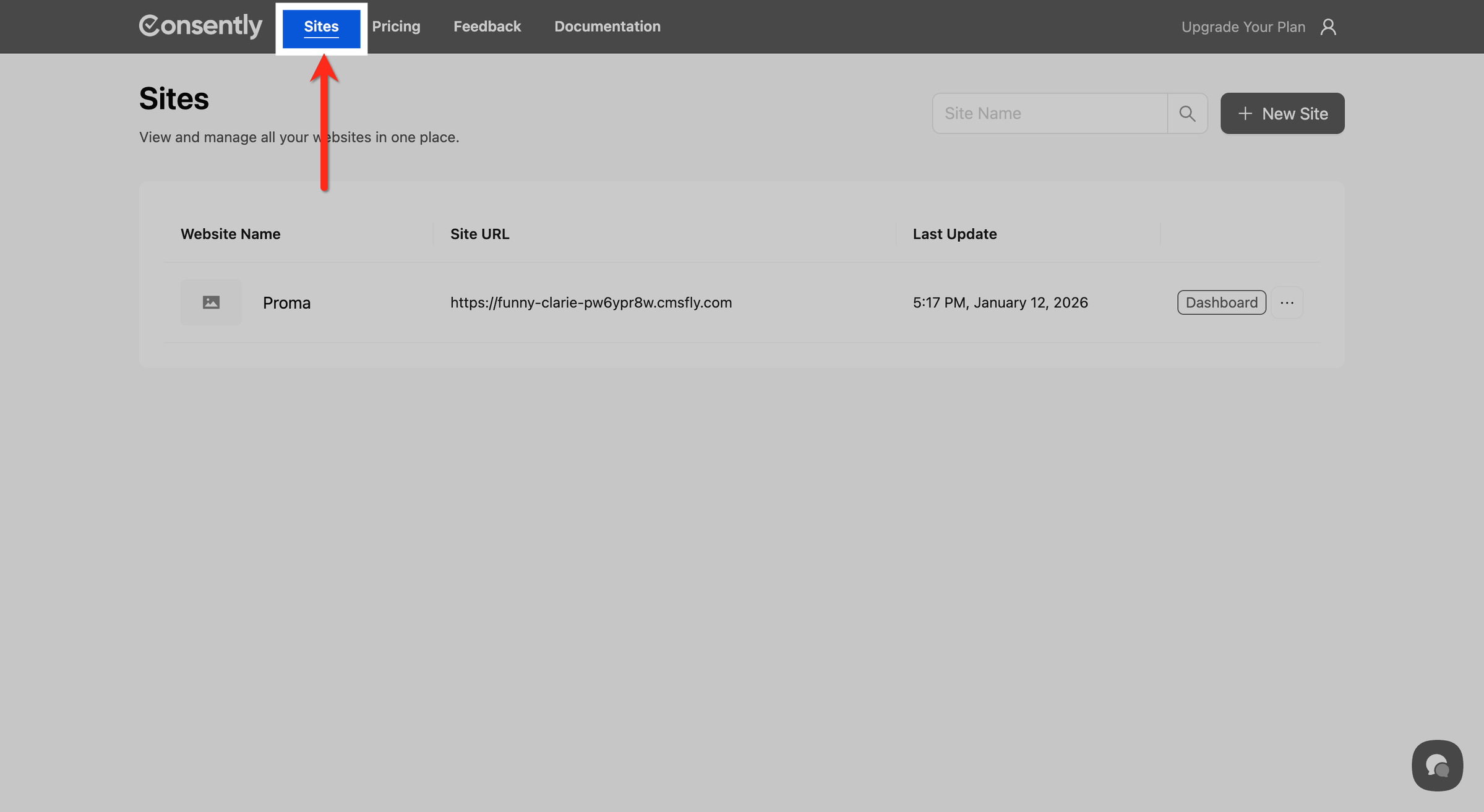
2. Choose your consent template
3. Get your embed script
4. Install the script on your website
5. Test your installation
The learning-curve verdict: easy for the one-line and GTM paths, and more hands-on once you need script-blocking edge cases or ad-tech configuration.
How Much Does Consently Cost?
Consently costs from $99 to $499 per year after a 14-day free trial, and there is no free-forever plan. Every tier includes every feature; plans differ only by domain count and monthly pageview allowance.
The mid Premium plan at $199 per year covers 5 domains and 1,000,000 pageviews with a multi-site dashboard and priority support.
| Plan | Monthly equivalent | Billed yearly | Domains | Pageviews/mo (per account) | Notable inclusions |
|---|---|---|---|---|---|
| Basic | $8.25/mo | $99/yr | 1 | 100,000 | All features; live chat |
| Premium | $16.50/mo | $199/yr | 5 | 1,000,000 | All features; multi-site dashboard; priority support |
| Enterprise | $41.50/mo | $499/yr | 10 | 3,000,000 | All features; multi-site dashboard; priority support |
The trial runs for 14 days with full feature access and no credit card required. Pageviews are shared across all domains on the account and reset each cycle. Near the limit, the banner keeps running without a silent upgrade or surprise charge. You can see the full Consently pricing page for current limits.
The value is real for multi-site buyers. Because pricing is flat and capacity-based, an agency runs 5 domains for $199 per year. Consently markets that same 5-domain coverage against CookieYes Ultimate at $2,750 per year. There is no per-domain billing and no forced auto-upgrade trap.
One honest caveat: there is no permanently free tier, so a single hobby site that needs only a basic banner may prefer a free competitor. The old AppSumo lifetime deal is sold out and is not current pricing.
What Are the Pros of Consently?
Consently's strengths are its pricing model, its multi-domain economics, and its all-in-one feature breadth on every plan. Each pro below is specific and evidenced.
-
Every feature on every plan: IAB TCF, Consent Mode v2, weekly scanning, and three policy generators are all included at the $99 entry tier
-
Flat multi-domain pricing that beats per-domain rivals at scale: 5 domains for $199 per year, 10 for $499, versus per-domain billing elsewhere
-
Three policy generators, including terms and conditions, where many rivals generate only cookie and privacy policies
-
Live chat support on all plans, plus priority support on Premium and Enterprise
-
Fast setup through a single one-line script, GTM, Zaraz, or the WordPress plugin, with most users live in under an hour
-
EU (Frankfurt) data hosting and WCAG 2.2 AA accessible banners, which support GDPR data-residency and accessibility needs
What Are the Cons of Consently?
Consently's main limitations are an immature script-blocking layer, incomplete certifications, and a thin track record. Each con below is specific and fair, and several are sourced to Consently's own public feedback board.
-
Auto-blocking can leak: some scripts execute before consent unless wrapped manually, and advanced script blocking is still in progress
-
Certifications are incomplete: the full Google CMP Partner listing is pending, not approved, and there is no ISO 27001 or 27701
-
Feature gaps for advanced buyers: no banner A/B testing, no native mobile or app SDK, and no deep IAB GPP, MSPA, or CTV consent
-
No true white-label, client sub-accounts, or DSAR and governance workflow, which rules out agencies needing client portals and regulated teams needing GRC
-
No native Shopify app yet, so Shopify stores rely on the head-script install
-
A young, thin track record: about 4.0 out of 5 from roughly 25 AppSumo reviews, with almost no organic G2, Capterra, or Reddit presence
What Do Users Say About Consently?
Consently's independent review base is still small and young. Its main source of verified feedback is the now-ended AppSumo lifetime deal. There, it holds about 4.0 out of 5 across roughly 25 AppSumo reviews as of June 2026. There is little organic G2, Capterra, or Reddit discussion yet, so the sentiment below is drawn from a narrow base.
The praise centers on ease and value. One five-star buyer called the interface "clean, easy to use" in their review. Another said auto-scanning "saves me so much time" and called brand-matching the banner "super easy" overall.
The criticism centers on setup and early scanning. One two-star buyer found it "very difficult compared to other tools," citing script and formatting issues. An early one-star reviewer hit a scan that "after 12 hours... is still queued," which predates the scanner revamp the team reports, though the documented prior-blocking gap remains.
Two honesty notes on the rating landscape. The G2, Capterra, and SaaSworthy profiles for Consently are auto-generated and carry near-zero organic reviews. There is no Trustpilot profile for consently.net; the Trustpilot results that surface are name collisions with unrelated companies.
Is Consently Worth It?
Consently is worth it at 3.7 out of 5 for cost-conscious multi-site owners and agencies. It is not worth it for regulated enterprises or advanced ad-tech teams. The decision comes down to whether flat pricing and all-in-one breadth matter more to you than a mature scanner and a long track record.
Choose Consently if:
-
You run multiple sites or client domains and want flat, predictable pricing with every feature included
-
You want one tool for the banner, scanning, consent logs, and cookie, privacy, and terms policies, without enterprise cost
-
You need Google Consent Mode v2 and IAB TCF on a budget
-
You prefer EU data hosting and live chat support on the entry plan
Look elsewhere if:
-
You need a fully certified enterprise CMP with ISO, governance, and DSAR workflows
-
You need native mobile or CTV consent, or deep ad-tech IAB GPP and MSPA support
-
You want a battle-tested tool with a long independent track record today
-
You want a permanently free tier or a native Shopify app
If the strengths fit your needs, start a free 14-day Consently trial with no credit card.
Alternatives to Consently Worth Considering
The right CMP depends on the need Consently does not fully serve. We map each unmet need to a better-fit tool below, each linked to its full review.
-
Enterprise compliance, ISO, governance, DSAR, ad-tech depth, A/B testing, or CTV: OneTrust is the heavyweight choice, or Usercentrics for mid-market scale and banner A/B testing
-
A deep Shopify-native store with checkout and customer-account surfaces: Consentmo offers a native Shopify app
For full side-by-side comparisons, see our ranking of the best consent management platforms and the best cookie consent tools.
If budget is the priority, see the best free cookie consent options. Consently sits in those rankings with its honest 3.7 score, not at the top by default.
FAQs
Is Consently legit?
Yes. Consently is a real consent management platform built by Dorik, Inc., a profitable website-builder company operating since 2020, and it launched in October 2025. It holds a Google AC v2 certification and hosts data in the EU. It is young, so its independent review base is still small.
Is Consently free?
No, Consently has no free-forever plan. It offers a 14-day free trial with full features and no credit card, then paid plans start at $99 per year for one domain. The old AppSumo lifetime deal that once offered a one-time price is sold out.
Is Consently good for agencies?
Yes, on cost. One account manages 5 domains for $199 per year or 10 for $499, with every feature included and a multi-site dashboard. The limit is the account model: there are no client sub-accounts, white-label, or separate client dashboards yet, so you run all clients from one login.
Is Consently better than CookieYes or Cookiebot?
It depends on the priority. Consently wins on flat multi-domain pricing and all-features-on-every-plan, which makes it cheaper at several sites. CookieYes and Cookiebot win on maturity, scanning track record, and a larger install base. The alternatives section above links a full comparison.
Does Consently support Google Consent Mode and IAB TCF?
Yes. Consently enables Google Consent Mode v2 automatically and supports IAB TCF, and it is a Google-certified CMP for Additional Consent (AC v2). Two caveats apply. The full Google CMP Partner listing is still pending approval. Consently also labels its TCF version as 2.2 on the homepage and 2.3 on the pricing page, so confirm the live version in-product.
Is Consently good for Shopify or WordPress?
Consently works on both. WordPress has an official plugin, and Shopify is supported through the one-line head script or GTM. There is no native Shopify app yet. A deep Shopify store that wants app-level integration may prefer the native-app option linked in the alternatives section.
Is consently.net the same as consently.org or consently.in?
No. This review covers consently.net, the CMP built by Dorik. Consently.org (secure document sharing) and consently.in (an India DPDPA platform) are unrelated products with similar names. They appear in search results only because of the name collision.