The best OneTrust alternatives for cookie consent are Consently, Osano, Ketch, CookieYes, Enzuzo, Cookiebot, Usercentrics, and iubenda. I scored all eight on pricing, setup speed, compliance coverage, and Google Consent Mode.
The verdict: you can get full GDPR and CCPA compliance for under $500 a year, live in an afternoon, no consultant needed. OneTrust starts at roughly $10,000 a year. Its own consent module rates just 3.5 out of 5 on G2, below the governance tools you pay for.
Best OneTrust Alternatives at a Glance
These eight tools are ordered by switching-fit tier first, then by independent review score within each tier. Each entry names the specific OneTrust problem it solves.
-
Ketch: best for OneTrust users frustrated by integration complexity, with 1,000+ pre-built connectors and a guided “Ketch Switch” migration
-
Osano: best for teams that need a full privacy program, with DSAR automation and a No Fines guarantee
-
Enzuzo: best for budget-first switchers who also need legal documents, bundling consent, six generators, and DSAR from $9/mo
-
CookieYes: best for OneTrust users who only ever needed a banner, with the simplest WordPress and Shopify setup
-
Consently: best for multi-domain cost control after a price shock, with every feature on every flat-rate plan
-
Cookiebot: best for set-and-forget, Gold-certified Google Ads compliance on a single site
-
Usercentrics: best for IAB TCF publishers who want session-level pricing and the newest TCF version
-
iubenda: best for switchers who need lawyer-drafted policies alongside cookie consent
Disclosure: This guide is written by the Consently team. Consently competes with OneTrust and every tool on this list. It appears in the ranking, scored by the same rubric as everyone else (not self-ranked first).
How we score: Every product carries the overall score from our published review methodology, which weights Compliance, Scanning, Banner, Setup, Pricing, Performance, and Support. The list is ordered by switching-fit tier, then by that score. Read the full method at how we review consent management software.
Why People Switch from OneTrust
OneTrust is the most capable consent and governance platform you can buy. It has 45 million-plus pre-categorized cookies, 250-plus banner languages, and recognition from Gartner and Forrester as a category leader. It now powers more than 14,000 organizations. If your legal or GRC team runs multi-pillar privacy governance across a multinational business, OneTrust earns its price.
The problem is the price. Independent pricing aggregators including Vendr (325 contracts) put the minimum contract near $10,000 a year. The median buyer pays roughly $11,500. There is no public pricing, no free trial, and every path runs through sales. Renewal increases of 275% to 468% with as little as 21 days notice appear across review aggregators. If your need is a cookie banner for a few sites, you are paying a GRC suite price. Cookiebot ships the same feature for €7 a month.
The switching pressure comes from three specific friction points, detailed below.
-
Cost shock: Buyers describe a “$10,000-per-year minimum for a cookie banner I could replace for $99 a year.” There is no SMB tier, so a small site pays a GRC-suite price for a banner.
-
Setup complexity: “You basically need a consultant just to get it set up,” a sentiment Osano’s comparison page on OneTrust competitors summarizes and that recurs across G2, Capterra, and review aggregators. OneTrust’s Consent and Preferences module scores 3.5 out of 5 on G2, well below its other products.
-
Overkill: For a single-country site running one to five domains, OneTrust’s AI governance, third-party risk, and DSAR modules are features you pay for and never open.
Honest carve-out: OneTrust remains the right tool for large, regulated enterprises (roughly 1,000-plus employees) with a dedicated privacy or GRC team. Add multinational consent across web, mobile, and CTV, plus the budget to justify it. If that describes you, none of the alternatives below can replace the full platform. The tools on this list are strongest for teams that need a cookie banner, not a governance suite.
Read our full OneTrust review for the complete scorecard.
How to Choose a OneTrust Alternative
Before comparing prices, identify which OneTrust trigger is actually driving your switch. The three criteria below map to the reasons buyers leave.
Pricing model: flat vs. per-domain
OneTrust's cost shock is the most common trigger, so the next billing model matters. Per-domain pricing (CookieYes, Cookiebot) penalizes multi-site agencies and operators, because each site is a fresh charge. Flat plans (Consently, Ketch, Enzuzo, Osano) let you add sites without rebuying. Map the model to your portfolio shape before you commit.
Consent only vs. a full privacy program
OneTrust bundles DSAR, data mapping, and vendor risk you may never have used. Osano and Enzuzo bundle consent plus data subject request handling for teams that genuinely need it. If you only need cookie banners, the pure CMPs (Consently, CookieYes, Cookiebot) avoid paying for DSAR capacity you will not touch.
Google Ads measurement dependency
If Google Ads measurement is central, certification level decides the pick. Cookiebot and Usercentrics hold the Gold Tier on Google's CMP Partner program, which unlocks the full Consent Mode v2 signal set. Ketch is listed as a Google CMP partner. Consently, CookieYes, Osano, Enzuzo, and iubenda all support Consent Mode v2 at varying certification levels.
How These Alternatives Compare to OneTrust
Every alternative below undercuts OneTrust's roughly $10,000-a-year minimum with public, self-serve pricing and setup measured in minutes, not months. The table compares all eight against OneTrust on the dimensions that drive a switch.
| Tool | Score | Entry Price | Pricing Model | Setup Time | Google CM v2 | IAB TCF | Free Tier | DSAR |
|---|---|---|---|---|---|---|---|---|
| Ketch | 4.0* | $0/mo (Free) | Per visitor | Under 1 hr | Yes | Yes | Yes | Add-on |
| Osano | 3.9 | $0/mo (Free) | Per domain/users | Same day | Yes | Yes | Yes | Yes (paid) |
| Enzuzo | 3.9 | $0/mo (Free) | Per domain/mo | Same day | Yes | Yes | Yes | Yes (paid) |
| CookieYes | 3.8 | $0/mo (Free) | Per domain/mo | Under 30 min | Yes | v2.3 (Pro+) | Yes | No |
| Consently | N/A | $99/yr | Flat (domains) | Under 30 min | Yes | Yes (2.2) | 14-day trial | No |
| Cookiebot | 4.0 | €0/mo (Free) | Per domain/subpages | Under 1 hr | Gold Tier | Yes | Yes | No |
| Usercentrics | 3.7 | €0/mo (Free) | Session-based | Under 1 hr | Gold Tier | v2.3 (Pro+) | Yes | No |
| iubenda | 3.6 | €4.99/mo | Per site/mo | Under 1 hr | Yes | v2.2 | 14-day trial | No |
| OneTrust (reference) | 3.6 | ~$10,000/yr | Quote-only | 2-6 months | Yes | Yes | No | Yes |
*Ketch score is an estimate; no scored review exists yet. Consently authors this guide and is not self-scored.
Scores use our seven-dimension methodology (see disclosure above). Verified 2026-06-29.
1. Ketch: Best for Complex Ad-Tech and Integration Depth (4.0/5 estimated)
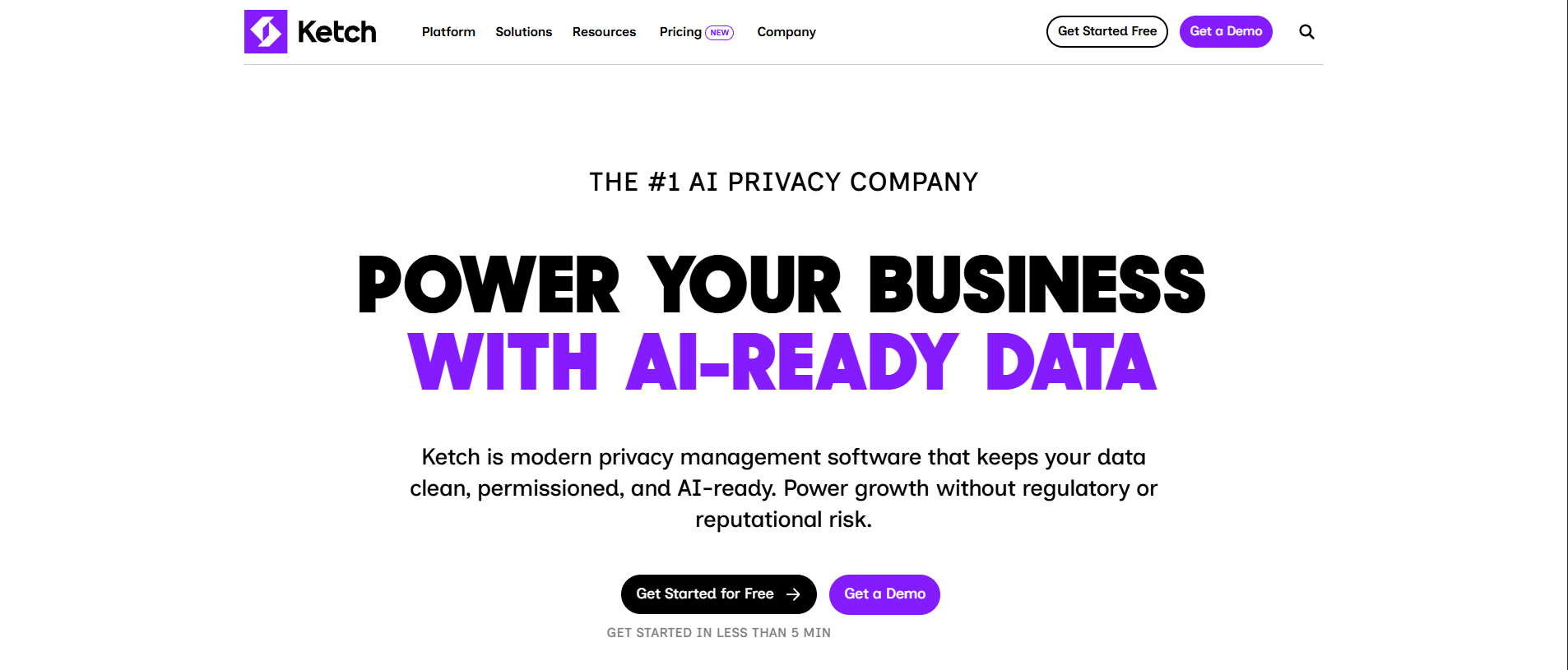
Ketch is the right switch from OneTrust when your problem is not cost but integration complexity. It describes itself as "a next-generation privacy and data control platform" and states that 30% of its customers come from OneTrust. Its switching pitch is specific: "30% lower cost", Ketch claims, with greater savings for companies handling many DSRs.
It scores an estimated 4.0/5 on our methodology, the highest in this list, though no scored review exists yet.
Best for: Teams leaving OneTrust over integration complexity rather than price, with heavy CRM, CDP, or ad-tech stacks that need 1,000+ pre-built connectors.
Key Features
Ketch leads on integration depth and migration tooling for OneTrust users.
-
400+ banner customization options via a "consent experience designer"
-
1,000+ pre-built API integrations with systems, apps, and AI models
-
Privacy law templates for GDPR, CCPA/CPRA, and other regulations
-
Consent record storage and website tracker scanning
-
Tag orchestration built in
-
"Ketch Switch" guided migration for OneTrust users
-
SOC 2 and ISO 27001 certified
-
Google CMP partner; IAB TCF supported
Pros
Ketch's strengths suit teams with heavy martech stacks.
-
Best integration depth on this list. 1,000-plus pre-built integrations makes it the closest to OneTrust for complex martech stacks.
-
Free plan is genuinely functional: full CMP at $0 for up to 5,000 visitors. No "demo mode" limitation.
-
"Ketch Switch" migration: guided migration process, with customers reporting "core workflows in a few weeks."
-
Strong Google G2 rating at 4.5 out of 5 across 148 reviews.
Cons
Ketch's pricing and unverified certification details temper the case.
-
Self-serve pricing escalates quickly: $150/mo for 30,000 visitors (Starter), then $499/mo annually for 100,000 visitors (Plus). That is well above the SMB range.
-
Google CMP certification tier is a CMP partner listing, but the specific Gold or Silver tier was not confirmed on Ketch's live pages at the time of writing. Cookiebot holds a verified Gold Tier; verify Ketch's status against the Google partner registry before relying on it for maximum Google Ads signal recovery.
-
Estimated score (4.0): no scored Consently review exists for Ketch yet, so this score is an estimate based on our methodology applied to documented evidence.
Pricing
Ketch scales by monthly visitors, with integrations gated to higher tiers.
| Plan | Price | Visitors/mo | Integrations |
|---|---|---|---|
| Free | $0 | 5,000 | 2 included |
| Starter | $150/mo | 30,000 | 2 included |
| Plus | From $499/mo (annual) | 100,000 | 1,000+ (add-on) |
| Pro | Custom | 100,000+ | Unlimited |
What Users Say
Ketch reviewers on G2 highlight the banner customization range and integration breadth as primary strengths. The migration experience from OneTrust gets specific praise. One customer cited "implementation in 4 weeks with outstanding level of work."
Migrating from OneTrust to Ketch
What transfers: consent workflows, DSR automation setups, and vendor integrations. The "Ketch Switch" program provides guided data mapping and consent deployment. Ketch's 1,000-plus integrations means most of your martech stack has a pre-built connector.
Feature mapping: closer to OneTrust than any other alternative on this list. DSR automation maps to Ketch's DSR module (Plus add-on). Consent signals flow through the tag orchestration layer. OneTrust's GRC and AI governance modules have no Ketch equivalent, but for consent and DSR, the mapping is strong.
2. Osano: Best for a Full Privacy Program with a Compliance Guarantee (3.9/5)
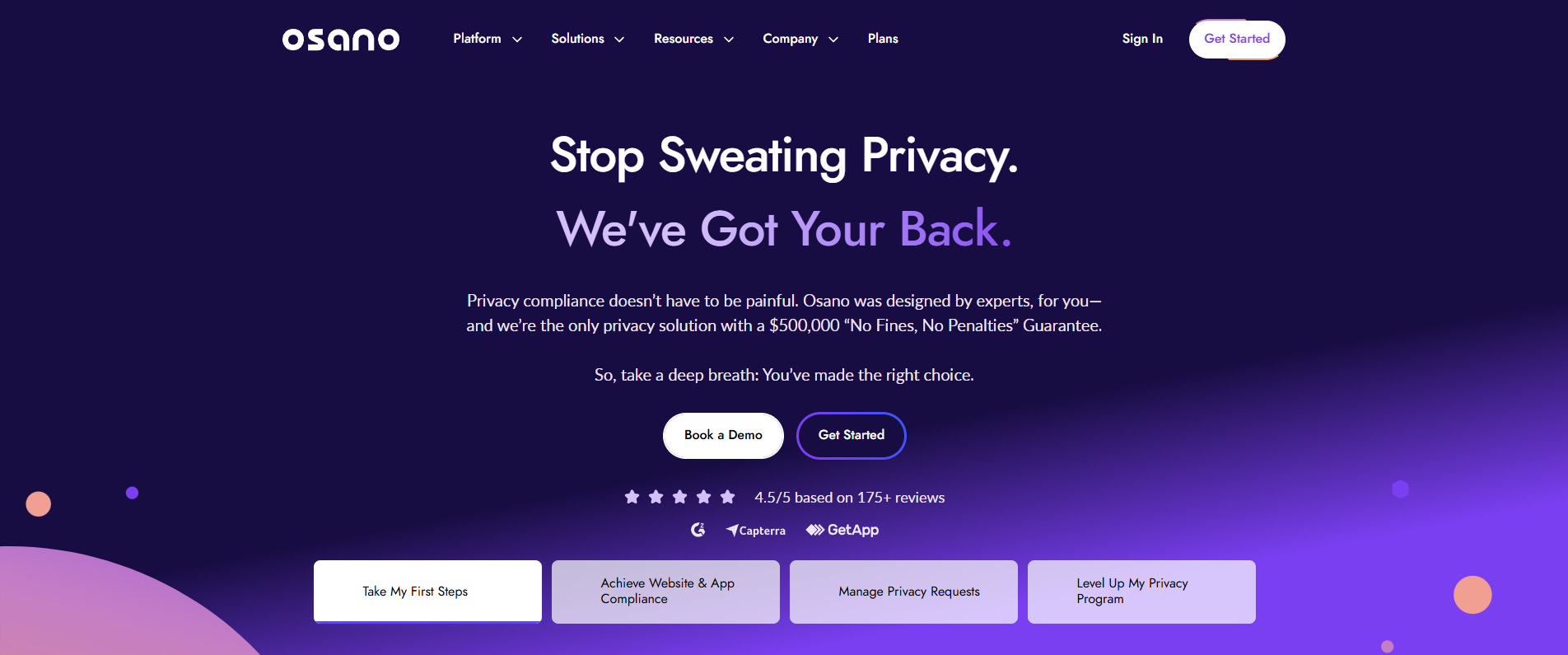
Osano is the right switch from OneTrust if your real need is a privacy program, not just a cookie banner. It bundles consent management, DSAR automation, data mapping, and vendor risk scoring, targeting mid-market teams rather than SMB solo sites.
Its comparison page states it is designed as a "simpler, more user-friendly alternative to OneTrust" and competes on support quality across G2 dimensions.
It scores 3.9/5 on our methodology. Read the full Osano review for the breakdown.
Best for: OneTrust switchers who needed DSAR automation, data mapping, and vendor risk scoring, not just a banner, and want a risk-reducing fines guarantee.
Key Features
Osano spans consent and a wider privacy program in one platform.
-
Cookie consent banner with Consent Mode v2
-
DSAR intake and workflow automation (Basic Privacy plan and above)
-
Vendor privacy risk management
-
"No Fines, No Penalties" guarantee: up to $500,000 for regulatory fines
-
Single-line JavaScript install
-
Privacy and legal templates; UK and GDPR Article 27 representative (Plus)
-
Processes more than 1 billion consents a month
Pros
Osano's draw is program breadth plus a risk-reducing guarantee.
-
Broadest privacy program scope of any self-serve alternative on this list.
-
"No Fines, No Penalties" guarantee is a genuine differentiator for risk-averse buyers.
-
Public Benefit Corporation with strong support reputation: G2 scores show Osano leading OneTrust on ease of use, ease of admin, and quality of support.
-
Free tier exists: 1 domain, 5,000 visitors, basic consent management at $0.
Cons
Osano's self-serve limits and guarantee fine print are the trade-offs.
-
Self-serve visitor cap is tight: the Plus plan at $199/mo covers 30,000 monthly visitors across 3 domains. Anything above that moves to custom enterprise pricing.
-
The $500,000 guarantee excludes Free and Plus plans. It applies to Basic Privacy (custom pricing) and above. The plan most OneTrust switchers land on (Plus) does not carry the guarantee.
-
$199/mo is 2x OneTrust's estimated monthly minimum only if you are already at the very bottom of OneTrust's range ($10,000/yr = ~$833/mo). Osano Plus is cheaper, but not dramatically so.
Pricing
Two self-serve tiers sit below a quote-gated enterprise plan.
| Plan | Price | Domains | Visitors/mo |
|---|---|---|---|
| Free | $0 | 1 | 5,000 |
| Plus | $199/mo | 3 | 30,000 |
| Basic Privacy | Custom | Unlimited | Unlimited |
What Users Say
Osano users on G2 cite support responsiveness and setup simplicity as the primary differentiators. G2 data shows Osano outscoring OneTrust on ease of implementation, ease of use, and quality of support. Reviewers note the platform is "much more intuitive" for smaller IT teams.
Migrating from OneTrust to Osano
What transfers: consent records (export from OneTrust first), and your general compliance workflows. The DSAR and data mapping modules map closely. Osano's onboarding team handles migration support on the Basic Privacy plan; self-serve buyers on Plus are on their own for setup.
If the 30,000-visitor Plus cap is the blocker, weigh the cheaper cookie-only options in Osano's class before committing.
3. Enzuzo: Best for Budget-First Buyers Who Also Need Legal Documents (3.9/5)
Enzuzo bundles cookie consent, six legal document generators, and DSAR management from $9/mo. It is the cheapest consolidated option here for buyers who need consent, a privacy policy, and a DSAR workflow without buying three separate tools.
It scores 3.9/5 on our methodology. The full Enzuzo review covers the detail.
Best for: Budget-first OneTrust switchers who need consent, legal documents, and a DSAR workflow bundled into one low-cost plan.
Key Features
Enzuzo bundles consent, legal documents, and DSAR in one low-cost plan.
-
Cookie consent banner with Google Consent Mode v2
-
Six legal document generators: privacy policy, cookie policy, terms and conditions, and more
-
DSAR management: 3 requests/mo on Free; up to 50/mo on Growth; unlimited on Pro
-
Google CMP partner (Consent Mode v2)
-
25+ languages (Starter and above)
-
Geo-specific cookie manager (Growth and above)
-
4.6 out of 5 on G2 across 18 reviews
Pros
Enzuzo's appeal is consolidation at the lowest bundled price.
-
Cheapest full-bundle entry on the list: $9/mo covers one domain, basic consent, and legal docs together.
-
Strong G2 reputation: 4.6/5 across 18 reviews, highest of any tool here by rating.
-
White-label available: Agency plan ($99/mo, 20 domains) includes white-labeling for client resale.
-
DSAR without a separate tool: Growth plan at $29/mo handles up to 50 data subject requests per month.
Cons
Enzuzo's caps and smaller footprint are the main caveats.
-
Visitor caps are tight at lower tiers: Free and Starter both cap at 5,000 visitors/mo. Growth covers 10,000.
-
Enzuzo states a "half-day migration" from OneTrust is possible via GTM deployment. Via GTM that claim is plausible; direct script or SDK migration extends to days. Treat the "half-day" claim as a best-case GTM scenario, not a general expectation.
-
Smaller brand footprint than CookieYes, Cookiebot, or Osano: fewer third-party integrations and community tutorials.
Pricing
Enzuzo uses flat multi-domain tiers, with DSAR and white-label gated higher.
| Plan | Price | Domains | Visitors/mo |
|---|---|---|---|
| Free | $0 | 1 | 5,000 |
| Starter | $9/mo | 1 | 5,000 |
| Growth | $29/mo | 4 | 10,000 |
| Pro | $79/mo | 10 | 30,000 |
| Agency | $99/mo | 20 | N/A |
| Enterprise | Custom | Unlimited | Unlimited |
What Users Say
G2 reviewers highlight the legal document bundle as the primary reason they chose Enzuzo over simpler CMPs. The most common limitation cited: visitor caps feel tight for growing sites, requiring earlier-than-expected upgrades.
If those caps force an upgrade sooner than you want, other flat-rate tools in Enzuzo's class are worth a look.
4. CookieYes: Best for Single-Site WordPress and Shopify Compliance (3.8/5)
CookieYes is the easiest budget CMP for a single site. More than 1.5 million WordPress sites run it as the "Cookie Law Info" plugin. Setup takes one paste or plugin install. The catch: pricing is per domain, so costs climb fast when you add sites.
It scores 3.8/5 on our methodology. See the full CookieYes review for the breakdown.
Best for: OneTrust switchers who only ever needed a banner on a single WordPress or Shopify site and want the simplest possible setup.
Key Features
CookieYes keeps the feature set lean and WordPress-friendly.
-
Free plan: one domain, 5,000 pv/mo
-
WordPress plugin, Shopify app, Wix app, plus snippet install
-
Auto-scan against 100,000+ known cookies
-
Google Consent Mode v2 on all plans
-
IAB TCF v2.3: gated to Pro ($25/mo/domain) and above
-
14-day free trial on paid plans
Pros
CookieYes wins on simplicity and ecosystem reach.
-
Simplest setup of any tool on this list: install the WP plugin, accept scan results, publish.
-
Largest install base: 1.5 million-plus active WordPress installs gives it unmatched community support resources.
-
Free plan is genuinely useful for a single small site.
-
Affordable entry: $10/mo for one domain covers 100,000 pageviews.
Cons
CookieYes shows its limits once you add sites or need TCF.
-
Per-domain pricing punishes multi-site: five domains on Pro costs $125/mo ($1,500/yr). Consently's Premium covers five domains for $199/yr.
-
IAB TCF v2.3 requires Pro or above: if you run programmatic ads and need full TCF on a budget, you land at $25/month minimum per domain.
-
Overage fees: $0.30 per 1,000 pageviews over the cap on Basic and Pro. High-traffic months can surprise.
Pricing
CookieYes charges per domain, with pageview and scan caps rising by tier.
| Plan | Price | Pageviews/mo | Pages/scan |
|---|---|---|---|
| Free | $0 | 5,000 | 100 |
| Basic | $10/mo/domain | 100,000 | 600 |
| Pro | $25/mo/domain | 300,000 | 4,000 |
| Ultimate | $55/mo/domain | Unlimited | 8,000 |
What Users Say
Reviewers describe CookieYes as the "easiest" setup among paid CMPs, with strong community documentation for WordPress users. The consistent critique is per-domain pricing: multi-site operators hit sticker shock when they calculate the total cost across a portfolio.
See our CookieYes alternatives roundup if the per-domain pricing is a blocker.
5. Consently: Best for Multi-Domain Cost Control After a Price Shock (3.7/5)
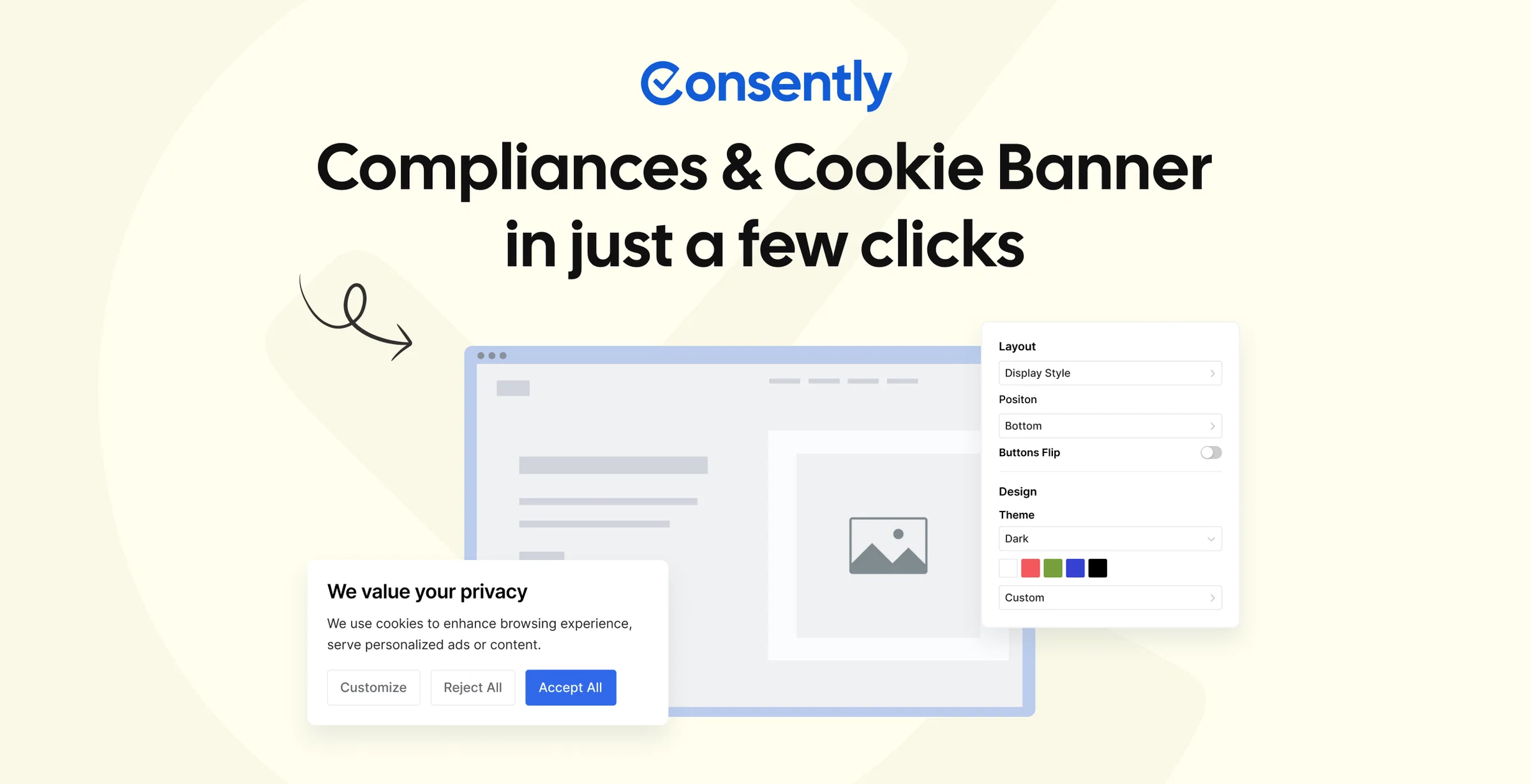
Consently is our platform, so it is included here at its earned rank and scored by the same rubric as everyone else: 3.7/5. It suits OneTrust buyers whose only real pain was cost, especially across several domains. Every feature ships on every flat-rate plan with no module gating.
I set up a Consently banner on a test domain in under 20 minutes. Paste the one-line script, accept the scan results, choose a template, and publish. A customer on our feedback page noted "Live in under 30 minutes with minimal setup," which matches my experience.
Best for: OneTrust switchers who left over a price shock and run multiple domains, and want predictable flat pricing with no per-feature gating.
Key Features
Consently covers the full consent stack on every plan, with no module gating.
-
Cookie consent banner with 35 languages
-
Automatic weekly cookie and tracker scanning (revamped scanner, approximately 70% better accuracy per AppSumo changelog)
-
Google Consent Mode v2 built in on every plan
-
IAB TCF 2.2 support
-
Geotargeting: GDPR opt-in for EU, CCPA opt-out for US, automatic by region
-
Consent logs with export
-
Cookie, script, and iframe auto-blocking
-
Legal policy generation: privacy policy, cookie policy, terms and conditions
Pros
Consently's strengths cluster around price predictability and zero feature gating.
-
All features on every plan: Basic at $99/yr gets the same scanner, Consent Mode, and IAB TCF that Enterprise gets. No module gating.
-
Flat domain capacity: five domains on Premium ($199/yr) versus five separate CookieYes Pro plans at $25/domain/month ($1,500/yr). One customer quoted exactly that comparison.
-
No per-domain billing trap: adding a sixth domain on Premium Enterprise does not trigger a per-site charge, it just means upgrading the plan tier.
-
14-day trial with no credit card. You can see the full product before committing.
Cons
Consently is a focused CMP, so it skips several adjacent capabilities.
-
No DSAR automation: if you need data subject request handling, Osano or Enzuzo is the better fit.
-
No white-label option: agencies that rebrand tools for clients cannot white-label Consently. Enzuzo's Agency plan ($99/mo) includes it.
-
35 banner languages: broad, but short of OneTrust's 250-plus or Usercentrics' 60 from the Pro plan.
-
No GPC signal detection: Global Privacy Control is not currently supported.
Pricing
Three flat annual tiers scale by domain count and pageviews, all features included.
| Plan | Price | Domains | Pageviews/mo |
|---|---|---|---|
| Basic | $99/yr | 1 | 100,000 |
| Premium | $199/yr | 5 | 1,000,000 |
| Enterprise | $499/yr | 10 | 3,000,000 |
What Users Say
"3 Simple Steps ... no complex setup needed." That quote from a customer on our feedback page captures what we hear most. The other side: early users flagged scanner accuracy issues before the revamp. The current scanner is approximately 70% more accurate than the original, per our AppSumo changelog.
Migrating from OneTrust to Consently
What transfers: your consent records (export from OneTrust's admin before cancellation), your cookie category structure, and your banner language choices. Consently scans your site fresh to rebuild the cookie inventory, so you do not need to port the cookie database.
Feature mapping: OneTrust's DSAR, data mapping, and GRC modules have no equivalent in Consently. If you used those, keep OneTrust or pair Consently with a DSAR-specific tool. For consent-only use: the cookie banner, scanning, blocking, and Consent Mode functions map directly. IAB TCF signals transfer if you configure the TCF vendor list fresh in Consently.
Learning curve: lower than OneTrust. The Consently dashboard is a single-screen setup. There is no "configuration workshop" step. You should be live within a day, even if migrating multiple domains.
Migration support: our help center covers the GTM setup, WordPress plugin installation, and Shopify app installation. Email support is available on all plans.
See the Consently vs OneTrust comparison for the full feature-by-feature side-by-side.
The best consent management platform roundup shows how every tool here stacks up.
6. Cookiebot: Best for Set-and-Forget, Gold-Certified EU Compliance (4.0/5)
Cookiebot, run by Usercentrics, holds the Gold Tier on Google's CMP Partner program. For a single site where Google Ads measurement is the compliance priority, that certification is the clearest reason to choose it. 600,000-plus customers and more than 2.4 million websites trust it.
It scores 4.0/5 on our methodology. The full Cookiebot review and the onetrust vs cookiebot comparison cover the details.
Best for: Single-site OneTrust switchers whose top priority is Gold-certified Google Ads measurement with hands-off automatic scanning.
Key Features
Cookiebot centers on certified scanning and Google Ads compliance.
-
Google CMP Gold Tier (Consent Mode v2)
-
Automatic monthly cookie and tracker scanning (Lite and above: 47+ languages, geotargeting)
-
IAB TCF support
-
Free tier: one domain, up to 50 subpages, manual blocking
-
Cookie database: 13,000-plus known cookie entries scanned monthly
-
ISO 27001 and ISO 27701 certified
Pros
Cookiebot's strengths are certification, scale, and automation.
-
Highest Google Ads measurement credibility: Gold Tier certification unlocks the full Consent Mode v2 signal set.
-
Longest track record: Usercentrics has run Cookiebot since 2012.
-
600,000-plus customers and 2.4 million-plus websites: the deepest user community and documentation library.
-
Automatic categorization: scan finds and categorizes cookies automatically; no manual list required.
Cons
Cookiebot's billing model is where the friction concentrates.
-
Per-domain billing trap: plans auto-upgrade when your site's subpage count crosses a tier boundary. A site that grows from 300 to 400 subpages can jump a price tier without warning. The pricing page states: "Plans automatically upgrade depending on your website's number of subpages."
-
Subdomains cost extra: each subdomain counts as a separate billable domain.
-
Per-domain pricing: same multi-site cost trap as CookieYes. Five domains on Lite costs 5x €7/mo.
-
Free tier is limited: 50 subpages and manual blocking only, with no customization.
Pricing (all prices EUR, exclude VAT)
Cookiebot prices per domain and scales tiers by subpage count.
| Plan | Price | Subpages | Languages |
|---|---|---|---|
| Free | €0/mo | Up to 50 | 1 |
| Lite | €7/mo per domain | Up to 50 | 47+ |
| Small | €15/mo per domain (4+ domains) | Up to 350 | 47+ |
| Medium | €30/mo per domain | Up to 3,500 | 47+ |
| Large | €50/mo per domain | Up to 7,000 | 47+ |
| XL | €90/mo per domain | 7,000+ | 47+ |
What Users Say
Reviewers frequently mention setup as "set and forget" and cite the Gold Tier certification as the reason they chose Cookiebot over cheaper alternatives. The main frustration: unexpected plan upgrades when the subpage count crosses a tier boundary.
See Cookiebot alternatives if per-domain billing is a dealbreaker.
7. Usercentrics: Best for IAB TCF Publishers and Session-Level Analytics (3.7/5)
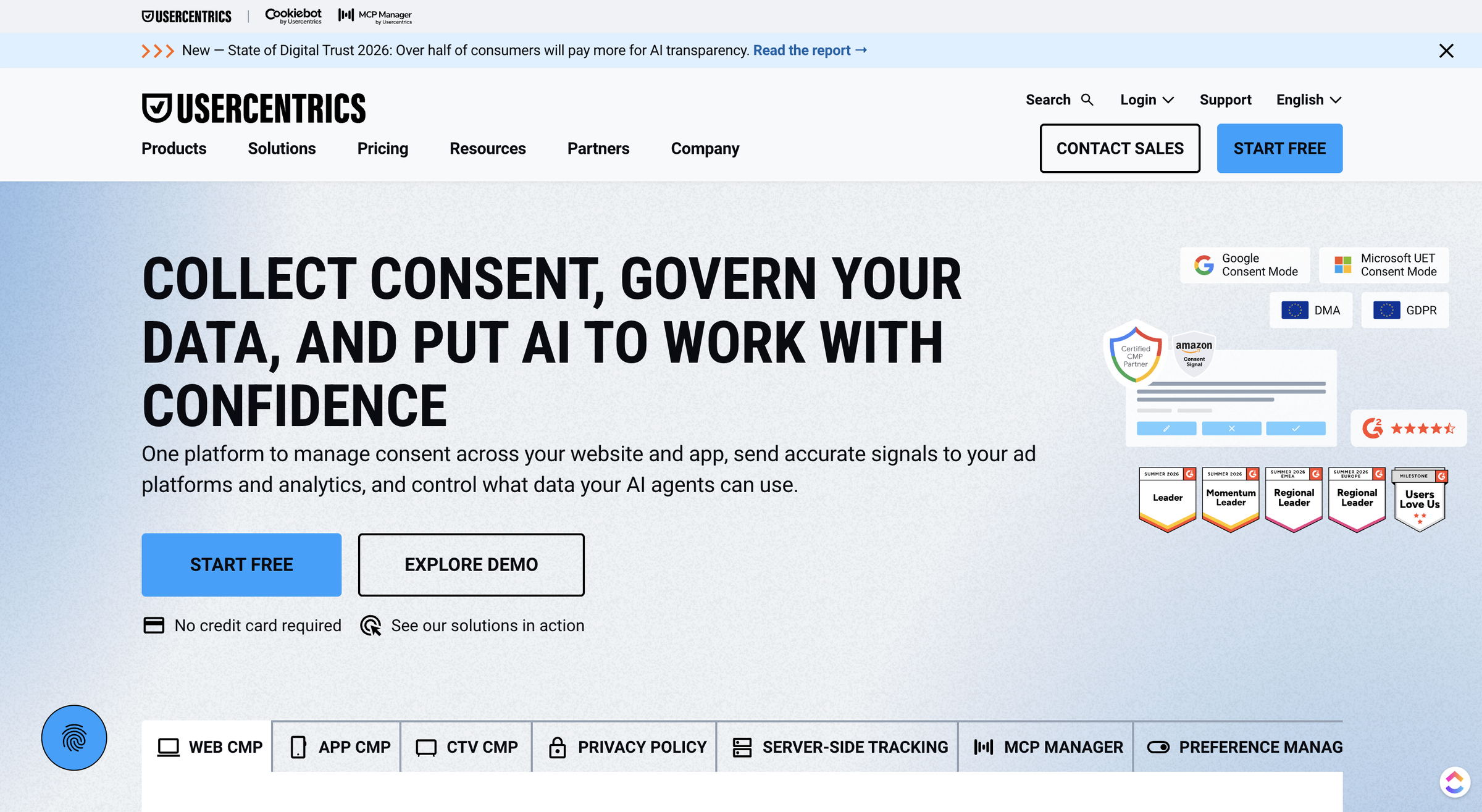
Usercentrics is the parent company of Cookiebot and runs a separate CMP product targeting publishers and martech-heavy sites. It holds the Gold Tier on Google's CMP Partner program and supports IAB TCF v2.3 from the Pro plan. Its pricing is session-based rather than per-domain. That suits sites with many pages but few sessions, and adds billing risk for sites with high session counts.
It scores 3.7/5 on our methodology. Read the full Usercentrics review for the breakdown.
Best for: OneTrust switchers who are IAB TCF publishers wanting the newest TCF version and session-based pricing across many low-traffic pages.
Key Features
Usercentrics targets publishers with current TCF and broad certifications.
-
Google CMP Gold Tier (Consent Mode v2)
-
IAB TCF v2.3: Pro plan and above
-
Up to 60 banner languages from the Pro plan
-
ISO 27001: all tiers including Free
-
WCAG 2.2 AA accessibility: all tiers
-
1,500-plus auto-blocking service templates
-
Session-based pricing with cross-domain consent sharing (Pro and above)
Pros
Usercentrics edges Cookiebot on TCF currency and language breadth.
-
Gold Tier Google certification: same level as Cookiebot.
-
IAB TCF v2.3: more current than iubenda's v2.2. Relevant for publishers running programmatic ads through Google Ad Manager.
-
ISO 27001 on the free plan: a compliance credential most free CMPs do not carry.
-
60 languages: broadest language support of any self-serve alternative here.
Cons
Usercentrics carries billing risk and a lower overall score than its sibling.
-
Session-based billing auto-upgrades on overage: exceed your session cap in a month and your plan tier bumps automatically. For sites with unpredictable traffic spikes, this is a billing surprise.
-
IAB TCF v2.3 gated to Pro (€30/mo): the Free and Essential plans (€0 and €7) do not include full TCF. If that is your use case, you start at €30/mo minimum.
-
Price in EUR with no USD equivalent prominently displayed: US buyers need to do currency conversion.
-
Lower overall score (3.7/5) than Cookiebot (4.0/5) on our methodology, primarily on pricing and scanning dimensions.
Pricing
Usercentrics prices by monthly sessions, gating TCF and languages to Pro.
| Plan | Price | Sessions/mo | Domains | Languages |
|---|---|---|---|---|
| Free | €0 | 1,000 | 1 | 2 |
| Essential | €7/mo | 1,500 | 1 | 2 |
| Plus | €15/mo | 3,000 | 1 | 5 |
| Pro | €30/mo | 15,000 | 3 | 60 |
| Business | €50/mo | 50,000 | 10 | 60 |
| Corporate | Custom | 1,000,000+ | Unlimited | 60 |
What Users Say
Reviewers who chose Usercentrics over Cookiebot cite the session model and the stronger TCF v2.3 support. The session model suits multi-domain or multi-subdomain setups where subpage count would push Cookiebot costs up. The billing surprise on session overage is the most consistent negative.
If session-based pricing is the dealbreaker, flat-priced tools in Usercentrics' class avoid the overage risk entirely.
8. iubenda: Best for Lawyer-Drafted Policies Alongside Cookie Consent (3.6/5)
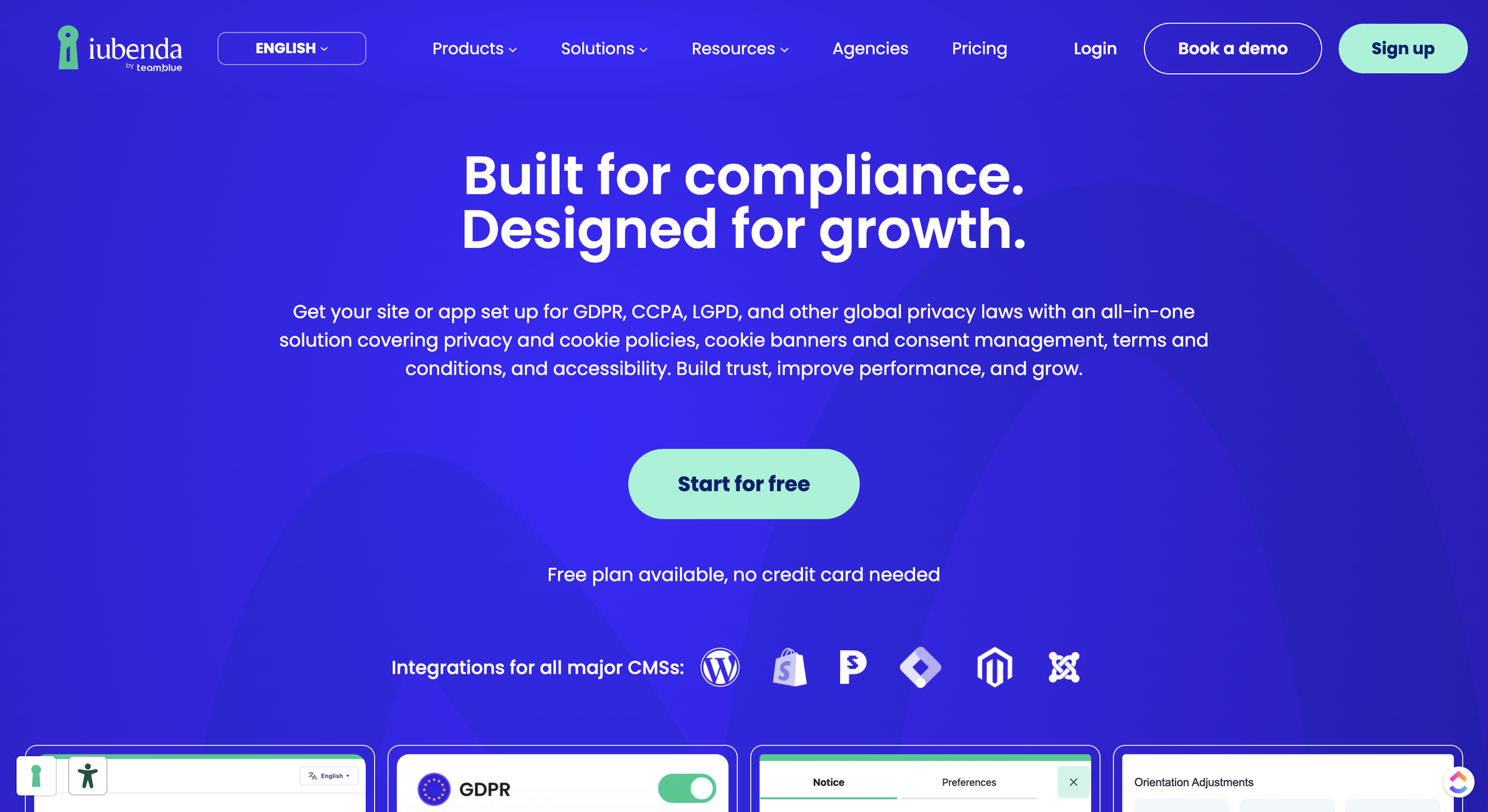
iubenda solves two problems at once: cookie consent and lawyer-drafted website policies. Its library of 2,400-plus clauses, covering privacy policies, cookie policies, and terms, is unique among tools in this category. If you need both a compliant banner and a documented legal foundation, iubenda bundles them more credibly than any competitor here.
It scores 3.6/5 on our methodology. See the full iubenda review for the detail.
Best for: OneTrust switchers who need lawyer-drafted, jurisdiction-specific policies bundled with a compliant cookie banner.
Key Features
iubenda pairs consent with the deepest legal-policy library in the category.
-
Cookie consent banner with Google Consent Mode v2
-
2,400-plus lawyer-drafted policy clauses in 27 languages
-
IAB TCF 2.2 support
-
WCAG AAA accessibility
-
ISO 27001:2017 certified
-
14-day free trial on all plans
-
Geo-targeting from the Advanced plan
Pros
iubenda's strengths center on legal depth and accessibility credentials.
-
Best-in-class legal document generation: 2,400-plus clauses drafted by lawyers, covering more service-specific scenarios than any generator-only tool.
-
IAB TCF 2.2 certified.
-
Long-established credibility: one of the oldest pure-compliance tools on this list.
-
WCAG AAA accessibility certification: the highest accessibility standard, important for public-sector and large-enterprise compliance.
Cons
iubenda's friction shows up most in setup and overage pricing.
-
Lowest setup score of any tool here: our review records G2's Ease of Setup score for iubenda at 5.0 out of 10. First-time users consistently find the interface and clause-selection process confusing.
-
Pageview overage: €0.05 per 1,000 pageviews over the Essentials cap (25,000/mo). At 50,000 pageviews you are paying €5.50 instead of €4.99, but the risk compounds at higher traffic.
-
No DSAR automation.
-
G2 Ease of Setup at 5.0/10 is the most cited friction point in reviews.
Pricing (annual billing, EUR)
iubenda prices per site by monthly pageviews across three tiers.
| Plan | Price/mo (annual) | Pageviews/mo | Languages |
|---|---|---|---|
| Essentials | €4.99 | 25,000 | 1 |
| Advanced | €19.99 | 50,000 | All |
| Ultimate | €79.99 | 150,000 | All |
USD equivalents: approximately $5.99/mo (Essentials) to $99.99/mo (Ultimate) at annual billing.
What Users Say
Reviewers who chose iubenda over cheaper CMPs cite the lawyer-drafted policy library as the primary reason. The consistent complaint: setup is harder than the price implies. One G2 reviewer noted the interface requires more time to learn than comparable tools.
If the setup friction outweighs the policy library for you, simpler tools in iubenda's class are worth comparing.
The Verdict: Which OneTrust Alternative Should You Choose?
Your switching trigger determines the right pick.
-
If you are switching because of cost: Consently at $99/yr solves cookie consent for one domain, and Consently Premium at $199/yr solves it for five. Enzuzo at $9/mo is the cheapest option that also includes legal documents. CookieYes at $10/mo is the cheapest for a single site if you want the largest support community.
-
If you are switching because setup was too complex: any of these alternatives is simpler than OneTrust. Osano and CookieYes both emphasize simplicity over breadth. Consently takes under 30 minutes, while iubenda takes longer.
-
If you only needed cookie consent and got a full GRC suite: Consently, CookieYes, and Cookiebot are pure CMPs. If you used DSAR or vendor risk in OneTrust, Osano and Enzuzo are the closest replacements without going back to enterprise pricing.
-
If you are switching for Google Ads measurement accuracy: Cookiebot and Usercentrics both hold Google’s Gold Tier on Consent Mode v2. Ketch is a listed Google CMP partner. All others on this list support Consent Mode v2 at varying certification levels.
-
If you need integration depth and DSR breadth: Ketch maps closest to OneTrust, with 1,000-plus pre-built connectors and a guided “Ketch Switch” migration.
OneTrust still makes sense for large, regulated enterprises running GRC, data mapping, vendor risk, and consent in one platform. No tool on this list replaces the full suite. What they replace is the cookie consent module specifically, at a fraction of the cost and a fraction of the setup time.
Try Consently free for 14 days
FAQs
How long does it take to migrate from OneTrust to another CMP?
Migration time depends on how you are installed. Via Google Tag Manager, switching a OneTrust banner for any CMP here takes a few hours. You replace the OneTrust GTM tag with the new CMP's tag, test consent signals, and publish. For sites using OneTrust's direct JavaScript SDK or on-page code, migration extends to one to three days. Export your consent records from OneTrust before cancelling your contract.
Can I export my consent records before leaving OneTrust?
Yes. OneTrust's admin panel includes consent log export functionality. Export your records before cancelling your contract. All eight alternatives store consent logs independently, so you do not import old records. Your new CMP begins capturing records from day one. Keep the OneTrust export for any pre-migration compliance audit.
What is the best alternative to OneTrust?
The best alternative to OneTrust depends on the limitation you are escaping. For pure cookie consent at the lowest cost, Consently fits, starting at $99 a year with every feature on every plan. For a privacy program with DSAR, Osano is the closest replacement. For complex martech stacks, Ketch offers 1,000-plus integrations. None replaces OneTrust's full GRC suite.
How much does OneTrust cost per year?
OneTrust costs roughly $10,000 a year at the minimum, with a median buyer paying around $11,500 a year across 325 contracts tracked by Vendr. There is no public pricing, no self-serve signup, and no free trial. Every purchase runs through a sales quote, and renewal increases are a frequent complaint among reviewers.
What is cheaper than OneTrust for GDPR compliance?
Every tool on this list is cheaper. Consently starts at $99/yr for one domain. CookieYes and Cookiebot both have genuine free tiers. Even Osano at $199/mo for three domains is cheaper than OneTrust's minimum contract of roughly $10,000/yr, as reported by independent pricing aggregators including Vendr. For a single small site, iubenda's Essentials plan at €4.99/mo makes OneTrust's pricing look like a rounding error.
Does OneTrust have a free plan?
No. OneTrust has no free tier and no free trial. Every purchase runs through sales, and independent pricing aggregators put the minimum contract at around $10,000 a year. If you want a free CMP, Consently offers a 14-day trial with no credit card. Osano, Ketch, CookieYes, Cookiebot, Enzuzo, and Usercentrics all have free plans with genuine CMP functionality.
Is OneTrust being sold?
As of mid-2026, OneTrust is independent. The Information reported private-equity sale talks rumored to be above $10 billion, a figure covered by Secure Privacy. That figure sits well above OneTrust's last official valuation of $4.5 billion from July 2023. The company is operationally profitable and reports more than $550 million in ARR, but has not announced an IPO or confirmed a deal. Monitor this space if you are signing a multi-year contract.
What is the difference between OneTrust and TrustArc?
Both are enterprise-grade privacy and consent platforms. TrustArc is older (founded 1997 as TRUSTe), positions on regulatory expertise and audit services, and is often compared to OneTrust for large enterprise GRC deployments. Neither publishes self-serve pricing, and both require sales engagement. For cookie-consent-only buyers, both are overkill in the same way. The tools on this list are the relevant comparison for buyers who need a CMP, not a full GRC platform.
Is OneTrust overkill for a small business?
In most cases, yes. OneTrust's core advantage is breadth: AI governance, third-party risk, data mapping, DSAR automation, and cookie consent in one platform. A small business that needs GDPR-compliant cookie banners is buying five features it will never use. A user review on Capterra's OneTrust listing puts it plainly: OneTrust is "overkill" for a small shop with a web presence in one country. That is the honest verdict for most small businesses. The tools on this list deliver compliant banners for 1 to 3 percent of OneTrust's cost.