

The seven strongest CookieYes alternatives for 2026 are Cookiebot, Consently, Complianz, Osano, Termly, CookieFirst, and iubenda. Each is scored on the same seven-dimension rubric, then ranked by switching-fit tier. The right replacement depends on why you are leaving: per-domain cost, scanner accuracy, legal documents, or a full privacy program.
Below: a quick list, why people switch, how to choose, a comparison table, and migration detail per tool.
Best CookieYes Alternatives at a Glance
The best CookieYes alternative depends on your switching trigger. Cookiebot wins on scanning depth, Consently on multi-domain flat pricing, and Complianz for WordPress owners who want self-hosted control. The sharpest single number: a five-domain site pays CookieYes $1,250 per year at Pro, against $199 per year on Consently Premium.
-
Cookiebot: Best for CookieYes users whose scanner misses cookies, patented automated scanning with documented accuracy
-
Consently: Best for CookieYes users priced out by per-domain billing, flat multi-domain pricing with every feature on every plan
-
Complianz: Best for WordPress owners escaping pageview caps, self-hosted plugin at $59/year with no overage
-
Osano: Best for teams that need more than a banner, a full privacy program with DSAR and vendor risk
-
Termly: Best for owners who need broad legal documents, 10 attorney-crafted document types
-
CookieFirst: Best for EU-focused sites that need documented data residency, AMS3 Amsterdam hosting
-
iubenda: Best for single sites that need lawyer-drafted legal breadth, a 2,400-clause library in 27 languages
Disclosure: This guide is written by the Consently team. Consently competes with CookieYes and every tool here, and appears in the ranking, scored by the same rubric as everyone else. Consently earns 3.7 out of 5, below Cookiebot, Complianz, and Osano on raw score. It still ranks second because flat multi-domain pricing is the strongest answer to CookieYes's dominant switching trigger.
How we score: Every product carries the overall score from our published review methodology, which weights Compliance, Scanning, Banner, Setup, Pricing, Performance, and Support. The list is ordered by switching-fit tier, then that score. Read the full method at how we review consent management software.
Why People Switch from CookieYes
Teams leave CookieYes mainly because of per-domain billing that compounds across sites and useful features gated behind higher tiers. CookieYes is the volume leader in budget cookie consent, with more than 1.5 million sites running it. For a single site under the pageview cap, it stays the right tool.
Where CookieYes genuinely earns its users: setup is fast, support earns top G2 ratings, and the agency partner program offers up to 50% reseller discounts. The free plan works for low-traffic sites. If you run one or two domains and stay under the pageview cap, the economics are fine.
The switching pressure comes from four specific friction points, detailed below.
-
Per-domain billing that compounds: On the Basic plan ($10/month per domain), five domains cost $600 per year. The model multiplies with every site you add.
-
Core features gated to Pro: IAB TCF, GPC, geo-targeting, and banner customization beyond two layouts are available on Pro ($25/month per domain). One G2 reviewer notes that “some options for customization are only available at the second pricing level.”
-
Pageview caps and overage: Overage runs at $0.30 per 1,000 pageviews above the limit on Basic and Pro, creating unpredictable billing.
-
Scanner and banner complaints: Recurring G2 reviews flag inaccurate cookie detection and banner performance slowdowns. Reddit developers report creating a new account per site to keep using the free plan, a signal that the paid structure is not working for multi-site buyers.
Honest carve-out: CookieYes remains the right tool for a single non-technical site owner who wants easy setup, responsive support, and a low entry price. It earns a 3.8 out of 5 in our CookieYes review and is genuinely competitive there. The alternatives below win specifically when the per-domain model becomes a cost or feature constraint.
How to Choose a CookieYes Alternative
A consent management platform should handle four things well: a compliant banner, automatic cookie scanning, script blocking before consent, and a consent log for audits. Identify which CookieYes friction is driving your evaluation, then weigh these criteria against it.
Pricing model: flat vs. per-domain
Per-domain billing compounds fast, which is the top reason people leave CookieYes. Flat-capacity pricing (per-year, all domains included) reduces multi-site cost dramatically. Self-hosted plugins remove pageview overage entirely. Match the billing shape to how many sites you actually run.
Feature gating: what sits behind a paywall
IAB TCF, GPC, geo-targeting, and custom banner styling are standard compliance requirements. CookieYes gates these to Pro. Any alternative that repeats that pattern behind a mid-tier plan solves nothing. Look for tools that include the compliance basics on the entry plan.
Scanning reliability
The scanner's job is to find every cookie before consent and block it. CookieYes's recurring complaint is detection accuracy. Look for documented scan frequency, page depth, and user evidence of accuracy, not just a large cookie database.
Platform fit
A WordPress plugin is a different product from a SaaS CMP. Complianz is the right answer for WordPress purists who want self-hosted data; a hosted SaaS is right for everyone else. Match the product type to your site stack before comparing prices.
CookieYes Alternatives Compared
Scores below come from the same seven-dimension rubric we use for every platform in our network. The methodology link sits in the how-we-score block above.
| Tool | Score | Starting price | IAB TCF | T&C generator | Multi-domain pricing | Platform |
|---|---|---|---|---|---|---|
| Cookiebot | 4.0 | $8/mo/domain | Yes (Premium) | No | Per domain | Any |
| Consently | 3.7 | $99/yr (1 domain) | Yes (all plans) | Yes (all plans) | Flat: 5 domains $199/yr | Any |
| Complianz | 3.9 | Free ($59/yr paid) | Yes (paid) | Yes (Pro) | 1 to 10 sites/yr plan | WP + Shopify only |
| Osano | 3.9 | $199/mo | Yes | No | 3 domains on Plus | Any |
| Termly | 3.8 | $10/mo/site (yr) | Yes (paid) | Yes (10 docs) | Per site | Any |
| CookieFirst | 3.8 | EUR 9/mo/domain | Plus+ only | No | Per domain | Any |
| iubenda | 3.6 | $5.99/mo/site (yr) | Yes (all paid) | Advanced+ only | Per site | Any |
| CookieYes (reference) | 3.8 | Free / $10/mo/domain | Pro+ only | No | Per domain | Any |
Prices and features were verified in June 2026. CookieYes data is sourced from the CookieYes pricing page. Visit each product's site for current rates.
1. Cookiebot: Best for Scanner Accuracy (4.0/5)
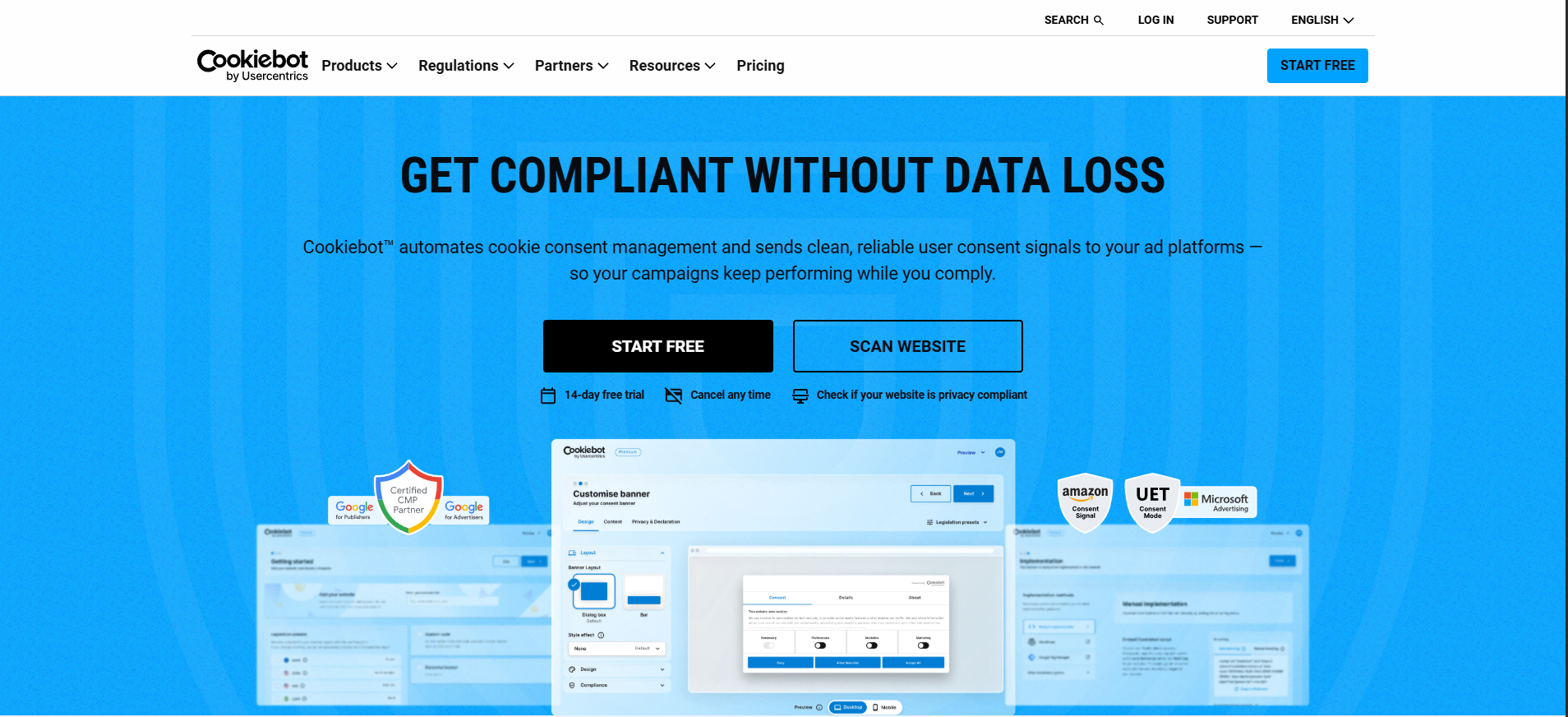
Cookiebot by Usercentrics earns the highest score in our review. It beats CookieYes on scanning depth and compliance breadth while keeping a similar per-domain structure. It is the natural upgrade for anyone who outgrew CookieYes's scanner accuracy without wanting to change their pricing model.
Best for: single or few-domain owners who need better scanning than CookieYes delivers and accept a higher per-domain price for documented accuracy.
Key Features
The core strength is the scanner, with breadth that goes well beyond CookieYes.
-
Patented cloud scanner that crawls your site automatically and categorizes cookies against its repository, no manual first-run setup
-
Google Certified CMP (Premium class) covering GDPR, CCPA, LGPD, ePrivacy, and other frameworks
-
IAB TCF v2.3 on paid tiers
-
320-plus employees and 2.4 million sites across 60-plus languages
-
Automatic scanning and blocking before consent
Pros
These are the strengths that justify moving up from CookieYes.
-
Scanner detection accuracy is rated above CookieYes in documented user reports and independent hands-on reviews
-
Regulation depth is unmatched in the SMB segment, covering frameworks beyond GDPR and CCPA
-
Trusted, long-standing product with a deep documentation base and a clear Usercentrics enterprise upgrade path
Cons
The honest weaknesses are about cost and billing, not capability.
-
Per-domain tiers run from $8/month (Lite) to $96/month (XLarge); the math stacks fast across many domains
-
The automatic upgrade is the most-complained-about billing mechanism: when a site grows past the current tier's subpage limit, Cookiebot upgrades the plan and bills the new rate, a billing surprise rather than a feature
-
No flat multi-domain bundle, so multi-site agencies face real cost exposure
Pricing
Free (50 subpages, 1 domain); Lite $8/mo per domain; Small $16 to $34/mo per domain; Medium $34; Large $56; XLarge $96. Annual billing available.
What Users Say
Cookiebot is recommended most often by compliance managers at regulated industries and companies with multi-jurisdiction presence. Reviews on G2 praise regulation depth and automatic scanner quality. The most cited frustration is cost at multi-domain scale.
Migrating from CookieYes to Cookiebot
Cookiebot's scanner model makes migration straightforward.
-
Create a domain in Cookiebot and run the automatic scan, then review the auto-categorized cookies.
-
Remove the CookieYes embed (or deactivate its WordPress plugin) and install Cookiebot's JavaScript tag via header or GTM.
-
Activate Google Consent Mode v2 through Cookiebot's GTM template.
Each domain requires its own Cookiebot domain entry, and Cookiebot's setup documentation includes a migration guide.
For the full scored evaluation, see our Cookiebot review and Cookiebot alternatives. For a direct comparison, see CookieYes vs Cookiebot.
2. Consently: Best for Multi-Site Flat Pricing (3.7/5)
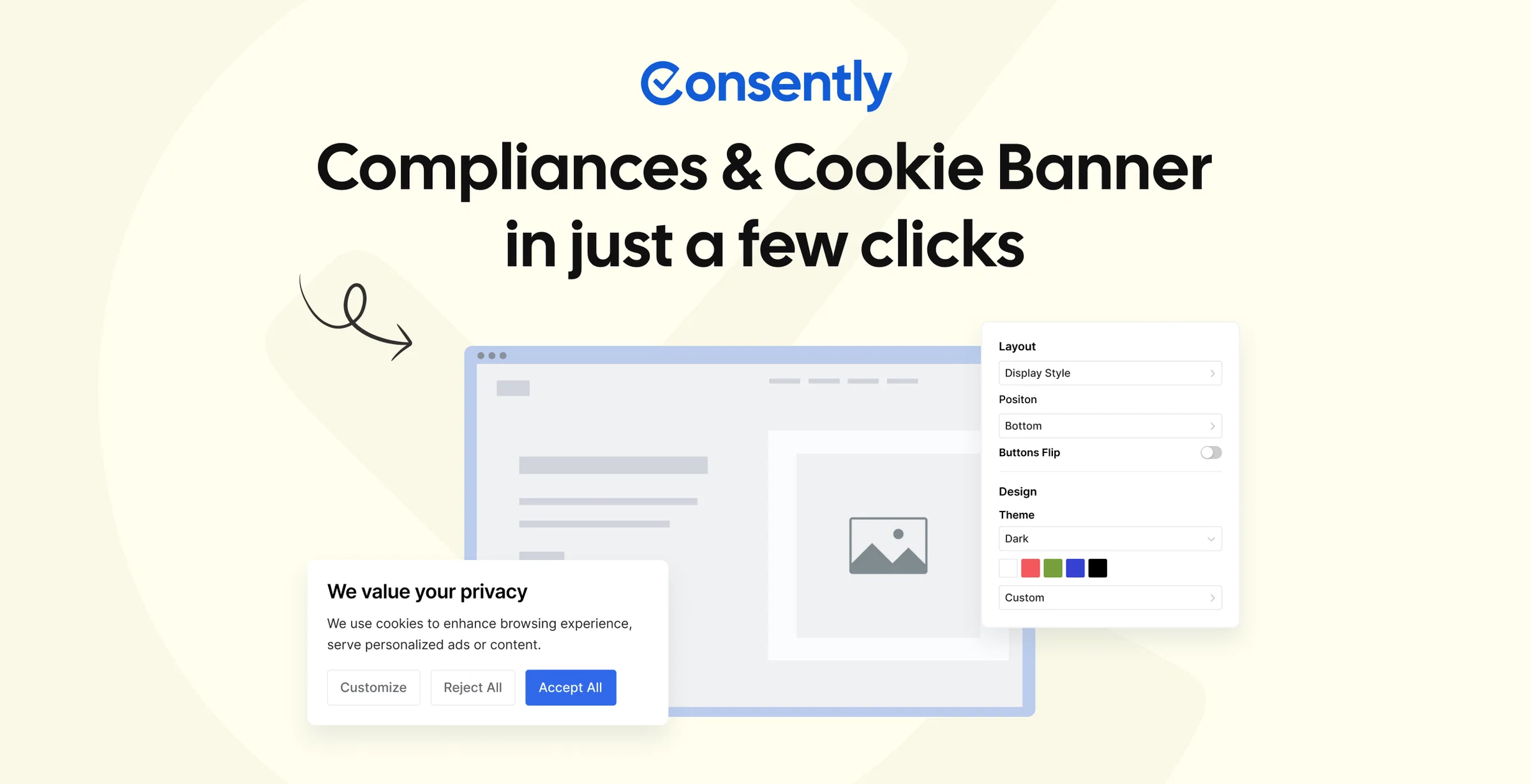
Consently scores 3.7 out of 5, below the top-rated tools and below CookieYes's own 3.8 on raw score. It still ranks second here because flat multi-domain pricing is the strongest answer to CookieYes's dominant switching trigger.
For a small agency running five client domains, CookieYes at Pro ($25/month each) costs $1,500 per year, versus Consently Premium at $199 per year.
Best for: agencies and freelancers managing 3 to 10 client domains, and small to medium businesses that want every feature at a flat annual rate.
Key Features
Consently's defining feature is its pricing model, which removes CookieYes's per-domain and per-tier gates.
-
Capacity-based pricing, not per-domain: Basic $99/yr (1 domain), Premium $199/yr (5 domains), Enterprise $499/yr (10 domains)
-
Every feature on every plan, no tier gating: IAB TCF, geo-targeting, 35-language banners, and consent logs are on the $99/year Basic plan
-
All three policy generators (privacy, cookie, and T&C) included on every plan
-
Google Additional Consent AC v2 certification (full Google CMP Partner listing pending)
-
14-day free trial, no credit card required
Pros
The strengths center on price and feature parity for multi-site owners.
-
No feature-tiering: you do not pay a second time for what CookieYes gates at Pro
-
Flat multi-domain pricing: five domains cost $199/year, against $1,250/year on CookieYes Pro for the same domain count
-
All three policy generators included on the lowest paid tier, where CookieYes offers privacy and cookie policy only
Cons
The limitations come from product age and certification depth.
-
Launched in October 2025, so it lacks the review volume, track record, and certification depth of a 10-year incumbent
-
The scanner was revamped in 2026 and AppSumo reviewers report improved accuracy, but it does not yet match Cookiebot's patented scanning depth
-
No native Shopify app (script install only); Global Privacy Control handling is not yet documented, so GPC-dependent publishers should verify support directly
Pricing
Basic $99/yr (1 domain), Premium $199/yr (5 domains), Enterprise $499/yr (10 domains). All plans include all features. 14-day free trial, no credit card required. Try Consently free.
What Users Say
Consently's AppSumo launch generated reviews averaging 4.0 out of 5. Praise focuses on the flat, all-inclusive pricing and setup simplicity, and reviewers note that the 2026 scanner revamp improved accuracy.
Criticism covers scanner queue times during peak load. AppSumo buyers are deal-motivated, so their feedback skews toward price-value impressions over long-term compliance operations.
Migrating from CookieYes to Consently
The migration requires three things: removing the old script, installing the new one, and re-running a cookie scan.
-
Remove the CookieYes script.
-
Create a Consently account
-
Install the Consently script.
-
Re-scan your cookies.
-
Map your existing banner settings.
Consent records and scan history do not transfer, so plan for a fresh compliance baseline from the migration date. Setup documentation covers WordPress, Shopify, GTM, and Cloudflare Zaraz, and support is available during the trial.
3. Complianz: Best for WordPress Self-Hosted Control (3.9/5)
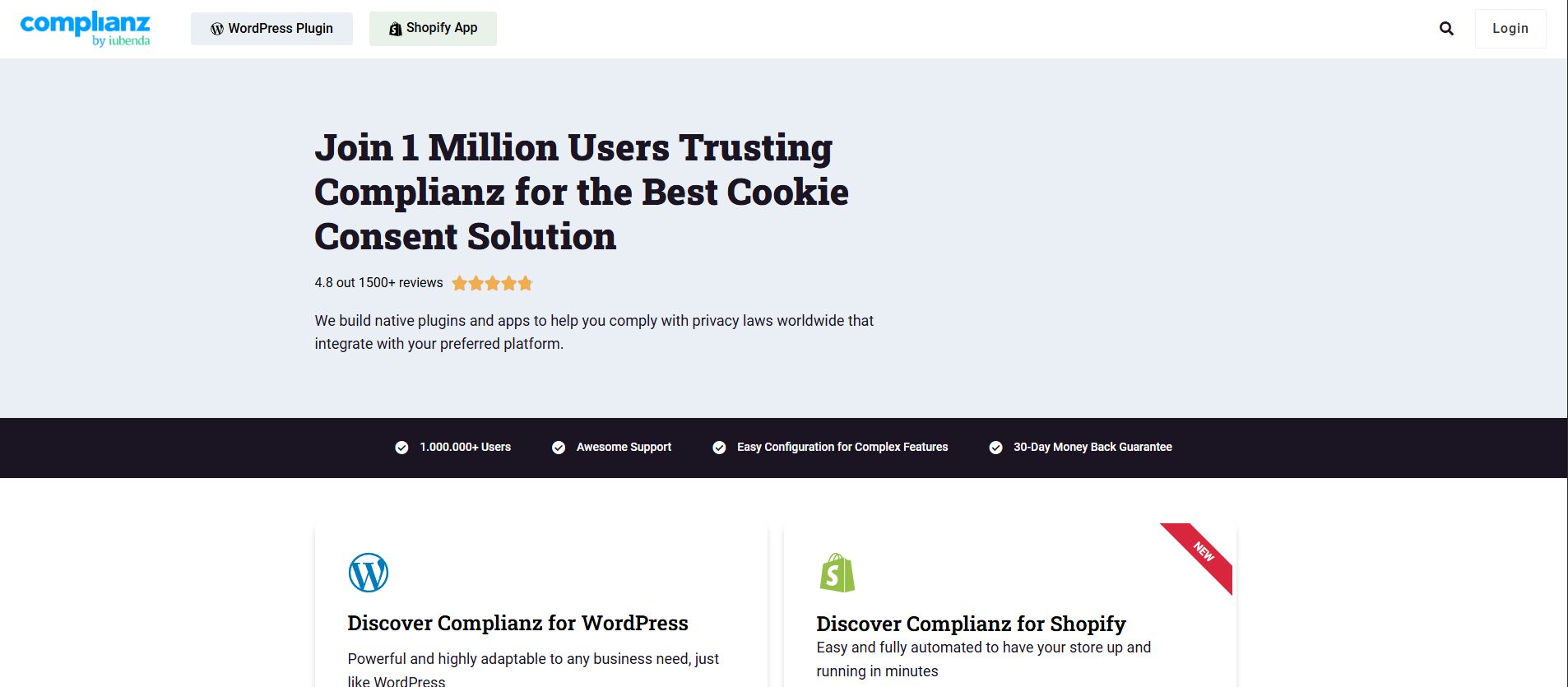
Complianz earns a 3.9 out of 5 in our Complianz review. It is the strongest option here for WordPress owners who want consent management inside WordPress rather than routed through an external SaaS. The catch is total: if your site is not on WordPress or Shopify, Complianz does not exist for you.
Best for: WordPress owners running 1 to 10 sites who want self-hosted consent data, no pageview caps, and a guided configuration wizard.
Key Features
The distinctive feature is the self-hosted model, which keeps consent data on your own server.
-
Self-hosted model: consent data stays on your own server, with no pageview caps and no overage billing
-
IAB TCF documented (CMP ID 332, Google CMP certified July 2024)
-
Guided setup wizard that surfaces GDPR and CCPA choices one by one
-
More than 1 million active installations and a 4.7/5 rating from 1,639 WordPress.org reviews
-
Separate, simpler Shopify product available
Pros
The strengths are cost control and compliance depth inside WordPress.
-
No third-party dependency: a WordPress owner paying CookieYes's per-domain fee and fielding mobile performance complaints can move to $59/year with no pageview caps
-
Compliance depth on WordPress is genuinely strong, with Records of Consent and Google Consent Mode v2 included
-
Flat per-site annual pricing avoids CookieYes-style per-domain compounding
Cons
The trade-offs are platform lock-in and configuration effort.
-
WordPress and Shopify only; Webflow, Wix, Squarespace, and custom stacks are unsupported
-
Plugin conflicts are the most-cited issue: a self-hosted plugin that blocks scripts can interfere with caching plugins and page builders, so test in staging first
-
The wizard is thorough and educational but takes more time than a snippet install
Pricing
Free plugin (limited compliance); $59/yr (1 WordPress site, Records of Consent, Google Consent Mode, IAB TCF); $179/yr (3 sites); $399/yr (10 sites). Shopify: free, $2.99 to $14.99/mo matched to the Shopify plan.
What Users Say
Complianz reviews are dominated by WordPress developers and agencies who switched from per-domain SaaS tools to get unlimited site coverage at a flat cost. The setup wizard earns repeated praise. The most common complaint is that the initial configuration requires reading documentation rather than clicking through a quick-start flow.
Migrating from CookieYes to Complianz
Complianz uses an onboarding wizard rather than an import.
-
Install the plugin from WordPress.org and run the setup wizard, which re-scans your site and auto-categorizes cookies.
-
Remove the CookieYes code, then verify Google Consent Mode v2 via Complianz's native GTM template.
Migration for one site typically takes under 30 minutes, and Complianz's documentation for migrating from other CMPs is thorough.
See Complianz alternatives for more options.
4. Osano: Best for a Full Privacy Program (3.9/5)
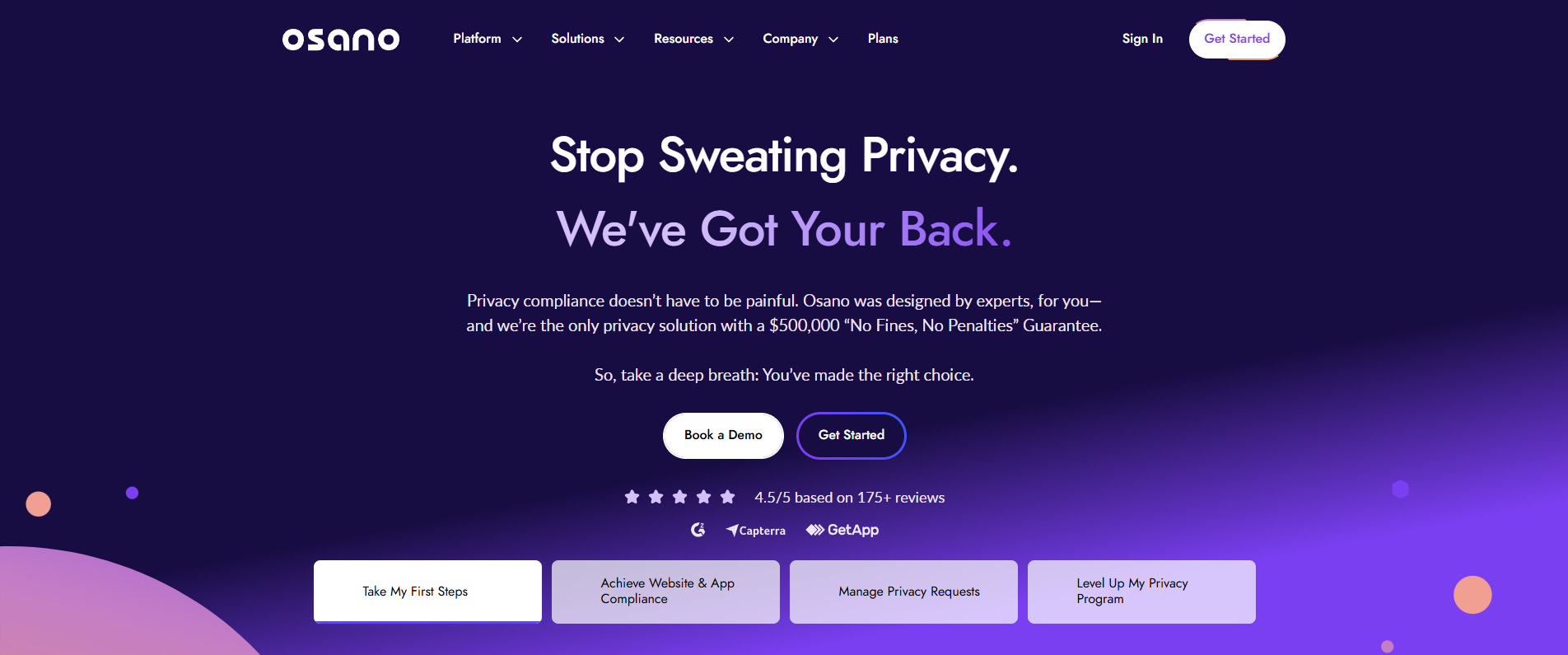
Osano earns a 3.9 out of 5 in our Osano review. It is not a cookie banner alternative in the traditional sense. It is one of the best enterprise consent management platforms and an all-in-one data privacy platform that includes a consent management layer. If the reason you are leaving CookieYes is that you need more than a banner, Osano warrants serious consideration.
If you only need a banner, Osano is overkill and overpriced.
Best for: in-house legal and privacy teams at mid-market companies that need DSAR handling, vendor risk review, and consent management in one platform.
Key Features
What Osano adds beyond the banner is a full privacy toolset on every self-serve plan.
-
DSAR (Data Subject Access Request) management system
-
Data mapping tool and vendor risk monitor alongside the consent layer on every self-serve plan
-
Public Benefit Corporation, founded 2018 in Austin
-
IAB TCF supported
-
Consent management across multiple jurisdictions
Pros
The strengths suit teams that need a recognized, broad privacy platform.
-
Breadth in one product: DSAR handling, vendor risk, and data mapping sit beside consent, useful for a team managing regulatory exposure across jurisdictions
-
The Public Benefit Corporation structure resonates with procurement teams that include vendor ethics review
-
A recognized privacy platform vendor for enterprise contracts and legal sign-off
Cons
The constraints are price and trial access.
-
Self-serve pricing floors at $199 per month for the Plus plan (2 users, 3 domains, 30,000 monthly visitors)
-
No free trial on paid tiers
-
The widely-cited $500,000 compliance guarantee excludes the Plus plan, so the headline benefit applies only to enterprise contracts
Pricing
Plus $199/mo (2 users, 3 domains, 30K visitors); higher tiers custom, sales-led. No free trial on paid tiers.
What Users Say
Osano is most cited by in-house privacy and legal teams that need a recognized vendor for procurement. Reviewers value the DSAR and vendor-risk modules in one platform. The most common critique is price. Against $199/year for Consently or $59/year for Complianz, Osano's $199/month floor is a different category.
Migrating from CookieYes to Osano
Osano onboarding starts with adding your domain and running its scanner to categorize cookies. Remove the CookieYes embed and install Osano's consent script, then configure Google Consent Mode v2. Osano is a full privacy platform, so plan extra time for the DSAR workflow, data map, and vendor risk monitor beyond the banner.
Osano provides implementation support on enterprise contracts.
See Osano alternatives for comparable platforms.
5. Termly: Best for Legal Document Breadth (3.8/5)
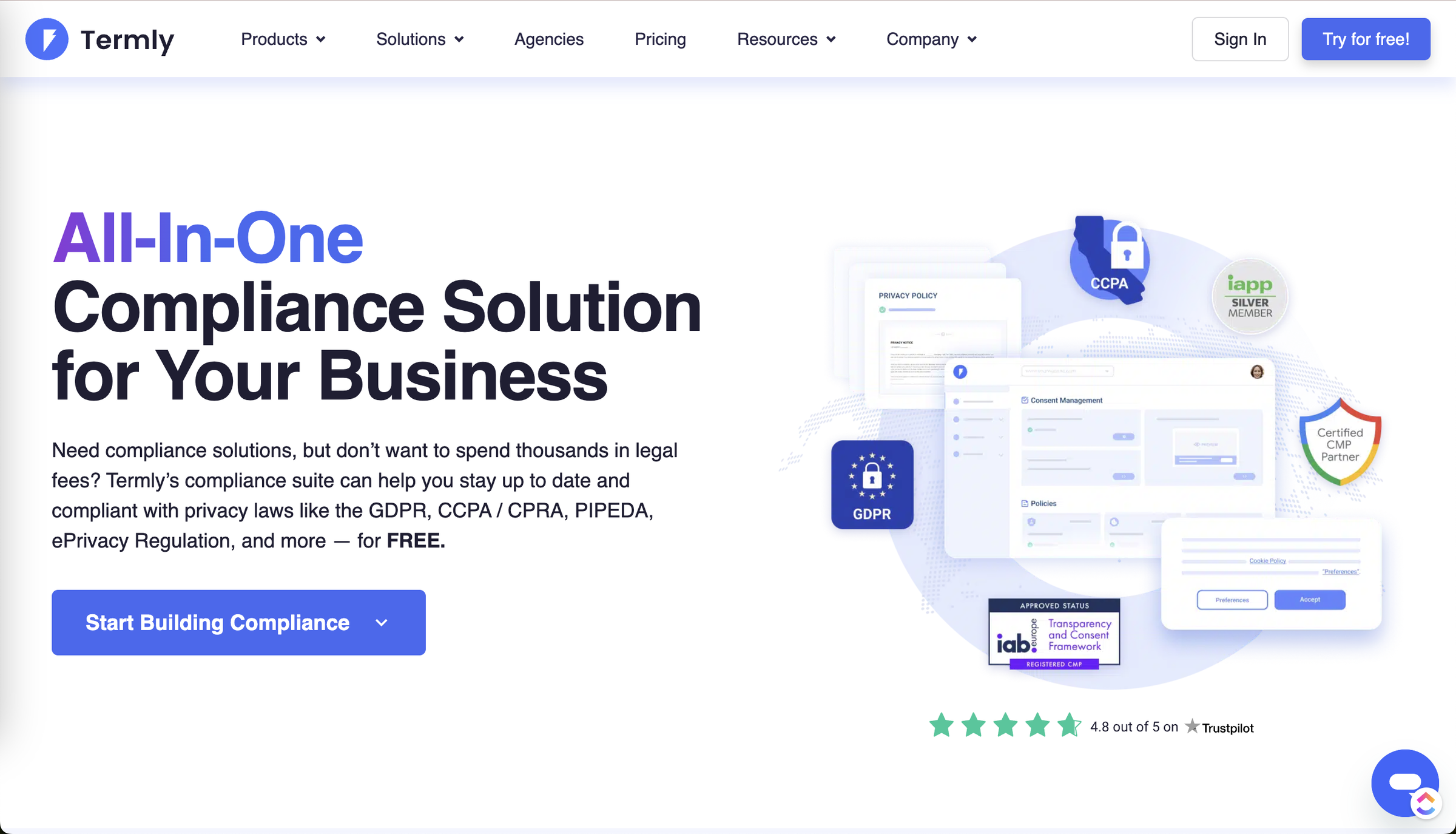
Termly earns a 3.8 out of 5 in our Termly review. Its strongest claim is the widest legal document set on this list: 10 attorney-crafted document types. These include a privacy policy, cookie policy, T&C, disclaimer, acceptable use policy, and a return and refund policy. If CookieYes's two-policy limit is your switching trigger, Termly addresses it more broadly than any other option here.
Best for: single-site owners or small teams that need the broadest legal document set alongside a certified consent banner.
Key Features
The document suite is the differentiator, with a solid consent layer attached.
-
10 attorney-crafted legal document types, the broadest suite on this list
-
Google CMP Gold Tier partner, with IAB TCF on paid tiers
-
GDPR and US opt-out models, with Global Privacy Control honored where US state law requires it (off by default)
-
Starter plan at $10/month per site (billed annually) includes unlimited banner views, weekly scans, and the policy suite
-
Well-documented setup
Pros
The strengths center on legal-document breadth and predictable banner billing.
-
The most comprehensive legal document generation here reduces DIY legal risk for US-focused businesses managing CCPA and multi-state compliance
-
Attorney-drafted, auto-updated documents go well beyond CookieYes's privacy-and-cookie-policy limit
-
Unlimited banner views on the Starter plan avoid pageview-overage surprises
Cons
The limitations mirror CookieYes's per-site structure.
-
Per-site pricing mirrors CookieYes's problem: one Termly Starter license for five sites costs $600 per year
-
The free plan limits you to 10,000 banner views per month and quarterly scans, which is thin for any real business site
-
No A/B testing or consent analytics below Enterprise
Pricing
Free (1 policy, 10K banner views/mo, GDPR only, watermark); Starter $10/mo per site (billed annually); Pro+ $15/mo per site (billed annually).
What Users Say
Termly reviews heavily cite policy generation quality and phone support accessibility. Users with US-centric compliance needs praise the coverage of state laws that other CMPs do not handle. The most common criticism is per-domain pricing at scale and the limited features on the Starter plan.
Migrating from CookieYes to Termly
Termly's setup takes minutes. Create an account, add a domain, run the scanner, generate your policies, and embed Termly's script or use the WordPress plugin.
For CookieYes migrants, export your current cookie category list, configure matching categories in Termly, remove the CookieYes script tag, and add Termly's embed. Google Consent Mode v2 is configured via GTM, and Termly's help center has a migration section.
See Termly alternatives for more options. For a direct comparison, see CookieYes vs Termly.
6. CookieFirst: Best for EU Data Residency (3.8/5)
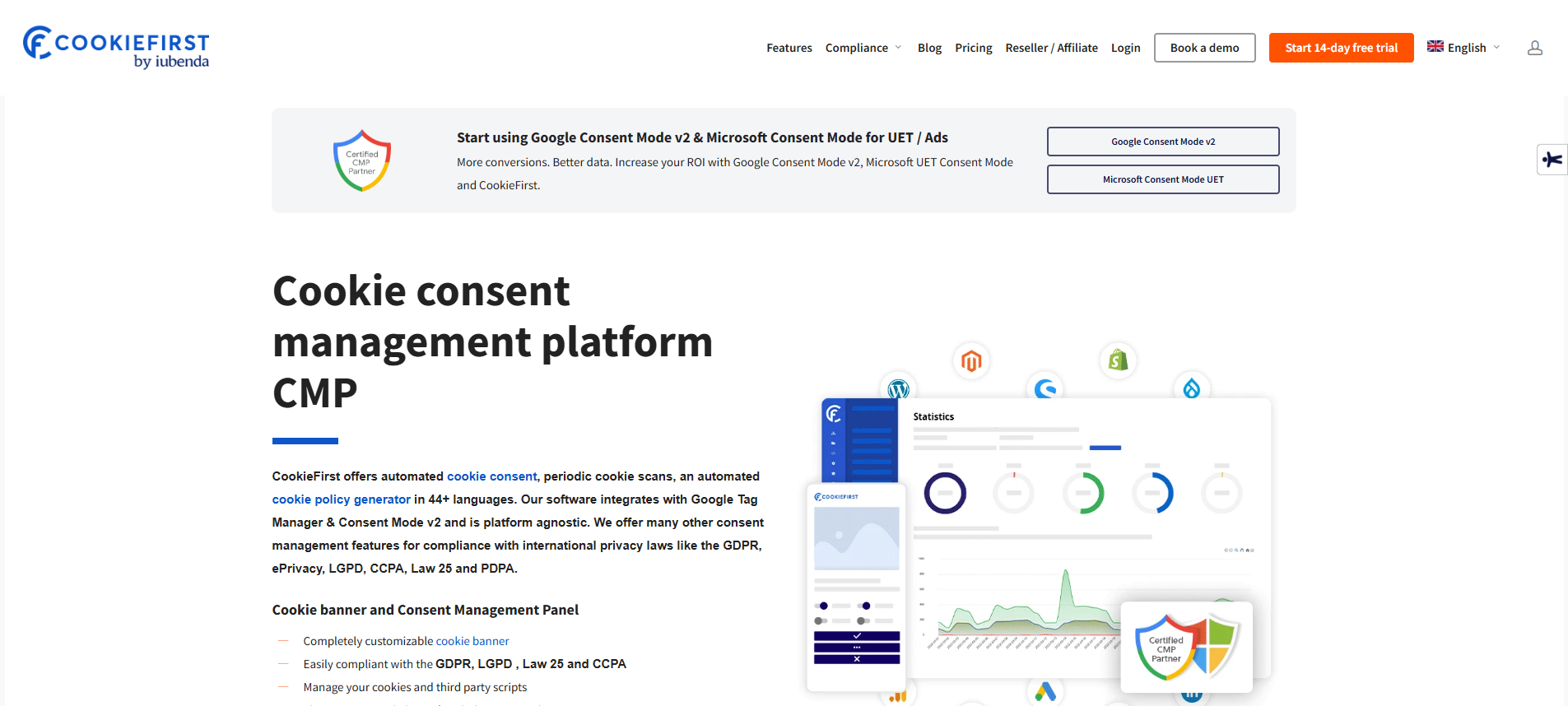
CookieFirst earns a 3.8 out of 5 in our CookieFirst review. It is the most EU-infrastructure-forward option on this list. CookieFirst hosts all data on DigitalOcean's AMS3 data center in Amsterdam, which holds ISO 27001, SOC 1 and 2 Type II, and PCI-DSS certifications.
For EU SMBs or sites serving EU users where data residency is a hard requirement, CookieFirst documents that residency more clearly than CookieYes does.
Best for: EU-focused SMBs that want documented EU data residency, strong multilingual banner support, and clean setup.
Key Features
The standout is EU-hosted infrastructure with documented certifications.
-
All data hosted on DigitalOcean's AMS3 Amsterdam datacenter (ISO 27001, SOC 1 and 2 Type II, PCI-DSS)
-
Banner in 40-plus languages, Google CMP certified
-
Automatic scanner that categorizes cookies from its library
-
Measured, documented banner load impact backed by size and loading metrics
-
Cookie policy generated from the scan
Pros
The strengths are residency, languages, and a clean setup.
-
Documented EU data residency is clearer than CookieYes's, a hard requirement for some EU buyers
-
Strong multilingual support with a clean, fast setup
-
Per-domain pricing with monthly billing available
Cons
The constraints are document gaps, IAB TCF gating, and ownership change.
-
Cookie policy only: no privacy policy generator and no T&C generator, so you will need a separate tool for those documents
-
IAB TCF 2.2 is gated to the Plus plan at EUR 19 per month per domain (EUR 209 per year); the entry Basic plan at EUR 9 per month per domain (EUR 99 per year) does not include it
-
Acquired by iubenda (team.blue) in January 2025, so its roadmap now depends on a parent group's priorities
Pricing
Free (limited). Basic is EUR 9/mo per domain (EUR 99/yr, about $108). Plus is EUR 19/mo per domain (EUR 209/yr, about $228, adds IAB TCF, white-label, and a 24-hour SLA).
What Users Say
CookieFirst historically scored well on straightforward setup and white-label options at Basic pricing. Post-acquisition community discussion reflects some uncertainty about support quality and roadmap direction under iubenda. Buyers who need certainty about long-term product direction should weigh that transition risk explicitly.
Migrating from CookieYes to CookieFirst
Both tools use a script-tag embed model, so the migration mechanics are similar.
-
Create a CookieFirst account, add your domain, run a cookie scan, and configure your banner.
-
Remove the CookieYes embed and insert CookieFirst's tag.
Google Consent Mode v2 is configured via a GTM template, and CookieFirst's setup documentation is available in English and several EU languages.
See CookieFirst alternatives for more options.
7. iubenda: Best for Legal-Document Breadth on One Site (3.6/5)
iubenda earns a 3.6 out of 5 in our iubenda review. Its genuine strength is a 2,400-clause lawyer-drafted library covering privacy policy, cookie policy, and T&C in 27 languages. Its genuine weakness is that every site is its own subscription, so the bill multiplies with every domain.
Best for: single-site owners or small businesses on one to two sites who want the most legally rigorous document set and entry-tier IAB TCF.
Key Features
The document library is the differentiator, paired with entry-tier IAB TCF.
-
2,400-clause lawyer-drafted document library in 27 languages, drafted by in-house lawyers and updated when laws change
-
Google-certified CMP supporting IAB TCF v2.3 on all paid plans, including the entry Essentials tier
-
Geo-targeting from the Advanced tier
-
Monthly cookie scans on Essentials and Advanced
-
Mobile SDK on the Ultimate tier
Pros
The strengths are legal rigor and low-cost TCF access.
-
The clause library is the most legally rigorous here, solving CookieYes's missing T&C generator from the Essentials tier
-
IAB TCF is available on the entry $5.99/month Essentials plan, beating CookieYes's Pro-only gate ($25/month)
-
Localized legal documents in Italian, French, German, and more are hard to match for multilingual sites
Cons
The weaknesses are per-site cost and setup difficulty.
-
Pricing is per site, per month: five sites on Advanced cost $24.99 x 5 x 12 = $1,499.40 per year, repeating the per-site multiplication problem
-
G2 Ease of Setup rating is 5.0 out of 10, reflecting a steeper initial configuration than CookieYes or Consently
-
The banner is functional but documentation-forward, not drag-and-drop
Pricing
Essentials $5.99/mo per site (billed annually, 25K PV); Advanced $24.99/mo (50K PV, geo-targeting, T&C); Ultimate $99.99/mo (150K PV, branding removal, mobile SDK). Free plan available (limited).
What Users Say
iubenda is most cited by single-site owners and small businesses that need legally rigorous documents in multiple languages. Reviewers praise the clause library's depth and legal currency. The most common critique, reflected in its 5.0 out of 10 G2 Ease of Setup rating, is a steeper initial configuration than simpler banners.
Migrating from CookieYes to iubenda
iubenda does not import CookieYes configurations directly.
Create an iubenda account, add your site, and generate your legal documents from the clause library. Run iubenda's cookie scan to build your category list, then remove the CookieYes embed and insert iubenda's banner code.
Configure Google Consent Mode v2 and enable IAB TCF from your dashboard, available from the Essentials tier.
Expect more configuration time than a snippet install given the legal-document setup.
See iubenda alternatives for a broader comparison.
Which CookieYes Alternative Is Right for You?
The right pick follows directly from your switching trigger.
-
If you are switching because of per-domain cost across many sites: Consently (flat multi-domain pricing, $199/yr for 5 domains) or Complianz (self-hosted WordPress plugin, $59/yr, no pageview caps). Complianz wins if you are WordPress-only; Consently wins on any platform.
-
If you are switching because CookieYes's scanner misses cookies: Cookiebot (4.0/5, patented automated scanning with documented accuracy), which earns the top scanner rating on this list.
-
If you need legal documents CookieYes does not generate: Termly for the broadest suite (10 attorney-crafted document types, $10/mo/site), iubenda for the most legally rigorous option (2,400 clauses, $5.99/mo/site annually), or Consently for multi-site at flat pricing.
-
If you need a full privacy program, not just a banner: Osano ($199/mo, DSAR, data mapping, and vendor risk alongside consent).
-
If you need EU data residency documented: CookieFirst (AMS3 Amsterdam, ISO 27001/SOC 2, 40-plus languages).
CookieYes remains a competitive tool for a single non-technical site owner who values easy setup and responsive support. The Consently vs CookieYes breakdown covers the direct comparison. The tools on this list are better fits when the per-domain model becomes a cost or feature constraint.
FAQs
What are the best CookieYes alternatives?
The strongest CookieYes alternatives are Cookiebot, Consently, and Complianz, depending on which CookieYes limitation you are escaping. Cookiebot leads on scanner accuracy, Consently on flat multi-domain pricing from $99/year, and Complianz on self-hosted WordPress compliance at $59/year. Osano, Termly, CookieFirst, and iubenda each fit narrower switching needs around privacy programs, legal documents, EU residency, and clause breadth.
Can I migrate from CookieYes to another tool without losing my consent records?
No CMP on this list imports CookieYes consent records directly. When you switch, you start a new consent record baseline from the migration date, which is standard across all CMPs. Before switching, export your CookieYes consent log as CSV from the dashboard, store it, and document the migration date in writing. The new tool then builds its own timestamped record.
Is there a free CookieYes alternative that is actually usable for a business?
Complianz has a free WordPress plugin, though Records of Consent, Google Consent Mode v2, and IAB TCF require the $59/year paid plan. iubenda has a free plan for sites under 1,000 pageviews. Termly's free plan covers 10,000 banner views per month with quarterly scans, which is thin for any active site. For a live business site, the honest starting point is Complianz at $59/yr or Termly at $120/yr.
Does switching CMPs affect my Google Consent Mode signals?
Yes, briefly. When you replace your CookieYes script, returning visitors see the new banner and provide fresh consent. GA4 and Google Ads reflect that in their consent modeling for a few days. All tools on this list are Google Consent Mode v2 compatible, so signals resume correctly once the banner is live. The gap is typically hours or days, not weeks.
Which CookieYes alternative includes IAB TCF on the cheapest plan?
iubenda includes IAB TCF 2.2 on its Essentials plan ($5.99/month per site billed annually). Consently includes IAB TCF on every plan including the $99/year Basic. Complianz's paid WordPress plans ($59/year) include IAB TCF. CookieFirst gates IAB TCF to its Plus tier (EUR 19/month per domain), and CookieYes gates it to its Pro plan ($25/month per domain). For a publisher where IAB TCF is a baseline requirement, iubenda or Consently offer the lowest entry price with TCF included.
Is Consently a legitimate alternative if it is so new?
Consently launched in October 2025 and is built by Dorik, Inc., which has operated since 2020. It is younger than Cookiebot or iubenda, reflected in its 3.7/5 score versus Cookiebot's 4.0. It lacks the deep certification stack of a 10-year incumbent and has fewer published reviews. If your switching trigger is per-domain cost compounding across multiple sites, the flat pricing model addresses it directly. The full scored assessment is in the Consently review.
How do I choose between Complianz and Consently for a WordPress site?
Complianz is the better choice for consent data stored on your own server, no pageview caps, and a plugin inside the WordPress admin. Consently is the better choice for managing WordPress alongside non-WordPress sites, or if you need a built-in T&C generator. For a WordPress shop running 3 to 5 sites, the pricing is close. Complianz costs $179/year (3 sites) versus Consently Premium at $199/year (up to 5 sites). The right pick depends on whether self-hosting or document breadth matters more.