Sourcepoint is the best consent management platform for publishers in 2026, scoring 4.4 on our publishers-fit evaluation. Publishers running programmatic ads need a CMP that signals IAB TCF and GPP, satisfies Google’s certified-CMP requirement, and maintains consent rates. Sourcepoint leads on all three.
We scored 10 platforms by re-weighting our methodology for ad-supported publishers, with IAB TCF certification and GPP signaling as decisive factors.
Below: a score-ranked quick list, a comparison table, and a scored section per platform.
Disclosure: Consently publishes this guide and appears at rank 10 of 10 by its publishers-fit score of 3.7.
What Are the Best CMPs for Publishers?
Sourcepoint, ConsentManager, and Didomi lead this list for publishers. Sourcepoint earns the top publishers-fit score of 4.4. It pairs a full IAB TCF 2.2 plus GPP stack with Google certification, market-leading CTV/OTT support, and consent-rate A/B testing. ConsentManager and Didomi follow closely at 4.3 each.
-
Sourcepoint (publishers-fit 4.4): Best overall CMP for large publishers and ad-funded media
-
ConsentManager (publishers-fit 4.3): Best certified ad-tech CMP with built-in consent optimization
-
Didomi (publishers-fit 4.3): Best for EU-first publishers that need CNIL-grade TCF control
-
Axeptio (publishers-fit 4.1): Best CMP for publishers who treat the banner as a revenue lever
-
Usercentrics (publishers-fit 4.1): Best multi-surface CMP for web, app, and CTV networks
-
OneTrust (publishers-fit 4.0): Best for enterprise media groups that need a full privacy program
-
Cookiebot (publishers-fit 4.0): Best for publishers who want certified automatic scanning depth
-
Osano (publishers-fit 3.7): Best for publishers who want a CMP inside a broader privacy suite
-
InMobi CMP (publishers-fit 3.7): Best free CMP for ad-monetizing publishers
-
Consently (publishers-fit 3.7) Best budget all-in-one CMP for small publishers with light ad-tech needs
This list is ranked by the publishers' fit score. It re-weights our seven review categories for publishers and adds two decisive factors: IAB TCF plus GPP, and Google certification plus consent-rate optimization. Each product’s global review score is shown alongside, and ConsentManager and Didomi sit in a genuine tie at 4.3. Three ad-tech-native players (Sourcepoint, Didomi, InMobi CMP) are newly scored from public evidence because they do not yet have a full Consently review. For more details, see how we score every CMP.
What Is a CMP for Publishers, and Why Do Publishers Need One?
A consent management platform for publishers is software that collects and records visitor consent for cookies and data processing. It then signals that consent to ad partners through the IAB Transparency and Consent Framework. For a publisher running programmatic advertising, a CMP is infrastructure, not a legal checkbox.
Publishers face a problem that general websites do not. Google requires a consent management platform certified under its CMP Partner program for any publisher serving personalized ads in the EEA, UK, or Switzerland.
This applies to AdSense, Ad Manager, and AdMob, and the CMP must integrate with IAB TCF. A banner that collects a yes/no tick but does not pass a valid TC String to the ad server means lost addressable revenue.
Consent rate compounds the stakes. A publisher with a 40 percent opt-in rate monetizes 40 percent of its audience addressably. A CMP that lifts that rate to 65 percent through better UX or an A/B-tested banner turns a compliance cost into a revenue driver. That calculus explains why the top picks here all offer consent-rate tooling, and why ad-tech-native CMPs dominate the rankings.
What Should Publishers Look for in a CMP?
Publishers should prioritize five things. They are IAB TCF 2.2 plus the GPP, a Google-certified CMP tier, consent-rate optimization, ad-stack and CTV/OTT integration, and reliable scanning with pre-consent tag blocking. These criteria separate a publisher-grade CMP from a general consent banner. For a broader look at the general-buyer market, see the best consent management platforms guide.
IAB TCF 2.2, GPP, and the MSPA
The IAB Transparency and Consent Framework (TCF) 2.2 transmits a visitor’s consent decision as a TC String to every vendor in a publisher’s ad stack. Without a valid TC String, compliant demand-side platforms drop the bid. IAB TCF 2.2 is mandatory for any publisher running programmatic ads in the EEA or UK. TCF 2.3 is the current operative version and is backward-compatible.
The IAB Global Privacy Platform (GPP) extends the same signaling logic to US-state privacy laws. It bundles CCPA, Virginia VCDPA, Colorado CPA, and others into a single consent string. The Multi-State Privacy Agreement (MSPA) layers on an industry self-regulatory framework for US programmatic.
It lets publishers certify compliance to ad-tech partners at scale. For a US ad-funded publisher, GPP and MSPA support is increasingly expected by programmatic partners.
Sourcepoint, ConsentManager, Didomi, Usercentrics, and OneTrust all support IAB TCF plus the GPP, and OneTrust adds the MSPA. Consently supports IAB TCF 2.3 and Google Consent Mode v2, but it does not support the GPP or the MSPA. For more on the framework, see what IAB TCF is.
A Google-certified CMP for ad serving
Google’s certified CMP Partner program lists the tools that meet its requirements for collecting and passing consent to its ad products. To serve personalized ads in the EEA, UK, or Switzerland, a publisher must use a CMP from that list for AdSense, Ad Manager, or AdMob. The Google CMP Partners page maintains the current list. Google Ad Manager Help explains the requirement.
Gold is the highest tier, and certification carries three tiers: Gold, Silver, and Bronze. On Google’s current list, ConsentManager, Usercentrics, OneTrust, Cookiebot, Axeptio, and Didomi are Gold; Osano and Ketch are Silver; Sourcepoint is Bronze. All of them pass Google’s requirement to serve personalized ads. Consently supports Google Consent Mode v2 and Additional Consent (AC) v2. Its Google CMP Partner listing is still pending, though, so it does not appear on the certified list yet.
Consent-rate and ad-revenue optimization
A higher opt-in rate means more addressable impressions. Take a publisher on a 5 CPM programmatic floor. At a 40 percent opt-in versus a 65 percent opt-in, it gives up roughly 38 percent of addressable revenue. That gap is where consent-rate optimization tools earn their cost.
Three tools lead on this dimension. Sourcepoint offers a full A/B testing engine and a consent paywall (Consent-or-Pay), letting visitors choose between consenting to ads or paying for an ad-free experience.
ConsentManager embeds built-in A/B testing plus a machine-learning consent optimization layer. Axeptio publishes case-study consent rates of 72 to 84 percent, driven by its conversational banner design and Pay-or-Consent walls. Consently has none of these tools. Its banner is well-designed, but it offers no A/B testing or consent paywall.
Ad-stack and CTV/OTT integration
A publisher CMP must plug into the ad stack without friction. That means Prebid header-bidding wrappers and Google Ad Manager (GAM) certified integration. For media groups running video and streaming properties, it also means a certified CTV/OTT consent layer.
Sourcepoint leads on CTV/OTT. It is one of the few CMPs certified for connected TV and over-the-top media consent, handling 30 billion monthly touchpoints across web, app, and CTV. Usercentrics offers separate but integrated Web CMP, App CMP, and TV CMP products.
Both Didomi and ConsentManager provide mobile and CTV SDKs for publisher groups with app-based inventory. Consently is a web-script CMP with no native mobile SDK, no server-side consent option, and no CTV or OTT support.
Scanning, pre-consent tag blocking, and performance
Accurate scanning finds the tags that would fire before consent and maps them to the IAB GVL. Incomplete scanning means undeclared vendors, TCF audit failures, and regulator exposure. Pre-consent tag blocking ensures no ad, analytics, or tracking script fires until a valid TC String is generated.
Sourcepoint’s Diagnose tool provides accuracy-verified scanning with independent corroboration. DebugBear’s CMP performance comparison notes Sourcepoint as one of the lowest-INP consent tools. That matters for Core Web Vitals on ad-funded pages, where banner load affects Interaction to Next Paint.
Cookiebot’s scanner references a repository of over 13,000 cookie and tracker entries, the deepest database of any tool here. Consently’s scanner has improved significantly (roughly a 70 percent accuracy gain per recent notes) but is still maturing relative to these specialists.
How Do the Best Publisher CMPs Compare?
The table below compares all 10 CMPs on the attributes that matter most to publishers, sorted by publishers-fit score. “Score” is the global overall from our full review (Layer-1). “Publishers-fit” is the re-weighted composite this list is ranked by, and Google certification tiers are taken from Google’s current CMP Partners list.
| Product | Score | Publishers-fit | IAB TCF + GPP/MSPA | Google CMP cert | Consent-rate optimization | Entry price | Best for (publisher) |
|---|---|---|---|---|---|---|---|
| Sourcepoint | n/a, newly scored | 4.4 | TCF 2.2 + GPP | Certified (Bronze) | A/B + consent paywall | Custom (no free self-serve) | Large publishers, ad-funded media, CTV |
| ConsentManager | 3.9 | 4.3 | TCF 2.2 + 2.3 + GPP | Gold | Built-in A/B + ML | Free; EUR23/mo | Certified ad-tech with built-in optimization |
| Didomi | n/a, newly scored | 4.3 | TCF-first + GPP | Gold | A/B + preference mgmt | ~$200/mo; custom | EU-first publishers, CNIL-grade TCF |
| Axeptio | 4.0 | 4.1 | TCF 2.3 (GPP less documented) | Gold | Opt-in optimization (A/B Enterprise) | Free; $29/mo (1 domain) | Banner-as-revenue-lever |
| Usercentrics | 3.7 | 4.1 | TCF 2.3 + GPP | Gold | A/B (Corporate tier) | Free; $8/mo | Web, app, and CTV networks |
| OneTrust | 3.6 | 4.0 | TCF 2.2 + GPP/MSPA | Gold | Enterprise tooling | Custom (~$10k+/yr) | Enterprise media groups + full privacy program |
| Cookiebot | 4.0 | 4.0 | TCF (GPP via Usercentrics group) | Gold | None native | Free; EUR7 to EUR90/mo per domain | Certified automatic scanning depth |
| Osano | 3.9 | 3.7 | TCF limited; US-state/GPP focus | Silver | None | Free; $199/mo (3 domains) | CMP inside a broader privacy suite |
| InMobi CMP (fmr Quantcast Choice) | n/a, newly scored | 3.7 | TCF 2.3 + Google standards | Supports Google standards (not directory-listed) | Ad-monetization focus | Free | Free CMP for ad-monetizing publishers |
| Consently | 4.0 | 3.7 | TCF 2.3 only (no GPP/MSPA) | Consent Mode v2 + AC v2; listing pending | None | 14-day trial; $99 to $499/yr | Budget all-in-one for small publishers |
Beyond these 10, publishers will also see other Google-certified CMPs in search results. The two most common are Ketch (Silver, rated 4.5 across 147 G2 reviews) and UniConsent (Gold, IAB TCF 2.3). Both are credible if your shortlist needs more options.
1. Sourcepoint: Best Overall CMP for Large Publishers and Ad-Funded Media
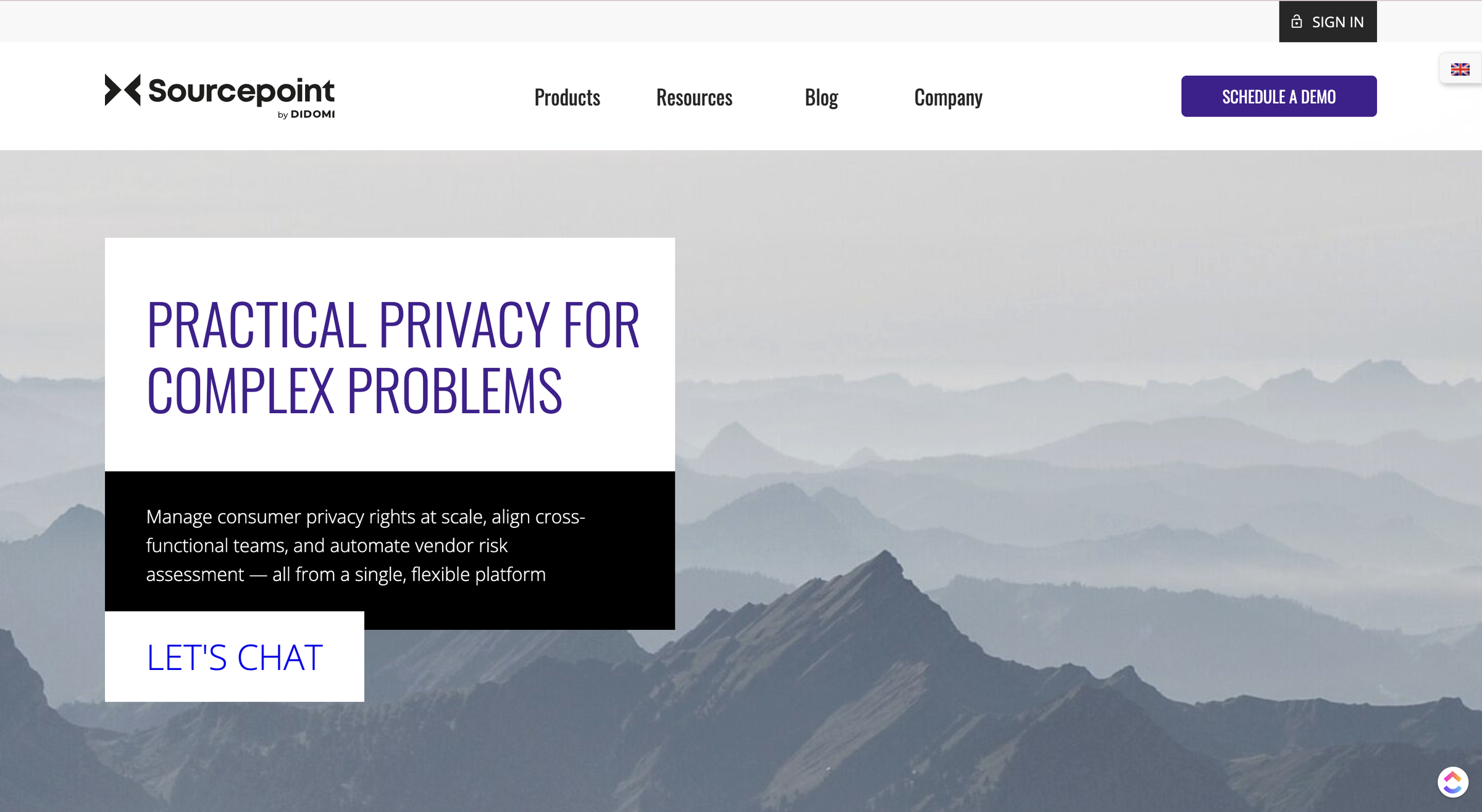
Sourcepoint is newly scored here from public evidence because it does not yet have a full Consently review. It earns 4.4 on our publishers-fit score, the top pick. It is the most publisher-grade CMP on this list, built from the ground up for the programmatic advertising stack. Sourcepoint is used by 10 out of 10 of the UK’s and 10 out of 10 of Germany’s top news publishers. Didomi acquired Sourcepoint in 2025 (Medium confidence; both CMPs are still sold as distinct products).
Key Features
Sourcepoint’s feature set is built around the programmatic ad stack and large-publisher scale.
-
IAB TCF 2.2 and GPP multi-framework consent signaling
-
Google-certified CMP, listed at Bronze tier on Google’s current CMP Partners list
-
Market-leading CTV/OTT consent layer (one of the few certified for connected TV)
-
Consent-rate A/B testing and a full experimentation engine
-
Consent-or-Pay (consent paywall) giving visitors a paid ad-free option
-
Accuracy-verified vendor scanning via the Diagnose tool
-
Authenticated consent profiles for returning users
-
Roughly 30 billion monthly consent touchpoints across web, app, and CTV
Pros
The strengths below reflect Sourcepoint’s depth at high-traffic publisher scale.
-
The deepest publisher and ad-tech stack here, with TCF 2.2 plus GPP plus CTV plus a consent paywall in one platform
-
Used at the scale of the UK’s and Germany’s top news brands, so its robustness at high traffic volume is independently demonstrated
-
Low Interaction to Next Paint impact on ad-funded pages (DebugBear CMP performance comparison)
-
Strong enterprise support and SLA structure for media groups
-
Consent-or-Pay is one of the few genuinely production-ready paywalls for GDPR-compliant publisher monetization
Cons
The limitations below matter most to small and mid-size publishers.
-
Enterprise-only pricing with no self-serve free plan, inaccessible for small or mid-size publishers
-
Steep learning curve; publisher operations teams typically require onboarding support
-
Limited policy-generation tooling relative to the compliance breadth it covers
-
UI frustrations noted in the r/adops community (“Sourcepoint is great but their UI is rubbish”)
Pricing
Pricing is custom, tiered by monthly page views and app users. There is no self-serve free tier, so contact Sourcepoint for a quote. This structure means it is realistically available only to mid-size and large publishers with a dedicated procurement process.
What Users Say
Independent ratings for Sourcepoint are positive but concentrated among ad-tech buyers.
“Sourcepoint is great but their UI is rubbish.” (r/adops, publisher switching CMPs)
rfp.wiki rates Sourcepoint 4.1 out of 5 across 60 reviews, compared to 2.4 out of 5 for InMobi CMP (formerly Quantcast Choice) across 6 reviews. TermsFeed (2026-06) lists its strengths as strong ad-tech integration, built-in consent paywall tools, and analytics and testing. Its noted weaknesses are enterprise-focused pricing and a steep learning curve.
2. ConsentManager: Best Certified Ad-Tech CMP With Built-In Consent Optimization
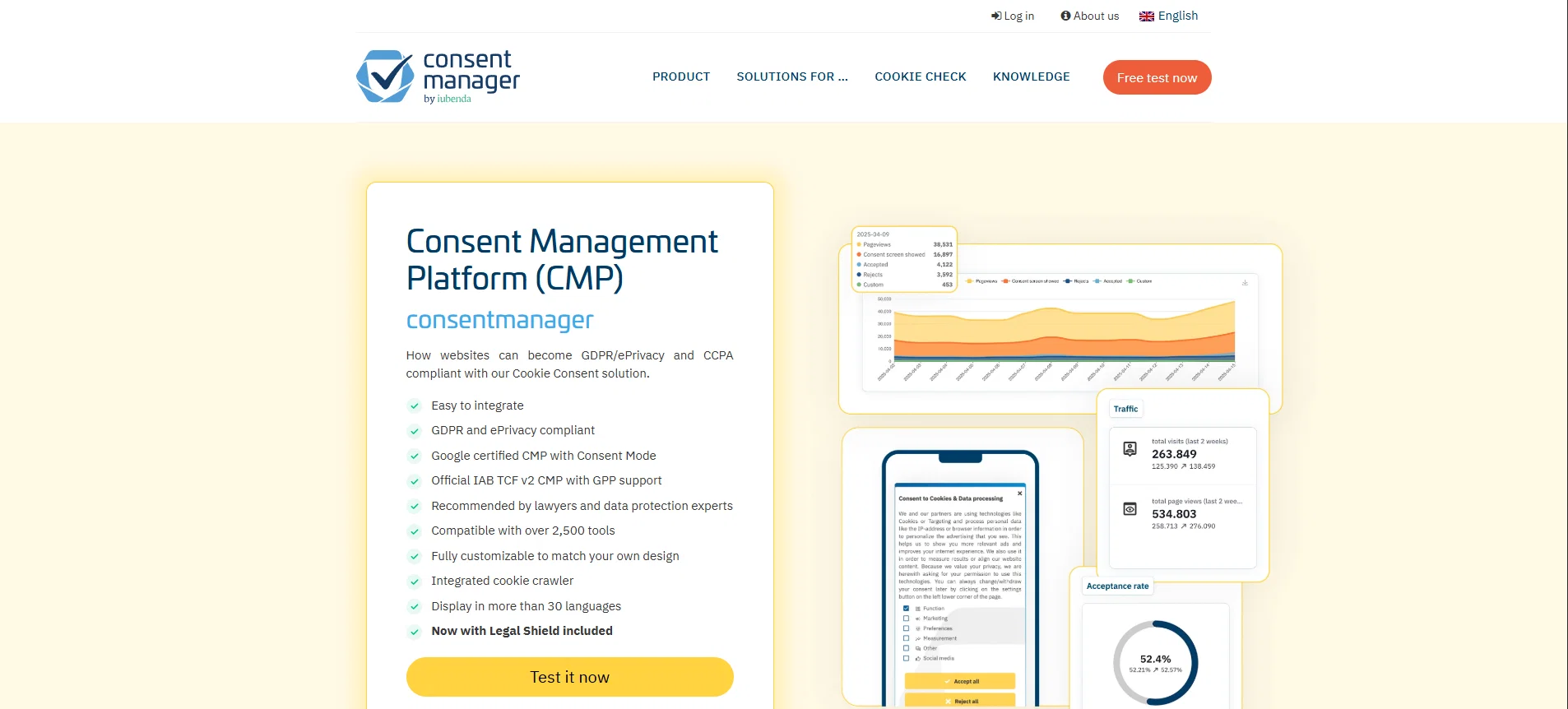
ConsentManager scores 3.9 out of 5 globally and 4.3 on our publishers-fit score, in a tie with Didomi for the highest composite. It is the highest-scoring product that has a full Consently review, and a registered IAB Europe CMP (ID 31). ConsentManager is the strongest pick for a mid-market publisher that wants Gold-tier certification and built-in A/B consent optimization. It delivers both on a managed self-serve entry tier, without Sourcepoint’s enterprise pricing.
Key Features
ConsentManager pairs deep TCF and GPP certification with consent-rate tooling at a self-serve price.
-
Registered IAB Europe CMP (ID 31), certified for IAB TCF v2.2 and v2.3, plus IAB GPP
-
Gold-tier Google Consent Mode v2 certification
-
Cookie Crawler with a database of over 3 million cookie and tracker entries
-
Built-in A/B testing for consent banners (gated to the EUR59 Essential tier and above)
-
Machine-learning consent optimization that adjusts banner parameters from real opt-in data
-
Multi-framework geolocation rules (GDPR banners in the EEA, CCPA in California, and so on)
-
Server-side and client-side deployment options
-
Mobile and CTV SDKs for publishers with app inventory
-
White-label option on the Ultimate tier
Pros
ConsentManager’s strengths center on certified ad-tech depth at a mid-market price.
-
Full TCF 2.2 plus 2.3 plus GPP coverage satisfies both the EEA programmatic requirement and US-state partners
-
Built-in A/B and ML consent optimization at a self-serve price, unlike Sourcepoint, which requires enterprise negotiation
-
The Cookie Crawler’s 3M+ database is one of the deepest scanning foundations available
-
EU data residency is available, satisfying data-localization requirements for European media groups
Cons
The limitations below mostly affect lower-tier buyers and very high-traffic publishers.
-
Onboarding is configuration-heavy, with up to nine setup stages and detailed vendor mapping required
-
IAB TCF and A/B testing are gated behind the EUR59 Essential tier; the free and EUR23 Starter tiers lack them
-
Per-view overage charges can compound quickly for high-traffic publishers without a traffic-ceiling plan
-
A privacy-policy generator is available, but a full terms-of-service or cookie-policy generator is not
Pricing
ConsentManager’s entry pricing is among the most accessible here, but the meaningful publisher features require the EUR59 tier. Free covers 1 site and 3,000 views/month, and Starter is EUR23/mo (1 domain). Essential at EUR59/mo (3 domains) unlocks TCF and A/B, then Professional is EUR219/mo (20 domains) and Ultimate is custom.
What Users Say
ConsentManager’s reviews are positive on support and scanning, with a caveat for app publishers.
“Setup was surprisingly easy for a tool with this depth.” (G2 reviewer)
G2 reviewers praise ConsentManager’s support response times. Capterra reviewers note a harder app-SDK integration path for publishers with native mobile inventory. Community consensus around the Cookie Crawler is positive. Users report it “reliably finds tools other scanners miss.”
Read the ConsentManager review or compare Consently vs ConsentManager.
3. Didomi: Best for EU-First Publishers That Need CNIL-Grade TCF Control
Didomi is newly scored here from public evidence because it does not yet have a full Consently review. It earns 4.3 on our publishers-fit score, in a tie with ConsentManager. Didomi is the EU publisher market’s specialist. It is a TCF-first CMP with CNIL-aligned granularity, Gold-tier certification, and broad multi-region support for media groups headquartered in France, Germany, and the broader EU. Didomi acquired Sourcepoint in 2025 (Medium confidence; both CMPs remain available as distinct products).
Key Features
Didomi’s feature set centers on TCF-first workflows and the broader privacy lifecycle.
-
TCF-first consent architecture with CNIL-grade granularity for French regulatory requirements
-
Gold-tier Google Consent Mode v2 certification
-
GPP and multi-region support for US-state privacy signals
-
Mobile SDKs (iOS, Android) and CTV support for publishers with app and streaming inventory
-
A/B testing and preference management for consent-rate optimization
-
DSAR (data subject access request) tooling and a preference center for broader privacy programs
Pros
Didomi’s strengths suit EU-first media groups that need deep regulatory control.
-
The EU publisher community’s default specialist CMP, with deep CNIL and TCF workflow expertise
-
Gold-tier certification and broad IAB TCF plus GPP coverage span EEA programmatic and US-state partners from one tool
-
Preference management and DSAR modules cover consent collection and the downstream data-rights lifecycle
-
G2 reviews aggregate around 4.6 out of 5, the highest independent rating on this list
Cons
The limitations below mostly affect smaller or non-EU publishers.
-
Enterprise and EU-centric pricing makes it a poor fit for small-budget publishers or those outside Europe
-
Pricing climbs to custom quotes for most publisher configurations, with no self-serve entry tier like ConsentManager’s EUR23
-
The full suite can be more functionality than a publisher that needs only a cookie banner and a TCF signal
Pricing
Paid tiers start around $200/mo and rise to custom enterprise quotes. Contact Didomi for a publisher-specific quote.
What Users Say
Didomi’s independent reputation is strong, especially among EU-first publishers.
“Didomi’s TCF-first workflows are the key differentiator for EU-first publishers.” (Lokker CMP comparison)
G2 aggregates approximately 4.6 out of 5. The Didomi and Sourcepoint combination, following the 2025 acquisition, is increasingly cited as the most comprehensive publisher privacy group.
4. Axeptio: Best CMP for Publishers Who Treat the Banner as a Revenue Lever

Axeptio scores 4.0 out of 5 globally and 4.1 on our publishers-fit score. It is the pick for a publisher that wants to turn the consent banner from a compliance friction point into an opt-in optimization asset. Its conversational banner design and Pay-or-Consent paywall make it the most banner-forward tool on this list.
Key Features
Axeptio’s feature set is built around banner design and opt-in optimization.
-
Gold-tier Google Consent Mode v2 certification
-
IAB TCF v2.3 (CMP ID #260, registered with IAB Europe and Canada)
-
Pay-or-Consent walls (consent-or-pay paywall) for GDPR-compliant publisher monetization
-
Cross-domain consent sharing across a multi-property site network
-
Conversational, opt-in-optimized banner with documented case-study consent rates of 72 to 84 percent
-
Native iOS and Android SDKs
-
Advanced Consent Mode v2 (basic and advanced modes)
-
Server-side option via Stape integration
Pros
Axeptio’s strengths center on the banner itself and a real opt-in optimization story.
-
The best-designed consent banner here and a genuine opt-in-optimization story, backed by published case-study consent rates of 72 to 84 percent
-
Pay-or-Consent is production-ready and GDPR-compliant, letting publishers offer an ad-free subscription alternative to consent
-
Gold-tier certification and IAB TCF v2.3 cover all EEA programmatic requirements
-
Cross-domain consent sharing simplifies compliance for publishers running a site network under one brand
Cons
The limitations below mostly affect multi-property publishers and those needing A/B testing.
-
A/B testing is gated to the Enterprise and Agency tier, so the tool that would tune the banner requires the most expensive plan
-
Per-domain pricing punishes multi-property publishers, because each domain is a separate line item, and page-view ceilings force upgrades
-
No practical free tier above 200 visitors per month; the Small tier at $29/mo covers only one domain
-
GPP documentation is limited relative to the depth of its TCF implementation, so US-multistate programmatic publishers should verify
Pricing
Axeptio’s per-domain model adds up for multi-property publishers. Free covers 200 visitors/month with no TCF, and Small at $29/mo (1 domain, 5,000 visitors) adds IAB TCF. Medium and Large tiers run up to $129/mo for 1 domain. Multi-domain coverage and A/B testing require the Enterprise tier, which is quote-only.
What Users Say
Axeptio’s reviews praise the banner and flag the per-domain pricing.
“The cleanest consent UI I’ve seen.” (G2 reviewer)
G2 reviewers praise Axeptio’s banner and opt-in rates. Capterra reviewers consistently flag per-domain pricing as a frustration for anyone running more than two or three sites. The Pay-or-Consent feature draws positive mentions from EU news publishers adapting to post-Schrems II consent economics.
Read the Axeptio review or explore Axeptio alternatives.
5. Usercentrics: Best Multi-Surface CMP for Web, App, and CTV Networks
Usercentrics scores 3.7 out of 5 globally and 4.1 on our publishers-fit score. It is the pick for a publisher group that runs a surface portfolio across website, mobile app, and connected TV. Such a group needs a single certified CMP stack to cover all three with IAB TCF and GPP, and Usercentrics provides it.
Key Features
Usercentrics covers multiple ad surfaces from one certified vendor.
-
Gold-tier Google Consent Mode v2 certification
-
IAB TCF v2.3 plus GPP (IAB Global Privacy Platform) support
-
Scanning with a library of over 1,500 service templates
-
Separate but integrated Web CMP, App CMP, and TV CMP products
-
Server-side tracking option
-
A/B testing for consent banner optimization (Corporate tier only)
-
Multi-site management dashboard
-
Session-based pricing model
Pros
Usercentrics’ strengths suit cross-surface publisher networks.
-
The only CMP here with distinct certified products for web, native mobile app, and CTV from one vendor, removing the need to integrate multiple providers
-
IAB TCF v2.3 plus GPP satisfies both EEA programmatic and US-state partner requirements
-
The multi-site dashboard is praised in G2 reviews for managing large networks of publisher properties
-
Session-based pricing scales more predictably than per-domain for high-session, multi-property publishers
Cons
The limitations below center on billing mechanics and complexity.
-
Session-based billing auto-upgrades when session thresholds are crossed, and the upgrade is typically irreversible within the billing cycle
-
The admin interface has up to 10 configuration tabs, so the learning curve is steeper than Axeptio or ConsentManager
-
A/B testing for consent-rate optimization is gated to the Corporate tier, which requires a custom quote
-
The Trustpilot aggregate (3.6 out of 5) skews toward billing and login complaints, indicating friction in the customer-success experience
Pricing
The free tier is functional for testing but too limited for live publisher traffic. The tiers are Free (1,000 sessions/month, 1 domain), Essential $8/mo, Plus $16/mo, Pro $34/mo (3 domains), Business $56/mo (10 domains), and Corporate (custom).
What Users Say
Usercentrics’ reviews are positive on the product and mixed on billing.
“Being able to manage multiple websites for our account is a big plus.” (G2 mid-market reviewer)
G2 mid-market reviewers value the multi-site management and call the pricing “flexible relative to the alternatives.” Trustpilot reviewers at 3.6 flag billing-related complaints after auto-upgrades. The net sentiment is positive on the product and mixed on the billing mechanics.
Read the Usercentrics review or compare Consently vs Usercentrics.
6. OneTrust: Best for Enterprise Media Groups That Need a Full Privacy Program
OneTrust scores 3.6 out of 5 globally and 4.0 on our publishers-fit score. Its global score is the lowest of any tool here with a review, dragged down almost entirely by its enterprise-only pricing. For a large media group that needs a CMP inside a complete privacy program (consent, DSAR, RoPA, vendor risk), it remains the market default.
Key Features
OneTrust pairs the deepest US-multistate stack with a full governance suite.
-
Full IAB TCF 2.2 plus GPP/MSPA support, the most complete US-multistate programmatic stack here
-
Gold-tier Google Consent Mode v2 certification
-
Certified deep scanning with a broad cookie and tracker library
-
Enterprise governance modules: DSAR automation, Records of Processing Activities (RoPA), privacy assessments, and vendor risk management
-
Over 250 languages for banner localization
-
A CMP module inside a broader privacy platform, not a standalone product
Pros
OneTrust’s strengths suit large media groups that need governance breadth.
-
The enterprise media-group default in r/programmatic and r/adops, which means broad system-integrator and ad-tech partner support
-
Full IAB TCF 2.2 plus GPP/MSPA is the deepest US-multistate programmatic coverage here
-
One vendor for the entire publisher privacy program: consent, DSAR, data mapping, and vendor risk
-
250+ language support for global media brands with regional editions
Cons
The limitations below make it overkill and costly for smaller publishers.
-
Enterprise-only pricing starting around $10,000 per year, with no self-serve or SMB tier
-
Renewal repricing documented at 275 to 468 percent increases (Gartner Peer Insights), so multi-year budget planning is complex
-
Implementation is consultant-led, not self-service, and onboarding typically requires a professional-services engagement
-
Significantly more than a publisher running a single or few properties needs; the governance suite is overkill for banner-only requirements
Pricing
OneTrust pricing is custom and quote-only, with no trial or self-serve access. Entry-level contracts start at approximately $10,000 per year, scaling by domains, users, and modules.
What Users Say
OneTrust’s reviews praise the breadth and criticize the cost.
“The renewal repricing is a significant budget-planning problem for multi-year commitments.” (Gartner Peer Insights reviewer)
Gartner Peer Insights aggregates 4.1 out of 5 and highlights OneTrust’s breadth and governance depth. G2 reviewers praised the compliance coverage but criticized the cost and implementation complexity.
Read the OneTrust review or explore OneTrust alternatives.
7. Cookiebot: Best for Publishers Who Want Certified Automatic Scanning Depth
Cookiebot scores 4.0 out of 5 globally, the highest global score of any product on this list. Its publishers-fit score sits at 4.0, mid-pack, because it lacks native consent-rate optimization. For a publisher whose primary concern is certified scanning accuracy and a clean cookie declaration, Cookiebot is the strongest choice.
Key Features
Cookiebot’s feature set centers on certified, deep automatic scanning.
-
Gold-tier Google Consent Mode v2 certification
-
Certified scanning against a repository of over 13,000 cookie and tracker entries, the largest database here
-
IAB TCF support (GPP sits at the Usercentrics group level; verify current status for the Cookiebot product directly)
-
47+ languages for banner localization
-
Branded cookie declaration report, suitable for embedding in a privacy policy
-
Automatic cookie categorization and a re-consent trigger on policy changes
-
Owned by Usercentrics since 2021
Pros
Cookiebot’s strengths center on scanning depth and reliability.
-
The 13,000+ cookie repository is the most thorough scanning reference here, reducing undeclared-vendor risk
-
Gold-tier certification satisfies Google’s EEA programmatic requirement
-
Over 600,000 customers represent a track record of reliability that few CMPs can match
-
Clean cookie declaration output is directly publishable in a privacy policy without reformatting
Cons
The limitations below mostly affect multi-property publishers and those needing optimization.
-
Per-domain billing with subdomains billed separately stacks up quickly for multi-property publishers, and a daily-scan add-on adds EUR99/mo on the free plan
-
No native consent-rate A/B testing, so publishers who need opt-in optimization must pair it with a separate tool
-
GPP support is listed at the Usercentrics group level, so confirm the status within the standalone Cookiebot product before relying on it for US-multistate programmatic
-
No terms-of-service or full cookie-policy generator; the declaration report covers cookies, not the full policy suite
Pricing
Cookiebot prices per domain in euros, so costs multiply for multi-property publishers despite the accessible entry price. The tiers are Free (50 subpages, 1 domain), then EUR7/mo (Lite) up to EUR90/mo (Extra Large), each per domain. Automated daily scans add EUR99/mo on the free plan.
What Users Say
Cookiebot’s reviews praise the scanning and criticize the multi-domain billing.
“Scanning reliability and the Gold-tier certification are the standout strengths.” (G2 reviewer)
G2 averages 4.2 out of 5, with praise focused on scanning reliability and the Gold-tier certification. Trustpilot aggregates 3.4 out of 5, with negative reviews concentrated on multi-domain billing and unexpected auto-upgrade charges. Publishers praise the scanning and criticize the pricing model.
Read the Cookiebot review or explore Cookiebot alternatives.
8. Osano: Best for Publishers Who Want a CMP Inside a Broader Privacy Suite
Osano scores 3.9 out of 5 globally and 3.7 on our publishers-fit score. Its IAB TCF and ad-tech depth are lighter than the specialists above, which is why the composite drops. For a publisher that also needs data mapping, vendor risk management, and DSAR tooling inside one platform, Osano is a legitimate option. For pure programmatic ad-stack depth, the tools ranked above it are stronger.
Key Features
Osano’s feature set centers on a privacy suite with consent built in.
-
Silver-tier Google Consent Mode v2 certification
-
AI-assisted one-line scanning across site properties
-
DSAR automation, data mapping, and vendor risk management
-
US multi-state and GPP signaling capability, with IAB TCF 2.0 enabled via a settings toggle
-
A no-fines pledge (terms apply; excludes the self-serve tier)
-
40+ languages for banner localization
-
A single dashboard covering consent, DSAR, and privacy operations
Pros
Osano’s strengths suit media organizations that want consent and privacy ops together.
-
The clearest publisher option for a media organization that wants consent collection and privacy operations from one vendor, without OneTrust’s enterprise pricing
-
Strong G2 support ratings (4.5 out of 5) and consistent praise for customer-service responsiveness
-
Named across publisher CMP listicles as a mid-market alternative to OneTrust for media organizations
-
US multi-state and GPP signaling covers US-based publishers running the CCPA opt-out alongside a GDPR consent flow
Cons
The limitations below center on ad-tech depth and price.
-
IAB TCF presence is limited and US-state focused, so it is not a deep programmatic TCF CMP like Sourcepoint or ConsentManager, which limits ad-stack confidence
-
No consent-rate optimization; the $199/mo Plus tier includes the banner but no A/B testing or paywall
-
The $199/mo entry for Plus is steep for a banner-only need, and the free Solo tier (5,000 visitors, 1 domain) is too restrictive for active publisher traffic
-
No-fines pledge exclusions limit its value for larger publishers on the self-serve tier
Pricing
Osano pricing steps sharply from free to $199/mo with no intermediate tier. The tiers are Free Solo (1 domain, 5,000 visitors/month), Plus $199/mo (3 domains, 30,000 visitors), and Basic Privacy and Enterprise (custom).
What Users Say
Osano’s reviews praise the support and flag the price and complexity.
“Easy setup and genuinely responsive support.” (G2 reviewer)
G2 averages 4.5 out of 5, with strong praise for ease of setup and support quality. G2 reviewers also flag price and console complexity as the main objections. The support reputation is the strongest here, which matters for media organizations that cannot afford downtime during ad-sales periods.
Read the Osano review or compare Consently vs Osano.
9. InMobi CMP (formerly Quantcast Choice): Best Free CMP for Ad-Monetizing Publishers
InMobi CMP, formerly Quantcast Choice, is newly scored here from public evidence because it does not yet have a full Consently review. It earns 3.7 on our publishers-fit score. It is the strongest free pick for a publisher that needs IAB TCF and cannot budget for a paid tool. InMobi acquired Quantcast Choice in 2023 and relaunched it as InMobi CMP, after Quantcast pivoted to its Q+ AI advertising platform.
Key Features
InMobi CMP’s feature set is free and ad-monetization focused.
-
Free consent management platform for publishers
-
IAB TCF v2.3 and Google CMP standards compliance, supporting 500+ Google-certified vendors
-
Ad-monetization focus with opt-in rate tooling for ad revenue
-
Vendor list management and TC String generation
Pros
InMobi CMP’s strengths center on cost and TCF coverage.
-
Genuinely free for publishers with no advertised pageview ceiling, making it the lowest-cost certified-standard option here
-
IAB TCF v2.3 compliance covers EEA programmatic requirements
-
Ad-monetization focus from its Quantcast heritage means opt-in rate tooling is built around publisher revenue, not just legal compliance
Cons
The limitations below center on a thin track record and reliability gripes.
-
The independent review base is weak: rfp.wiki aggregates 2.4 out of 5 across 6 reviews, compared to Sourcepoint’s 4.1 across 60
-
It does not currently appear on Google’s CMP Partners directory under its own name, though it states Google CMP standards compliance
-
Documented reliability gripes in r/adops include missing vendor entries in the TC String and a CCPA implementation issue (both from older threads; treat as indicative, not current)
-
Experimentation and A/B consent-rate tooling is thinner than Sourcepoint or ConsentManager
-
The Quantcast-to-InMobi rebrand creates a continuity risk, since the roadmap is less publicly documented than the established vendors
Pricing
InMobi CMP is free, with no paid tiers published. Contact InMobi for enterprise or high-traffic support options.
What Users Say
InMobi CMP’s reviews are thin and mixed, with specific reliability flags.
“A free alternative that supports IAB TCF v2.3 and Google CMP standards while helping publishers improve ad monetization.” (TermsFeed)
rfp.wiki rates InMobi CMP (then Quantcast Choice) at 2.4 out of 5 across 6 reviews. r/adops threads document a missing-vendor issue in the TC String and a CCPA handling complaint. Both are older posts that may not reflect the current product, but they are the most specific reliability data points available.
10. Consently: Best Budget All-in-One CMP for Small Publishers With Light Ad-Tech Needs
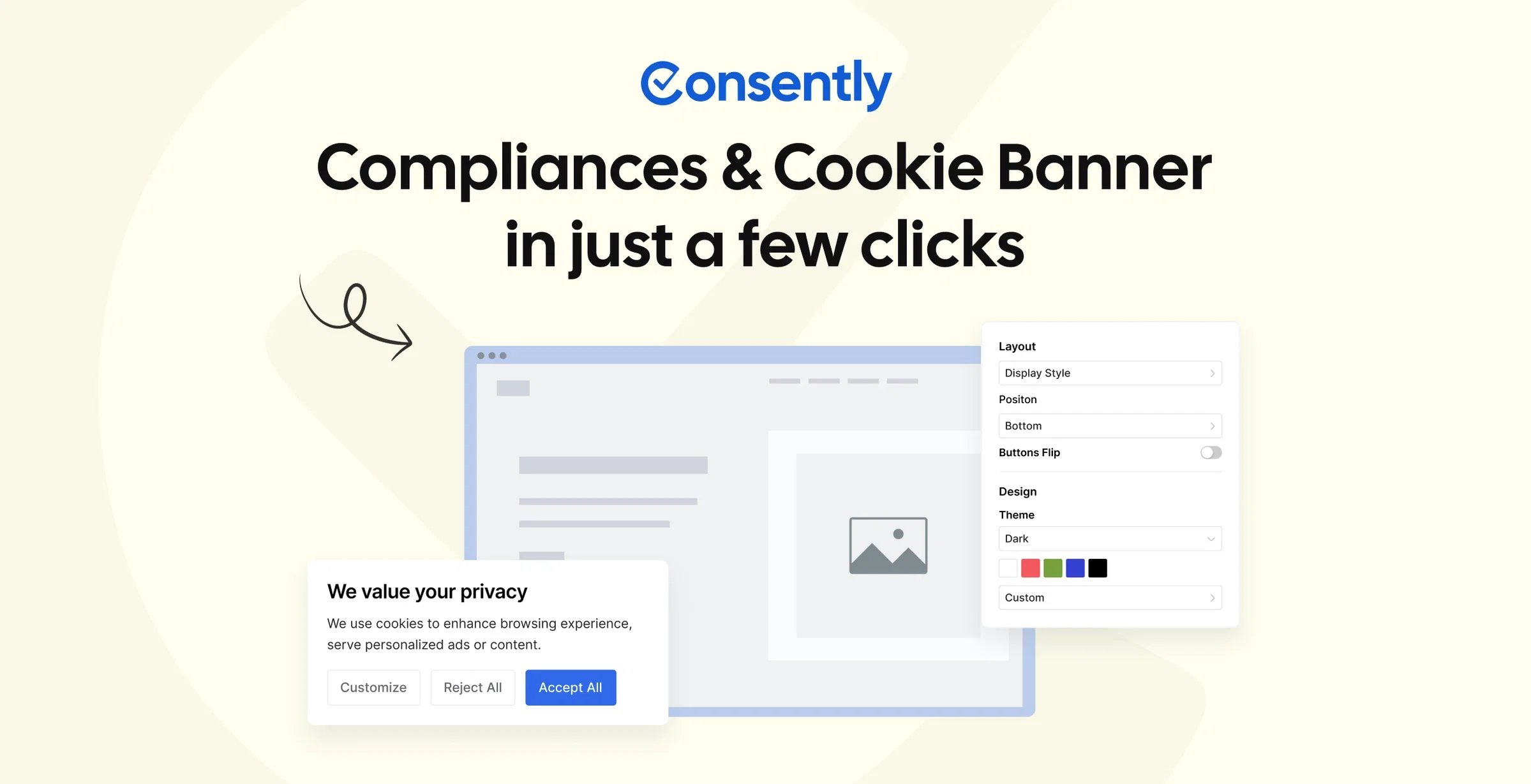
Consently scores 4.0 out of 5 globally and 3.7 on our publishers-fit score, last on this list. It is our own product, and we rank it here by the same publishers-fit method.
Consently has IAB TCF 2.3 and Google Consent Mode v2. It does not have the GPP, the MSPA, a certified partner listing, or the consent-rate depth that the ad-tech-native tools above bring.
If you run programmatic advertising at any meaningful scale, choose Sourcepoint, ConsentManager, Didomi, Usercentrics, or OneTrust instead. Consently is honestly the weakest publisher and ad-tech CMP on this list.
Why Consently Fits Small Publishers
Consently’s honest fit is a small content site or blog. The profile is a site that runs Google Consent Mode v2 and AdSense. It needs a banner, an automated cookie scanner, and privacy policies in one cheap tool, and it does not run a full TCF/GPP programmatic stack.
A small publisher on AdSense needs to pass Google Consent Mode v2 signals, declare its cookies, and present a compliant banner. Consently does all three, on every plan, with flat multi-domain pricing and no per-domain billing surprises.
Its scanner auto-blocks pre-consent cookies and scripts, including third-party ad pixels, without manual configuration. All three policy generators (cookie policy, privacy policy, and terms of service) are included on every plan.
Consider a publisher spending $199 a year on a subscription. At that price point, no other all-in-one tool includes the scanner, banner, consent logs, and all three policy generators. That is the niche Consently genuinely owns. It is breadth and price, not ad-tech depth.
Key Features
Consently bundles the consent essentials a small publisher needs into one flat-priced tool.
-
Cookie consent banner in four styles with deep visual customization, 35 languages, and WCAG 2.2 AA accessibility
-
Automated cookie scanner with pre-consent tag blocking (cookies, scripts, and iframes blocked before consent)
-
Consent logs and analytics, with consent-log and cookie-scan-result export
-
Three policy generators: cookie policy, privacy policy, and terms of service
-
Google Consent Mode v2 (basic and advanced) automatic integration, plus Additional Consent (AC) v2
-
IAB TCF 2.3 compliance on every plan
-
Official WordPress.org plugin (live and free), a native Shopify App Store app, plus one-line script, Google Tag Manager, and Cloudflare Zaraz install routes
-
EU hosting (Frankfurt: MongoDB Atlas, AWS, Upstash)
-
Live chat support on all plans
See every feature on every plan.
Best Use Cases for Publishers
Consently fits a few specific small-publisher scenarios.
-
A small ad-funded blog running Google Consent Mode v2 and AdSense that needs a compliant banner, a cookie scanner, and a published cookie policy in one tool for under $100 a year
-
A budget multi-site content operator with two to five domains that needs one consistent banner across properties without per-domain billing
-
A publisher that wants the banner, scanner, and all three policy generators in a single dashboard and does not run Prebid, Google Ad Manager, or a TCF/GPP programmatic ad stack
For publishers with ad-tech stack requirements beyond AdSense, see Consently for publishers to understand exactly where the product’s limits are.
Pros
Consently’s strengths center on all-in-one breadth at a flat price.
-
All-in-one package (banner, automated scanner, consent logs, scan-result export, three policy generators) at one flat annual price
-
IAB TCF 2.3 plus Google Consent Mode v2 plus AC v2 on every plan, including the entry tier ($99/yr)
-
Flat multi-domain pricing: five domains on the Premium tier costs $199/yr total, not $199/yr per domain
-
Official, free WordPress.org plugin, a native Shopify App Store app, plus one-line script, Google Tag Manager, and Cloudflare Zaraz install routes for fast setup
-
EU hosting and WCAG 2.2 AA compliance included at no extra cost
-
AppSumo reviewers describe the interface as “clean, easy to use” and say auto-scanning “saves me so much time”
Cons
The following are authentic current limitations. They are the main reason Consently ranks last on the publisher lens.
-
No IAB GPP or MSPA support. Consently supports IAB TCF 2.3 and Google Consent Mode v2, but not the IAB Global Privacy Platform (GPP) or the Multi-State Privacy Agreement (MSPA). A publisher running US-multistate programmatic partners who expect a GPP signal will find Consently insufficient.
-
Not a publisher or CTV ad-tech CMP. There is no native mobile SDK, no server-side consent option, no CTV or OTT support, no consent-rate A/B testing, and no consent paywall. Publishers with app inventory or CTV channels cannot use Consently for those surfaces.
-
Google CMP Partner listing is pending. Consently supports Consent Mode v2 and AC v2, but it is not yet on the Google-certified CMP partner list. Publishers required to use a certified CMP for EEA personalized ad serving should use a Gold-tier alternative until the listing is confirmed.
-
Maturing scanner. The scanner has improved significantly (roughly a 70 percent accuracy gain), but it is still maturing relative to Cookiebot’s 13,000+ entry database or Sourcepoint’s accuracy-verified scanning.
-
No permanently free tier. Consently offers a 14-day free trial with no credit card required, but there is no ongoing free plan.
For the full picture, read the full Consently review.
Pricing
Consently’s headline pricing is an annual subscription, with no overage charges and no auto-upgrade. Page views are shared across all domains on a plan.
-
Basic: $99/yr (1 domain, 100,000 page views/month)
-
Premium: $199/yr (5 domains, 1,000,000 page views/month, multi-site dashboard, priority support)
-
Enterprise: $499/yr (10 domains, 3,000,000 page views/month)
See Consently pricing for the full tier breakdown.
Start a free 14-day Consently trial, no card required. IAB TCF 2.3 and Google Consent Mode v2 ship on every plan, with flat multi-domain pricing and EU hosting.
What Users Say
Consently’s reviews are positive but the independent base is still young.
“Clean, easy to use, and the auto-scanning saves me so much time.” (AppSumo reviewer)
AppSumo aggregates 4.04 out of 5 across 28 reviews. Positive reviews highlight the clean interface and the auto-scanning time savings.
The independent review base is young, with near-zero organic presence on G2, Capterra, or Reddit, and no independent publisher or ad-tech review base yet. Treat the AppSumo aggregate as directionally positive but thin relative to established CMPs.
What Is the Best CMP for Publishers?
Sourcepoint is the best CMP for publishers running a full programmatic ad stack. It earns the top publishers-fit score of 4.4, with full IAB TCF 2.2 plus GPP, Google certification, market-leading CTV/OTT, and A/B plus consent-paywall optimization. For a self-serve alternative with a full review and a certified ad-tech stack, ConsentManager (publishers-fit 4.3) is the strongest option. It pairs built-in A/B and ML consent optimization with pricing that starts at EUR59/mo.
By publisher need:
-
EU-first publishers with CNIL requirements: Didomi (publishers-fit 4.3) for its TCF-first workflows and CNIL-grade granularity
-
Banner-as-revenue-lever optimization: Axeptio (publishers-fit 4.1) for Pay-or-Consent walls and documented 72 to 84 percent consent rates
-
Web, app, and CTV networks: Usercentrics (publishers-fit 4.1) for its integrated web, app, and TV CMP suite
-
Enterprise media groups with a full privacy program: OneTrust (publishers-fit 4.0) for TCF 2.2 plus GPP/MSPA plus governance
-
Free option for ad-monetizing publishers: InMobi CMP (publishers-fit 3.7), though with documented reliability concerns and a thin review base
Cookiebot holds the highest global score here (4.0) but sits mid-pack at publishers-fit 4.0, because it lacks native consent-rate optimization. Sourcepoint and Didomi are newly scored from public evidence and do not yet have full Consently reviews.
For small publishers with light ad-tech needs, Consently (publishers-fit 3.7) is the best budget all-in-one pick. Picture a content site running Google Consent Mode v2 and AdSense, with no TCF/GPP programmatic stack.
It wants a banner, scanner, and policies in one cheap tool, and Consently covers those compliance needs cleanly. To start, see the Consently section above for the trial. For the broader CMP market beyond publishers, see the best cookie consent tools roundup.
FAQs
What is the best CMP for a publisher running programmatic ads?
Sourcepoint tops our publishers-fit ranking at 4.4. It pairs full IAB TCF 2.2 plus GPP with Google certification, CTV/OTT support, and a consent-rate A/B plus paywall engine. For a self-serve tier with the same TCF and GPP certification, ConsentManager (publishers-fit 4.3) is the best pick with a full Consently review. It starts at EUR59/mo for TCF plus A/B features.
Which consent management platforms support IAB TCF and GPP?
Sourcepoint, ConsentManager, Didomi, Usercentrics, and OneTrust all support IAB TCF plus the GPP, and OneTrust adds the MSPA. Axeptio supports TCF v2.3, though its GPP documentation is limited. Cookiebot supports TCF, with GPP sitting at the Usercentrics group level. Consently supports IAB TCF 2.3 and Google Consent Mode v2, but does not support the GPP or the MSPA.
Do publishers have to use a Google-certified CMP?
Yes, if they serve personalized ads in the EEA, UK, or Switzerland through Google AdSense, Ad Manager, or AdMob. Google requires a certified CMP integrated with IAB TCF. Most tools on this list are Gold-tier, while Osano and Ketch are Silver and Sourcepoint is Bronze. Consently’s listing is still pending, so publishers with this requirement should use a certified alternative until it is confirmed.
What is the best free CMP for publishers?
InMobi CMP (formerly Quantcast Choice) is the strongest free option, with IAB TCF v2.3 and Google CMP standards. Its independent review base is weak, though (rfp.wiki 2.4 out of 5). ConsentManager, Usercentrics, and Cookiebot all offer free tiers, but those tiers have tight traffic or feature limits for live publisher traffic.
Does Consently work for publishers and ad-tech?
For light ad-tech, yes. Consently supports IAB TCF 2.3 and Google Consent Mode v2. You get a banner, automated scanner, and three policy generators from $59 one-time (or $99/yr). For programmatic ad-tech, no: it lacks the GPP, the MSPA, CTV/OTT support, and consent-rate A/B testing. A publisher running a programmatic ad stack or requiring a Google-certified CMP should choose ConsentManager, Sourcepoint, Usercentrics, or another certified tool ranked above Consently.
What is the MSPA, and which CMPs support it?
The MSPA (Multi-State Privacy Agreement) is the IAB’s US-state framework for signaling consent compliance across CCPA-style privacy laws in California, Virginia, Colorado, and other states. It lets publishers certify a single US-multistate signal to ad-tech partners rather than managing each state law separately. OneTrust and Sourcepoint are the clearest MSPA supporters here. Budget CMPs, including Consently, do not support the MSPA.
Can a CMP improve ad revenue and consent rates?
Yes. A higher opt-in rate means more addressable impressions and more addressable CPM. Sourcepoint, ConsentManager, and Axeptio offer A/B testing or a consent paywall (Pay-or-Consent) specifically to optimize consent rates. Axeptio cites documented case-study consent rates of 72 to 84 percent with its conversational banner. Sourcepoint’s experimentation engine is the most mature here, designed for large-publisher consent-rate testing programs.