Axeptio is best for EU brands and publishers that treat the cookie banner as a conversion lever. It offers the most polished consent UX on the market, with case-study consent rates of 72% to 84%.
Skip it if you run several sites on a budget, since every self-serve tier covers one domain. Paid plans start at $29 a month, with no usable free tier above 200 visitors.
Verdict: the best-designed CMP you can buy, and an expensive fit for multi-site owners. Below are Axeptio’s features, pricing, genuine pros and cons, and who should and should not use it.
Axeptio Review Scorecard
Axeptio scores 4.0 out of 5 overall. It is the highest-design CMP in its class, with case-study consent rates of 72% to 84%, per TermsFeed’s May 2026 review. The score is held back almost entirely by pricing, since every self-serve tier covers one domain. The verdict by dimension is below.
| Dimension | Score |
|---|---|
| Compliance and framework coverage | 4.5/5 |
| Cookie scanning and auto-blocking | 4.0/5 |
| Banner and consent experience | 4.5/5 |
| Ease of setup and integrations | 4.0/5 |
| Pricing and value | 2.5/5 |
| Performance and reliability | 4.0/5 |
| Support and reputation | 4.5/5 |
| Overall | 4.0/5 |
Verdict: the best-designed CMP for EU brands and publishers, held back by per-domain pricing that punishes multi-site owners.
How we score: we rate every consent platform across seven weighted dimensions. The evidence is the live pricing page, certification records, a page-speed test of the live banner, and verified user reviews. See our full methodology.
Disclosure: this review is written by the Consently team. Consently runs a consent platform that competes with Axeptio and is scored by this same method. The Consently alternative is kept to one clearly separated section at the end.
What Is Axeptio?

Axeptio is a French consent management platform, founded in 2018 in Montpellier. It reframes cookie consent as a branded, opt-in-optimizing experience. It handles web consent through a customizable conversational banner, native iOS and Android SDKs, and the free Shake tracker scanner. It also adds publisher ad-tech consent through IAB TCF.
Its tagline, “from compliance to conversion,” captures the whole thesis. The banner is the first thing every visitor sees, so Axeptio treats it as a conversion lever to raise opt-in rates. The product spans web consent, mobile app consent, a Terms acceptance module, and Shake, all run from one back office.
It is certified as a GOLD member of Google’s CMP Partner Program. Axeptio’s own site states a brand-stated install base of 80,000 to 200,000 equipped websites and 10 billion to 20 billion proofs of consent. The lower figure is the more recent third-party-cited one.
Either way, the customer roster skews European: Opera national de Paris, TUI, Trenitalia, BRP, FIBA, Veepee, Mistral AI, and Richard Mille all appear as logos.
The company is also actively expanding. Per TermsFeed’s May 2026 review, Axeptio acquired AdOpt in Brazil in February 2025 and CookieCode in the Netherlands in July 2025. It opened a Montreal subsidiary and earned ISO 27001 version 2022 certification in January 2026.
It then won the Tech Prize at the March 2026 CFNEWS Growth Awards. The momentum matters to a buyer: it signals that a vendor is investing in new markets and certifications rather than coasting.
Who Axeptio Is For
Axeptio fits a specific buyer well. You are a strong candidate if you match one of these four profiles.
-
EU brands and marketing teams that treat the consent banner as a brand and conversion touchpoint, common in travel, retail, sport, culture, and media.
-
Publishers monetizing ad inventory who need IAB TCF v2.3, Pay-or-Consent walls, and cross-domain consent across a site network.
-
Mobile-app owners who need a native consent SDK for iOS and Android, rather than a web-only banner.
-
SMBs and agencies in France and the wider EU who value a French-built product and responsive French-speaking support.
Who Axeptio Is Not For
The fit breaks down clearly in four cases, each documented rather than guessed.
-
Teams running several domains on a tight budget: Every self-serve tier covers a single domain, so multi-site coverage forces a “Contact Sales” quote.
-
Anyone who needs cookie, privacy, or terms policies generated: Axeptio’s Terms module logs acceptance of documents you supply; it does not write the legal text.
-
Anyone who wants A/B testing, API access, or the mobile SDK: without committing to an Enterprise or Agency contract, because those features are gated to the quote-based tiers.
-
US and English-market-first buyers: who want in-depth English documentation and live chat, since Axeptio’s product depth and support skew French.
What Are Axeptio’s Key Features?
Axeptio’s core capabilities are a customizable conversational cookie banner, the Shake cookie scanner, consent analytics and logging, and native iOS and Android SDKs. It also covers Google Consent Mode v2, IAB TCF v2.3, and a Terms acceptance module. Several sit behind higher tiers.
What separates a review from a feature list is judging how well each capability works and where its limits are. The sections below evaluate the six that matter most to the typical buyer.
Cookie Consent Banner and Consent UX
The banner is the real product, and it is genuinely differentiated. Axeptio builds consent as a conversational, immersive experience. You can add a hero video, swap in illustrations or “cookie characters,” set light or dark themes, and rewrite the copy to match your brand.
A Consent Wall format and a “Continue Without Consent” option round out the UX controls. The design craft here is Axeptio's strongest asset, and it powers its opt-in optimization story. There is a catch. A/B testing, the tool that would let you optimize that banner, is reserved for the Enterprise and Agency tiers. The conversion-tuning narrative applies only once you reach quote-based pricing.
Cookie Scanning with Shake
Shake is Axeptio’s free cookie and tracker audit. It detects active cookies and trackers and identifies the vendors against a catalog of over 1,500. It checks whether each fires before or after consent and verifies your Google Consent Mode v2 setup.
It then returns a multi-regulation PDF covering GDPR, Law 25, PIPEDA, GPC, and CCPA in roughly five minutes. Inside a paid plan, the scanner runs on a quota: five scans a month on Small, thirty schedulable scans on Medium and Large.
Shake lowers the hardest part of the CMP setup, which is finding everything that needs consent. The monthly scan caps are worth noting if you manage a fast-changing site.
Consent Analytics and Logging
Axeptio stores consent on every plan, including Free. It surfaces interaction rate, consent rate, and opt-in rate through a centralized dashboard that marketing, legal, and technical roles can share.
It connects to eight analytics tools: GA4, Google Tag Manager, Piano, Amplitude, Matomo, Plausible, Fathom, and Beyable. The honest limitation is depth. Some G2 reviewers note that the analytics “could be improved,” citing a lack of consent rates for specific cookies. If per-cookie reporting is central to your workflow, test it before committing.
Mobile SDK for iOS and Android
This is a real strength, and one many CMPs lack. Axeptio ships native mobile SDKs: iOS in Swift, Android in Kotlin, and under 2MB, so they do not slow app startup. It covers over 2,000 trackers, auto-translates into 25 languages, and offers offline sync that stores consent locally and syncs when connectivity returns.
If your product is a mobile app that must collect consent natively, this is a credible, well-built option. The one constraint is commercial, not technical. The SDK is packaged with the Enterprise and Agency tiers and priced based on monthly active users, so it is not available on the self-serve plans.
Google Consent Mode v2 and IAB TCF
Axeptio is a GOLD member of Google’s CMP Partner Program. It supports Google Consent Mode v2 in basic and advanced modes through a single switch, sending the four required signals to Google in real time. For publishers, it offers full IAB TCF support, Pay-or-Consent, and cross-domain consent across a site network.
Its TCF registration is CMP ID #260 and is certified by both IAB Europe and IAB Canada. A July 2025 partnership with Stape adds server-side script loading, which serves the banner first-party to bypass ad blockers and Safari’s tracking prevention.
One transparency note: marketing pages and TermsFeed cite TCF v2.3, while the WordPress plugin listing and help center still reference v2.2. Confirm the live version if a specific TCF release matters to your ad stack. The publisher and ad-tech depth here is real and is a genuine reason media buyers choose Axeptio.
Terms, Integrations, and What Axeptio Does Not Generate
Axeptio’s Terms module displays contractual documents (terms of service, a privacy policy, a DPA, legal notices) in a branded widget. It captures time-stamped, versioned acceptance as audit evidence.
It is important to be precise about scope: Terms logs acceptance of documents you provide and does not generate the legal text itself. No policy generator of any kind appears anywhere on Axeptio’s site. On integrations, Axeptio is broad, with native CMS routes for WordPress, Shopify, PrestaShop, Magento, Drupal, Webflow, Wix, Bubble, and WooCommerce.
The policy-generation gap is the single most important scope limit to understand before buying. It returns in the cons and in the alternative section below.
How Easy Is Axeptio to Use?
Getting from signup to a live banner takes about five steps and 15 to 30 minutes for a basic setup. Axeptio is genuinely no-code and polished for that first banner. A learning curve appears once you configure multiple languages, Google Consent Mode, or advanced features.
The detail below is drawn from Axeptio’s own first-setup documentation and current help center, cross-checked against its integration guides. Every step count and timing reflects what the setup actually involves.
Getting Started: From Signup to a Live Banner
Axeptio’s own first-setup documentation lays out the path in five steps, and the help center says the same. The documented time-to-live for a basic configuration is roughly 15-30 minutes. The only prerequisites are an account and a ready domain.
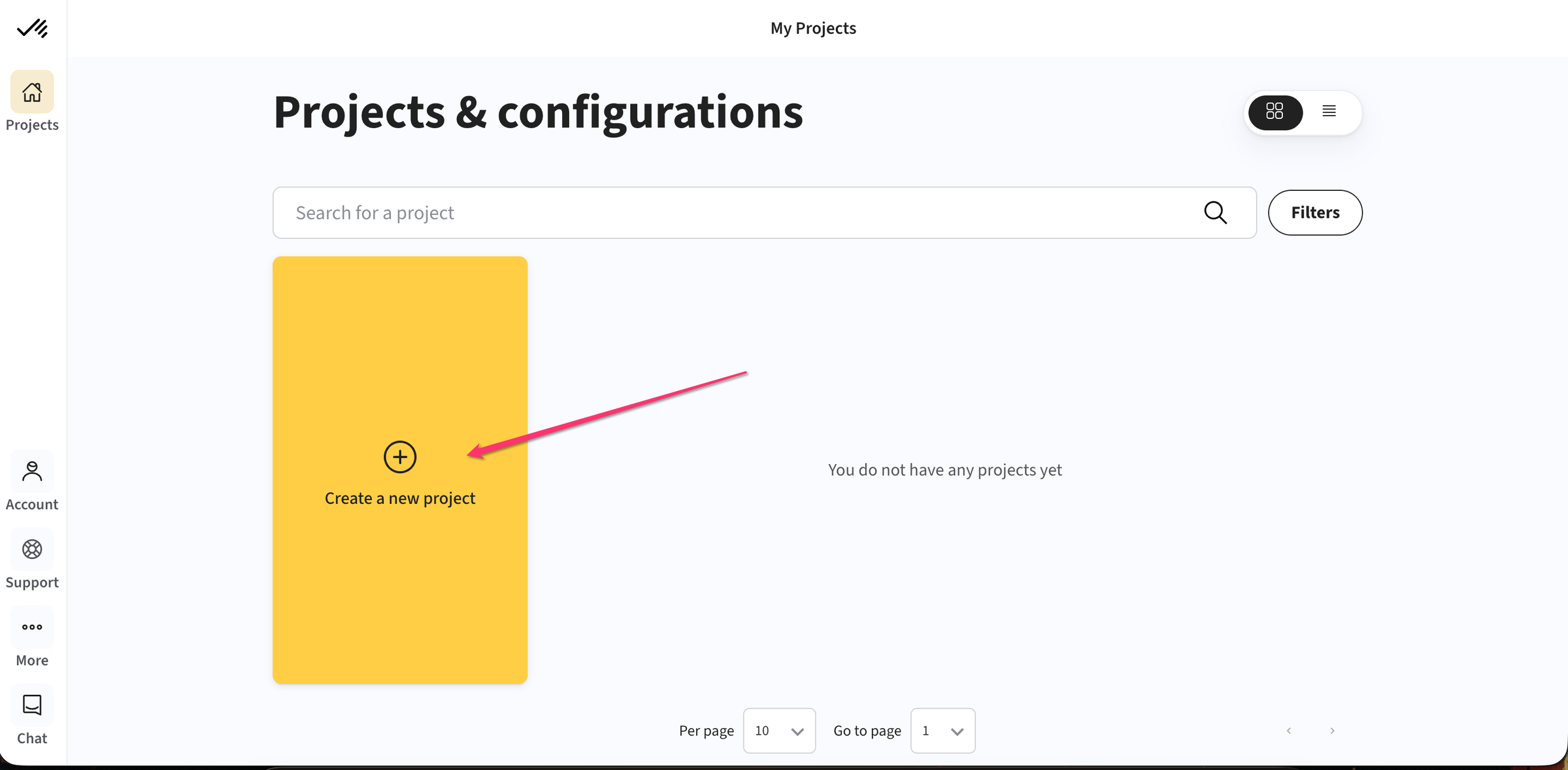
1. Create a project: in the Axeptio dashboard and receive your Project ID.
2. Choose a banner type: (Brands, Publishers, DPO, Terms etc).
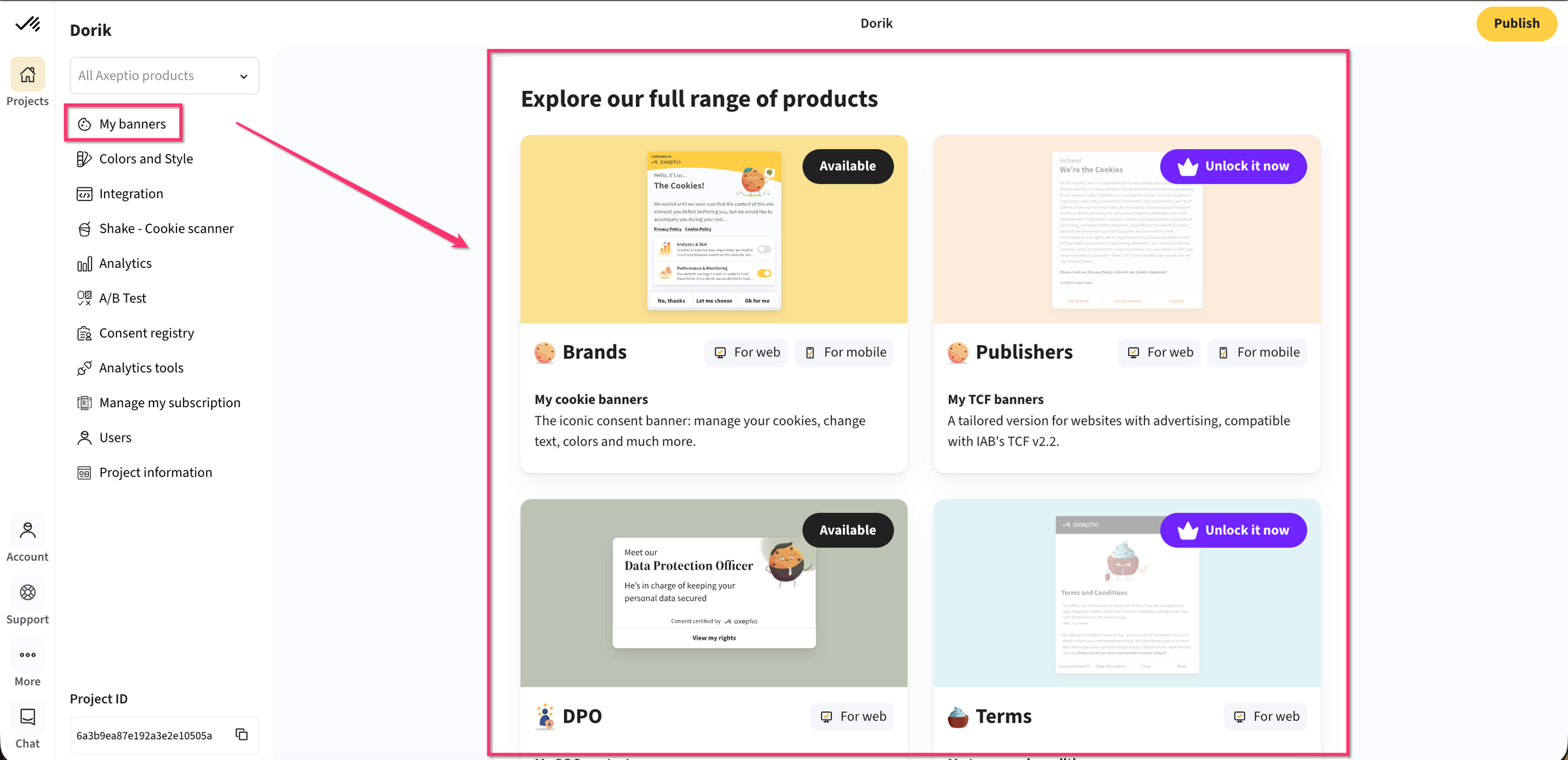
3. Brand the banner: upload your logo, pick a light or dark theme, and add illustrations or a hero video.
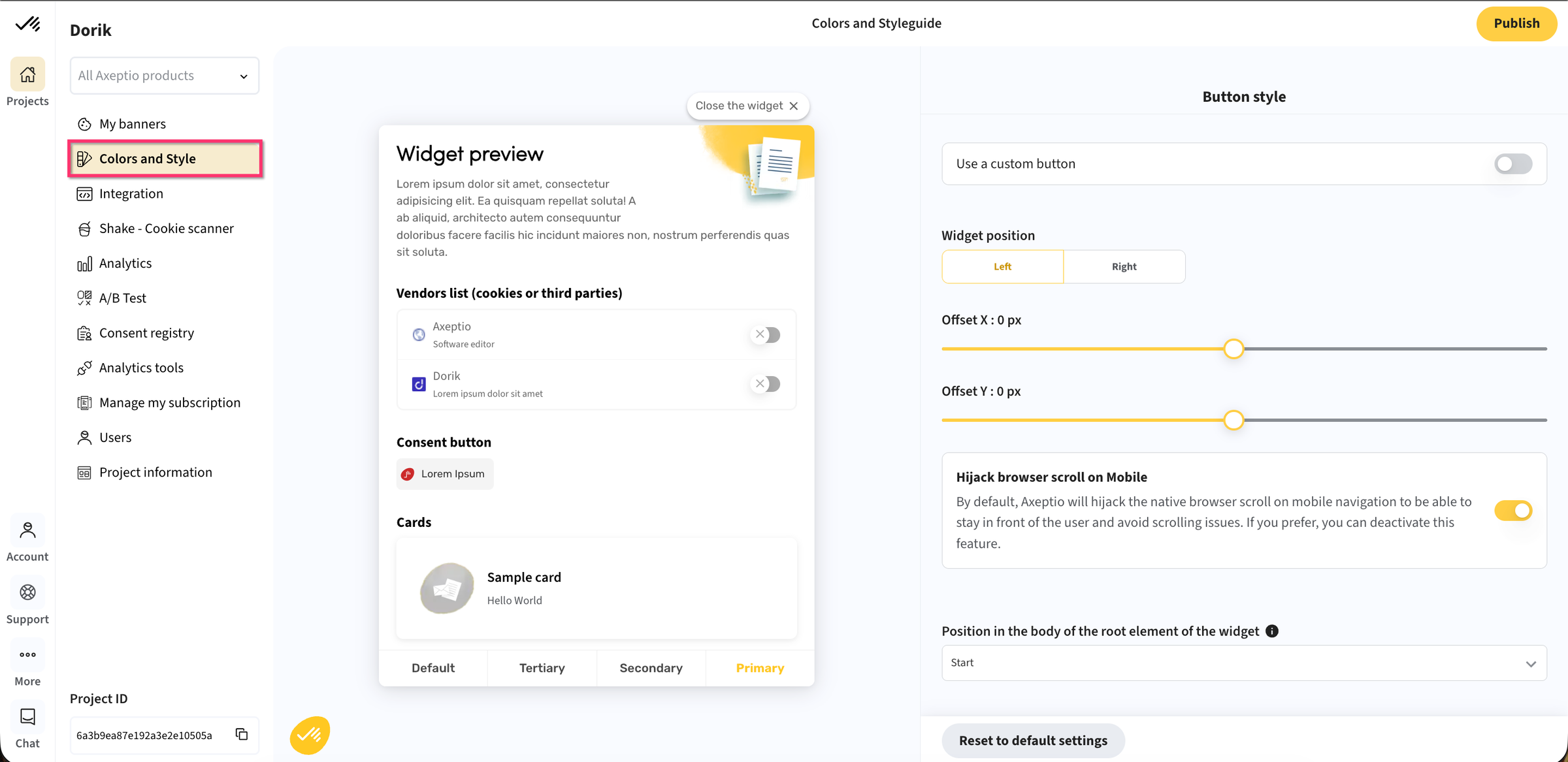
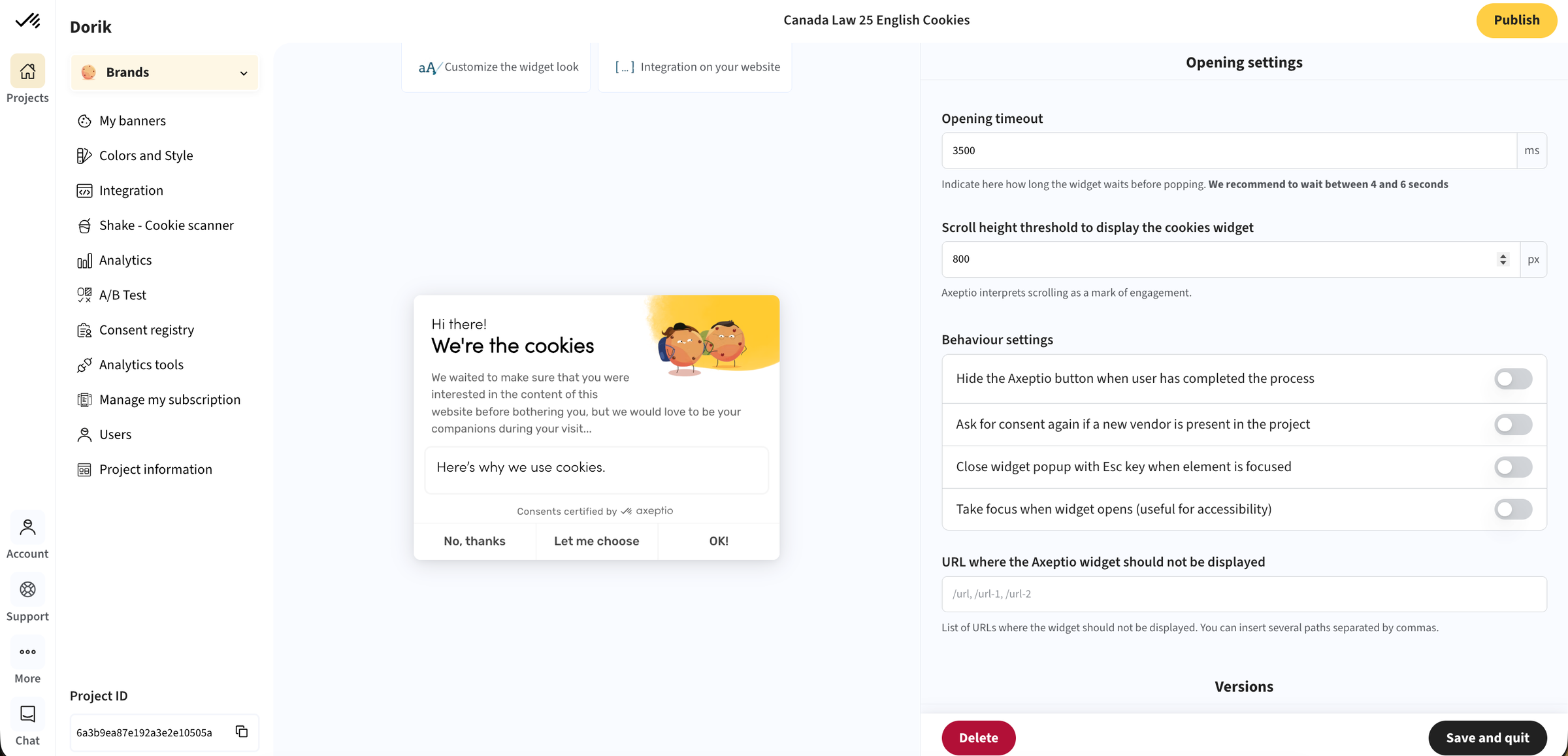
4. Customize the banner: edit the copy, set cookie category labels, and configure the preference center.
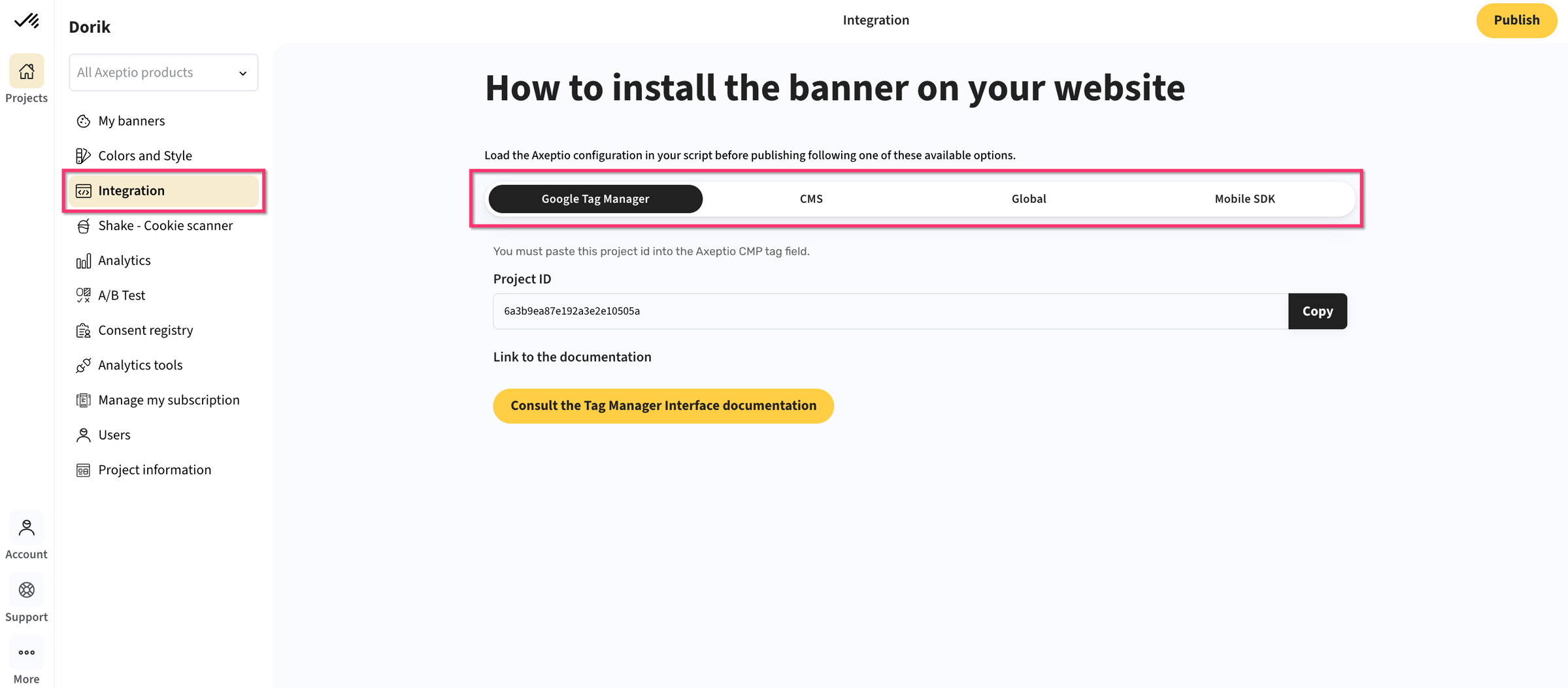
5. Integrate the banner: paste your Project ID into the GTM template, activate the WordPress plugin, or embed the script in your page head.
The interface backs this up. Axeptio’s admin uses a left-sidebar navigation with card layouts and drag-and-drop cookie management. The customization surface (text, colors, light or dark, logo or illustrations, hero video) is extensive without forcing you into code.
That matches the experience reviewers report: one Capterra reviewer called it “easy to integrate and set up on our Shopify eshop… a practical solution for maintaining GDPR compliance.” For a single, straightforward banner, the no-code path is real.
How Axeptio Compares for Everyday Tasks
For installation, it helps to look at the documented flow for one common task: deploying a banner through Google Tag Manager. Axeptio’s GTM path is create the project, paste the Project ID into the GTM template, deploy the tag, configure the blocking logic, then test.
That is four to five steps and roughly 15 to 20 minutes, and it does assume working GTM knowledge. By comparison, a direct-embed CMP using a copy-paste script into the page head documents a five-step flow under ten minutes with no GTM knowledge.
The difference is modest, not dramatic. Axeptio’s GTM route is more robust for complex tag setups, and its one-click WordPress plugin is the fastest path for a basic install.
Where the curve gets steeper is everything past the first banner. Reviewers consistently describe a learning period when configuring multi-language banners, Consent Mode, or advanced settings. One G2 reviewer captured the pattern well.
They praised the “simple integration via Google Tag Manager,” then noted “a learning curve at the beginning” that fades once you push past it. That is the honest read: easy to start, more demanding to master.
How Much Does Axeptio Cost?
Axeptio runs from a Free plan at $0 to a Large plan at $129 per month, with each self-serve tier covering one domain. Paid tiers have hard pageview ceilings, so a spike forces a tier upgrade. Multi-domain needs a “Contact Sales” quote, and A/B testing and the Mobile SDK are Enterprise-only.
The table below reflects Axeptio’s pricing page, verified on 2026-06-23.
| Plan | Monthly (per domain) | Annual | Pageviews/month (hard ceiling) | Domains | Notable inclusions and gating |
|---|---|---|---|---|---|
| Free | $0 | $0 | 200 visitors | 1 | Consent storage, Consent Mode v2; no scanner, no TCF, no stats |
| Small | $29 | $313 | 5,000 | 1 | Adds IAB TCF, Multilingual, basic stats, scanner (5/mo), ticketing |
| Medium | $69 | $745 | 100,000 | 1 | “Most Popular”; adds analytics connectors, Consent Wall, scanner (30/mo) |
| Large | $129 | $1,393 | 500,000 | 1 + subdomains | Adds full Consent Wall, Cookie List, standard stats |
| Enterprise / Agency | Contact Sales | Contact Sales | Custom | Unlimited | A/B testing, API access, Mobile SDK, advanced analytics, dedicated CSM |
Annual billing carries roughly a 10% discount, and Enterprise and Agency are quote-only with unlimited domains.
Axeptio Free Plan
The Free plan is permanent but built as a sampler, not a working tier. It covers up to 200 visitors a month on one domain and includes consent storage and Google Consent Mode v2. It excludes the cookie scanner, IAB TCF, statistics, and ticketing support. It also behaves like a limited trial.
Per the CookieScript comparison, the free plan shows “persistent pop-ups” and does not reliably save user preferences. For a tiny single-page site that just needs a banner, it can work. For anything you actually run, the free tier is a preview, not a destination.
The Multi-Domain Cost Trap
This is the sharpest pricing reality to understand. Every self-serve tier, Small through Large, covers exactly one domain. A second site means a second subscription or an Enterprise “Contact Sales” quote. The CookieScript comparison puts it bluntly: “even its cheapest plan costs EUR29/month/domain.” The math compounds fast.
Five sites on self-serve is not a single $129 plan. It is five separate subscriptions at the $29 Small minimum, which is $145 a month, or roughly $1,740 a year. For a freelancer or agency carrying a portfolio of client sites, per-domain pricing is the line item that grows fastest.
Is Axeptio Pricing Worth It?
For a single domain, Axeptio’s entry pricing is mid-market for the category and premium for a budget buyer. Enzuzo summarizes it as “Axeptio’s pricing might be a bit steep for small businesses.” Two structural traits sharpen that.
First, the hard pageview ceiling means a traffic spike jumps you a whole tier rather than charging a small overage. Cross from 80,000 to 120,000 monthly pageviews, and you move from Small to Medium, $29 to $69 a month.
Second, billing trust is a recurring complaint. French reviewers report “les tarifs ont beaucoup augmente” (the prices have risen a lot). TermsFeed’s May 2026 review notes “limited commercial flexibility on pricing negotiations” and price increases.
The design quality can justify the spend for the right buyer. The pricing structure is where cost-sensitive and multi-site buyers feel the pressure.
What Are the Pros of Axeptio?
Axeptio’s strongest assets are a design-led consent UX, responsive support, and real publisher and mobile depth. Case studies document consent rates of 72% to 84%, and support is the attribute reviewers praise most. The ad-tech depth runs through IAB TCF v2.3, a native SDK, and GOLD Google CMP Partner status.
The five pros below are specific and evidenced rather than generic.
-
A design-led consent UX with documented opt-in gains: The conversational banner with video, illustrations, and the Consent Wall is the real differentiator. Customer case studies put consent rates at 72% (Gites de France Corsica) to around 80% (Speedway). TermsFeed’s May 2026 review reports case-study rates up to 84%. That is the headline reason brands choose it.
-
Responsive, attentive support: This is the single most-praised attribute. G2 reviewers describe Axeptio’s people as “incredibly attentive, supportive, and responsive,” and French reviews cite replies in under four hours. TermsFeed notes support is praised across Capterra, G2, and GetApp.
-
Real publisher and ad-tech depth: IAB TCF v2.3 across Europe and Canada (CMP ID #260), Pay-or-Consent, cross-domain consent, GOLD CMP Partner status, and a catalog of over 1,500 vendors make Axeptio a credible publisher CMP, not just an SMB banner.
-
A genuine native mobile SDK: Native Swift and Kotlin SDKs, under 2MB, covering 2,000-plus trackers with 25-language translation and offline sync, are a capability many competing CMPs simply do not offer.
-
A genuinely light banner script: I ran Lighthouse against Axeptio’s own banner on 2026-06-23 and measured a total blocking time of just 7 milliseconds and a largest contentful paint of 771 milliseconds. That backs the “lightest on the market” claim and the G2-reported “minimal impact on performance,” alongside ISO 27001 version 2022 and marquee European logos.
What Are the Cons of Axeptio?
Axeptio’s main limitations cluster around pricing and scope. The big ones are per-domain pricing, no policy generators, and core features locked behind higher tiers. Add a forced banner logo on low tiers and reported price increases. Together they shape who Axeptio suits rather than ruling it out.
The six cons below each trace to documented behavior or recurring user feedback.
-
Per-domain pricing with no flat multi-domain self-serve plan: A second site needs a second subscription or a “Contact Sales” quote, so a five-site portfolio runs about $145 a month on self-serve ($29 each) rather than one plan. Multi-site costs balloon faster than the per-domain headline suggests.
-
No policy generators of any kind: The Terms module logs acceptance of documents you supply, but does not generate cookie, privacy, or terms text. If you need the documents written, Axeptio expects you to bring or buy them elsewhere.
-
Core features are tier-gated: IAB TCF and Multilingual become available at Small, but A/B testing, API access, Microsoft UET Consent Mode, and the Mobile SDK are reserved for Enterprise and Agency. The conversion-optimization story depends on A/B testing, which you cannot access on self-serve.
-
A forced Axeptio logo on lower tiers: On the cheaper plans, I could not remove Axeptio’s branding from the banner without upgrading, a point G2 reviewers raise repeatedly: “the requirement to display Axeptio’s logo on the cookie banner is a downside.”
-
Price increases since 2021, plus traffic-driven tier jumps: TermsFeed’s May 2026 review reports “significant price increases since 2021,” and French reviewers cite the same (“les tarifs ont beaucoup augmente”). Because each tier has a hard pageview ceiling, a traffic spike forces a tier upgrade rather than a small overage. There is no seasonal or traffic-based billing to flex with demand.
-
A jump from free straight to $29, with no middle tier: Nothing sits between the 200-visitor free plan and the $29 Small plan, so a growing site has no gentle on-ramp. TermsFeed flags this same gap.
-
A trial-like free tier, a French-skewed experience, and a learning curve: The free plan does not reliably save preferences, support is ticketing rather than live chat, and documentation depth skews French. Some reviewers also call the docs “difficult to navigate,” especially for advanced Google Tag Manager setups. That reads as a minority view on the UI itself.
What Do Users Say About Axeptio?
Axeptio is positive-leaning across review platforms, holding roughly 4.7 to 4.9 stars on G2, Capterra, GetApp, and Trustpilot. A consistent minority complains about per-domain cost, the forced logo, and price increases. French reviews are more numerous and more positive than the sparse US ones.
By the numbers, verified on 2026-06-23: G2 shows 4.7/5 from 122 reviews, and Capterra shows 4.9/5 from 61 reviews. GetApp averages 4.9/5 across 61 ratings, and Trustpilot averages 4.7/5 across 292 ratings.
Most-praised: design flexibility, ease of setup, and support responsiveness.
Most-criticized: per-domain pricing, the forced logo, and billing communication. One honest nuance: support inside the product is rated fast. Trustpilot, though, notes the company “typically takes over 1 month to reply” to public reviews.
A representative spread of voices:
“Easy to integrate and set up on our Shopify eshop… a practical solution for maintaining GDPR compliance. Reactive support team.”
“The interface is pleasant, implementation is fast, and the fact that it’s a French company reassured me immediately.”
“Compatible with Google’s Consent Mode… simple integration via Google Tag Manager. There is a learning curve at the beginning, but once passed, it is effective.”
“The requirement to display Axeptio’s logo on the cookie banner is a downside.”
the free plan “does not always save user preferences properly,” with “persistent pop-ups.”
Is Axeptio Worth It?
Axeptio is worth it for EU brands optimizing consent-rate UX and for publishers monetizing ad inventory. It is not worth it for budget-conscious multi-site owners, anyone needing policy generation, or US and English-first buyers who want live chat. The quality is high; the fit depends on your situation.
Choose Axeptio in these cases:
-
You are an EU brand that treats the banner as a conversion lever and wants design-led, opt-in-optimizing UX.
-
You are a publisher needing IAB TCF v2.3, Pay-or-Consent, and cross-domain consent.
-
You need a native mobile-app consent SDK for iOS and Android.
-
You value responsive, French-speaking support and EU institutional credibility.
Look elsewhere in these cases:
-
You manage several domains and per-domain pricing compounds. In that case, it is worth weighing the best Axeptio alternatives before committing.
-
You need cookie, privacy, or terms policies generated inside the tool, not just acceptance logged.
-
You want A/B testing or the mobile SDK without an Enterprise contract.
-
You are US or English-market-first and want deep English documentation and live chat.
On balance, Axeptio remains one of the strongest options for design-focused EU teams and publishers who treat consent as part of the brand.
Teams prioritizing predictable multi-site pricing, bundled policy documents, or English-first support should evaluate alternatives. Our roundup of the best consent management platforms, compared, is a useful next step for understanding where it sits in the field.
Considering an Alternative to Axeptio?
Axeptio’s per-domain pricing, tier-gated features, or the lack of policy generators may be your sticking points. Consently answers those three gaps directly. It offers flat multi-domain pricing with no sales quote and every feature on every plan. It also bundles three policy generators, including Terms and Conditions, plus live chat on all plans.
Axeptio charges per domain and sends multi-site buyers to a quote. Consently uses flat bundling instead: five domains for $199 a year, ten for $499, and an entry Basic plan at $99.
Axeptio also gates IAB TCF and Multilingual to paid tiers, A/B testing, and the mobile SDK to Enterprise. Consently includes IAB TCF, Google Consent Mode v2, weekly scanning, region-based consent, and all three policy generators on every plan. And where Axeptio’s Terms module only logs acceptance, Consently generates your cookie, privacy, and terms documents.
To stay honest, Axeptio is genuinely stronger than Consently in several areas. Those are its design-led consent UX with proven opt-in lift, its native mobile SDK, its IAB TCF and publisher depth, and its EU brand credibility.
Consently has no native mobile SDK, no A/B testing, and no GPC support, and its Google CMP Partner listing is still pending rather than GOLD. If those Axeptio strengths are what you are buying for, Axeptio is the better tool.
For the full side-by-side, see the Consently vs Axeptio breakdown, or check the flat plans on Consently’s pricing page. If multi-site coverage and bundled policies are your priority, start a free Consently trial, 14 days with no credit card required.
FAQs
Is Axeptio free?
Yes, Axeptio has a free plan that covers 200 visitors per month on one domain. It behaves like a limited trial, since it does not reliably save preferences and excludes the scanner, IAB TCF, and statistics. Paid plans start at $29 per domain per month.
Is Axeptio better than CookieYes?
It depends on your priority. Axeptio leads on design-led consent UX, opt-in optimization, and EU and publisher credibility, while CookieYes leads on WordPress install base and entry-level simplicity. Both price per domain, so neither solves multi-site cost on its own.
Does Axeptio generate my privacy and cookie policies?
No. Axeptio’s Terms module logs acceptance of documents you supply but does not generate cookie, privacy, or terms text. To create those documents you need a separate policy tool or an all-in-one CMP that bundles policy generators alongside consent.
Is Axeptio good for agencies and multiple websites?
It can be, but every self-serve tier covers one domain, so multi-site costs compound and full multi-domain coverage requires a “Contact Sales” quote. Flat multi-domain alternatives are usually cheaper once you manage more than two or three client sites.
Is Axeptio easy to use for beginners?
Mostly yes for a basic setup. Axeptio documents about five steps to a live banner in 15 to 30 minutes with no code. A learning curve appears when you configure multiple languages, Google Consent Mode, or advanced features, which reviewers note consistently.
What are the best alternatives to Axeptio?
The strongest alternatives depend on what you need. Consider CookieYes and Cookiebot for budget WordPress sites, iubenda for bundled policy generators, CookieScript for low per-domain cost, and Enzuzo for flat multi-domain pricing. The full alternatives roundup linked above compares each in detail.