OneTrust is the best enterprise consent management platform in 2026, scoring 4.2 on our enterprise-fit evaluation. Its global CMP score (3.6) is the lowest on this list. That gap is intentional: enterprise buyers need DSAR automation, governance tools, ISO 27001 and SOC 2 certifications, and enterprise SSO. OneTrust leads on every one of those criteria.
We scored 10 platforms by re-weighting our methodology for enterprise buyers, adding DSAR and GRC capability and security certifications as decisive factors.
Below: a score-ranked quick list, a comparison table, and a scored section per platform.
Disclosure: Consently publishes this guide and appears at rank 10 of 10 by its enterprise-fit score of 3.0.
What Are the Best Enterprise Consent Management Platforms?
The best enterprise consent management platforms in 2026 are OneTrust (enterprise-fit 4.2), Ketch (4.2), and TrustArc (4.0). All three clear the decisive gate. Each scores at least 3.0 on DSAR and privacy-suite breadth, the non-negotiable capability that separates an enterprise governance tool from a cookie banner.
-
OneTrust: Best overall enterprise CMP for full privacy and governance (enterprise-fit 4.2)
-
Ketch: Best for engineering-led teams enforcing consent where data flows (enterprise-fit 4.2)
-
TrustArc: Best for a mature governance, DSR, and assessments program (enterprise-fit 4.0)
-
Osano: Best for mid-market teams scaling into a full privacy program (enterprise-fit 4.0)
-
Secure Privacy: Best for audit-grade, SOC 2-backed certified consent (enterprise-fit 4.0)
-
Didomi: Best for global, multi-brand consent and preference management at scale (enterprise-fit 3.9)
-
Cookiebot: Best for ISO-certified automated scanning at enterprise scale (enterprise-fit 3.9)
-
ConsentManager: Best for ad-tech and publisher consent with TCF depth (enterprise-fit 3.6)
-
Usercentrics: Best for marketing-led consent with a dedicated customer success manager (enterprise-fit 3.6)
-
Consently: Best for cost-conscious SMBs and agencies, not enterprise governance (enterprise-fit 3.0)
We re-weight our seven standard scores for what an enterprise buyer relies on, with compliance and scanning weighted heaviest. We then add two enterprise-decisive factors scored from documented facts: DSAR and privacy-suite breadth, and ISO 27001/SOC 2 plus SSO. That is why the enterprise-fit ranking differs from our global overall scores. See how we score consent platforms for the full weights and evidence procedure.
What Is an Enterprise CMP, and How Is It Different from a Cookie Banner?
An enterprise consent management platform is a consent tool built for large, regulated organizations that need more than a banner. On top of the core cookie-consent layer, it adds four capability groups. Those are data subject access request (DSAR) automation, governance modules (RoPA, data mapping, vendor risk), ISO 27001 or SOC 2 certification, and enterprise SSO/SAML. It also extends consent across web, mobile, and CTV.
A standard consent management platform handles the legal basics: show a banner, record consent, block scripts before consent fires. An enterprise CMP does that plus automates the downstream compliance obligations that follow from consent. Those obligations include rights requests, audit records, and cross-border data-flow controls. For a broader primer on what consent management is at the category level, that page covers the fundamentals.
What Should Enterprises Look for in a Consent Management Platform?
Five criteria separate enterprise-fit CMPs from banner tools. They are DSAR and privacy-suite breadth, certifications and security, cross-device and multi-brand scale, IAB TCF plus GPP support, and analyst recognition. Each is detailed below.
DSAR and Privacy-Suite Breadth (GRC, RoPA, Data Mapping, Vendor Risk)
DSAR automation is the single biggest differentiator in the enterprise tier. An enterprise without it handles data subject access requests manually, which scales poorly once GDPR enforcement ramps up.
Full-suite tools (OneTrust, Osano, TrustArc) combine the consent layer with RoPA/Article 30 records, data-mapping inventory, third-party vendor risk assessments, and AI governance modules. Consent-only tools (Cookiebot, Usercentrics, Consently) stop at the banner. The r/fintech community surfaced this clearly. Enterprise buyers are shopping for platforms that “help automate consent and handle data subject requests” in one workflow, not two separate tools.
Certifications and Security (ISO 27001, SOC 2, SSO/SAML)
Enterprise procurement teams require a documented security posture. ISO 27001 (the information-security management standard) and SOC 2 Type II (the US audit standard for service organizations) are the two most common requirements. SSO/SAML integration with Okta, Azure AD, or a similar identity provider is a near-universal enterprise IT requirement.
OneTrust, Ketch, and Secure Privacy hold both ISO 27001 and SOC 2 Type II. Cookiebot holds ISO 27001 and ISO 27701. Didomi holds ISO/IEC 27001:2022. Consently holds none of these, which is a disqualifier for most enterprise procurement teams reviewing data privacy laws with legal counsel.
Cross-Device, CTV, and Multi-Brand Scale
Enterprise digital properties include apps, connected TV, and dozens of sub-brands. Cookie-focused CMPs cover web only. OneTrust and Didomi both handle cross-device and CTV consent natively. Didomi’s documented customer outcomes include 274 million users (Yahoo), 30 million customers across hundreds of Société Générale sites, and 130-country Europcar deployments.
Metering models matter here too. OneTrust meters by average daily visitors, Usercentrics meters by sessions, and ConsentManager meters by page impressions. Enterprise teams with high-traffic properties need to model these carefully before committing to a contract.
IAB TCF, GPP, and Google Consent Mode for Ad-Tech
Enterprise publishers and ad-tech platforms need IAB TCF 2.2 support to pass consent signals through the programmatic stack. The newer IAB GPP (Global Privacy Platform) consolidates multi-state US consent signals. Google Consent Mode v2 is required for accurate conversion modeling in Google Ads.
ConsentManager (IAB ID 31), Didomi, and Usercentrics have the deepest TCF implementation in this group. All ten platforms on this list support Google Consent Mode v2. For the most ad-tech-intensive use cases, see the best CMP for publishers guide, which ranks platforms on IAB TCF and GPP depth specifically.
Analyst Recognition and Audit Defensibility
Enterprise compliance teams defend their vendor choices to boards and auditors. Gartner Peer Insights, Forrester Wave, and G2 Enterprise Grid placement make that defensibility easier. OneTrust and Ketch both appear in the Gartner Privacy and Consent Management reviews. TrustArc holds the top G2 Satisfaction Score in the Enterprise Consent Management Platform Grid for ten consecutive quarters.
Analyst coverage is not a scoring criterion, but it is a procurement shortcut that matters in regulated industries. For a full framework on evaluating these tools, see how to choose a consent management platform.
How Do the Best Enterprise CMPs Compare?
The comparison below shows that the top enterprise picks are governance suites with strong DSAR and certification credentials. Consent-only tools, even those with strong global scores (Cookiebot at 4.0), rank lower because they lack the governance layer enterprises require.
| Product | Score (global) | Enterprise-fit score | DSAR/GRC + suite | ISO 27001/SOC 2 | SSO | Cross-device/CTV | IAB TCF/GPP | Pricing | Free tier/trial | Best for |
|---|---|---|---|---|---|---|---|---|---|---|
| OneTrust | 3.6 | 4.2 | Full suite (5.0) | ISO 27001 + SOC 2 Type II | Yes | Yes (web/mobile/CTV) | TCF 2.2 + GPP | Custom quote (~$10K+/yr) | No | Full privacy + governance |
| Ketch | 4.2 | 4.2 | Full suite (4.0) | ISO 27001 + SOC 2 Type II | Yes (Pro) | Yes | TCF 2.2 + GPP | Free / $150 / $499 / custom | Free tier | Engineering-led teams |
| TrustArc | 3.5 | 4.0 | Full suite (4.5) | Not publicly confirmed | Yes | Multi-domain | TCF 2.2 | Custom quote | No | Mature governance + DSR program |
| Osano | 3.9 | 4.0 | Full suite (4.0) | Not publicly confirmed | Yes (Plus+) | Web/mobile | TCF 2.2 + GPP | From $199/mo | No | Mid-market scaling to full suite |
| Secure Privacy | 3.9 | 4.0 | Governance add-ons (3.5) | SOC 2 Type II | Yes | Web/mobile | TCF 2.2 | From $99/mo | Free tier | SOC 2-backed certified consent |
| Didomi | 3.9 | 3.9 | Preference + DSR (3.0) | ISO/IEC 27001:2022 | Yes (Enterprise) | Yes (web/mobile/CTV) | TCF 2.2 + GPP | Custom quote | No | Global multi-brand at scale |
| Cookiebot | 4.0 | 3.9 | Consent-only (2.0) | ISO 27001 + ISO 27701 | Yes (Enterprise) | Web | TCF 2.2 | $8 to $96/mo/domain | Free tier | ISO-certified scanning only |
| ConsentManager | 3.9 | 3.6 | DSR tool, no suite (2.5) | Not confirmed | Yes (Pro) | Web | TCF 2.2 + 2.3 | €23 to €219/mo | Free tier | Ad-tech + publisher TCF depth |
| Usercentrics | 3.7 | 3.6 | Consent-only (2.0) | ISO 27001 (all tiers) | Yes (Corporate) | Web/app | TCF 2.2 | Free to €50/mo + Corporate | Free tier | Marketing-led with a CSM |
| Consently | 4.0 | 3.0 | None (1.0) | None (1.0) | No SAML/SSO | Web only | TCF 2.3 | $99 to $499/yr | 14-day trial | SMBs and agencies only |
Prices verified June 2026. Visit each product’s pricing page for current rates.
1. OneTrust: Best Overall Enterprise CMP for Full Privacy and Governance
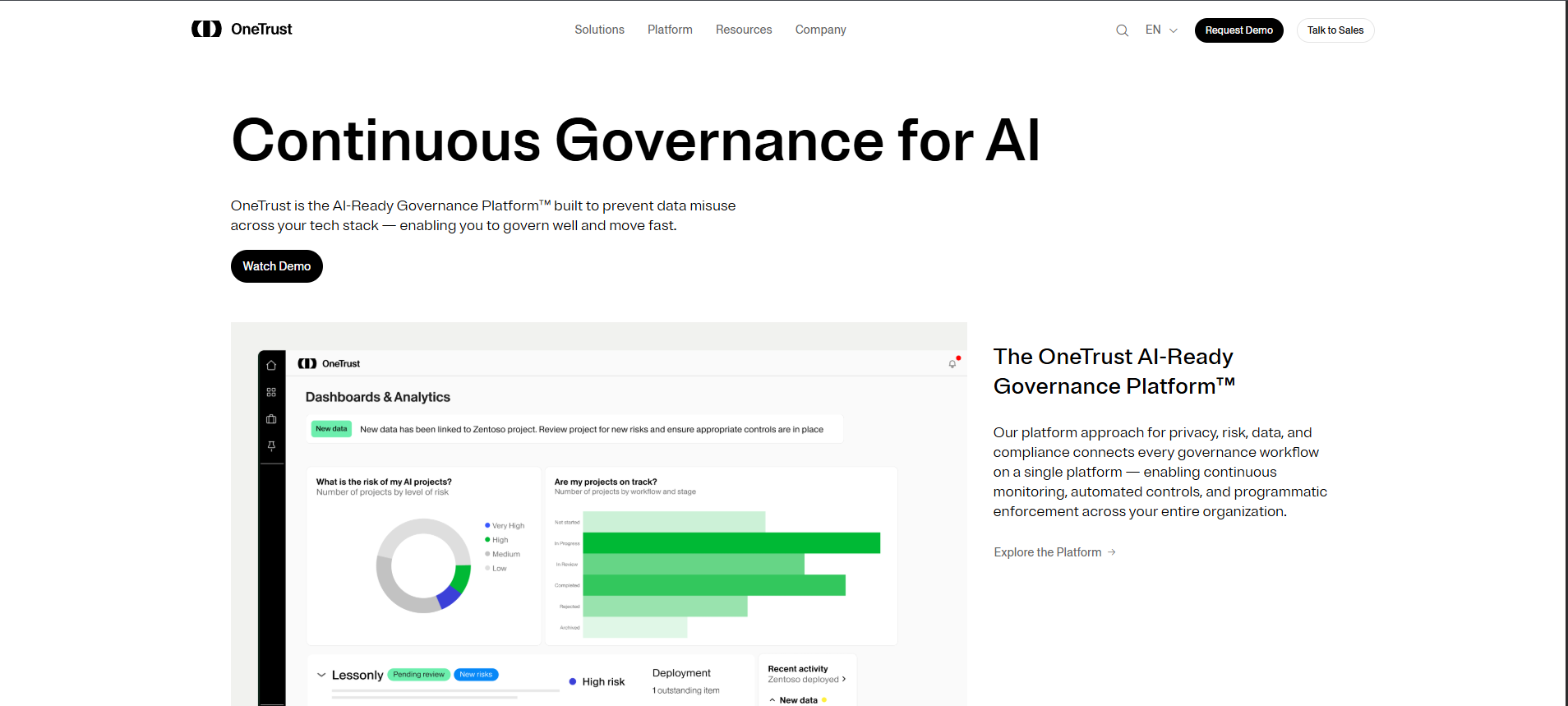
OneTrust earns an enterprise-fit composite of 4.2, the top score on this list, despite a global overall of 3.6. That inversion is intentional and important. OneTrust has the lowest global overall of any platform here, partly because its cookie-consent product alone underperforms its governance suite. The G2 Consent and Preferences module rates 3.5/5 from 16 reviews, while its governance modules rate 4.1 to 4.4. Enterprise buyers are not buying a banner tool. They are buying the full OneTrust review platform story. That story covers DSAR, RoPA, data mapping, vendor risk, AI governance, and ISO 27001 plus SOC 2 Type II, all from one vendor.
On SERP analysis, OneTrust appears on every enterprise CMP listicle retrieved, and is named the #1 enterprise pick by Ethyca, Enzuzo, and Concord. Gartner Peer Insights rates it 4.2/5 (28 reviews in the Privacy UX market).
Key Features
OneTrust spans the full privacy program from one platform, confirmed at onetrust.com/trust.
-
Consent orchestration across web, mobile, and CTV
-
DSAR / Individual Rights Management with automated workflow routing
-
RoPA (Record of Processing Activities) and data inventory mapping
-
Third-party vendor risk management
-
AI governance and data-use transparency modules (Gartner named OneTrust a Visionary in its 2026 AI Governance Magic Quadrant)
-
ISO 27001, ISO 27701, and SOC 2 Type II certification
-
Enterprise SSO/SAML and role-based access
-
Google Consent Mode v2 + IAB TCF 2.2 + GPP
Pros
OneTrust’s strengths are the depth and breadth that enterprise procurement rewards.
-
The broadest privacy and governance suite of any CMP on this list, spanning consent to GRC in one platform
-
ISO 27001 and SOC 2 Type II confirmed, satisfying enterprise procurement requirements without additional vendor audits
-
Cross-device and CTV consent handle multi-surface enterprise properties in a single deployment
-
G2 and Gartner coverage makes board-level and auditor justification straightforward
Cons
OneTrust’s drawbacks center on cost and complexity.
-
Pricing is quote-only, with no self-serve start. The floor is approximately $10,000 per year, and a $10,000 annual minimum took effect in Q2 2026. Vendr’s median OneTrust contract is approximately $11,500 per year (High confidence, Vendr marketplace data, 325 purchases).
-
No free trial. Evaluation requires a sales engagement.
-
The cookie-consent product alone rates 3.5/5 on G2, below its governance modules. Setup without a dedicated implementation resource is “moderately challenging and complex” per G2 reviewers.
-
Privacy professionals on r/cipp (40+ comment thread) describe it as priced for legal teams to justify internally, with a steep configuration learning curve.
Pricing
OneTrust uses custom, quote-based pricing only. The approximate floor is $10,000 per year, with a $10,000 annual minimum in effect since Q2 2026. Vendr’s median contract is approximately $11,500 per year. There is no free tier and no self-serve trial. Contact sales at onetrust.com/pricing.
What Users Say
G2 governance-module reviewers rate OneTrust 4.1 to 4.4, with consistent praise for breadth and audit-trail depth. The cookie-consent module alone rates 3.5/5, with reviewers noting it is “moderately challenging and complex” without dedicated support. Trustpilot scores (1.5/5) reflect renewal-driven pricing friction rather than product quality.
See OneTrust alternatives if the pricing or complexity is out of scope, or Consently vs OneTrust for a direct comparison.
2. Ketch: Best for Engineering-Led Teams That Need Consent Enforced Where Data Flows
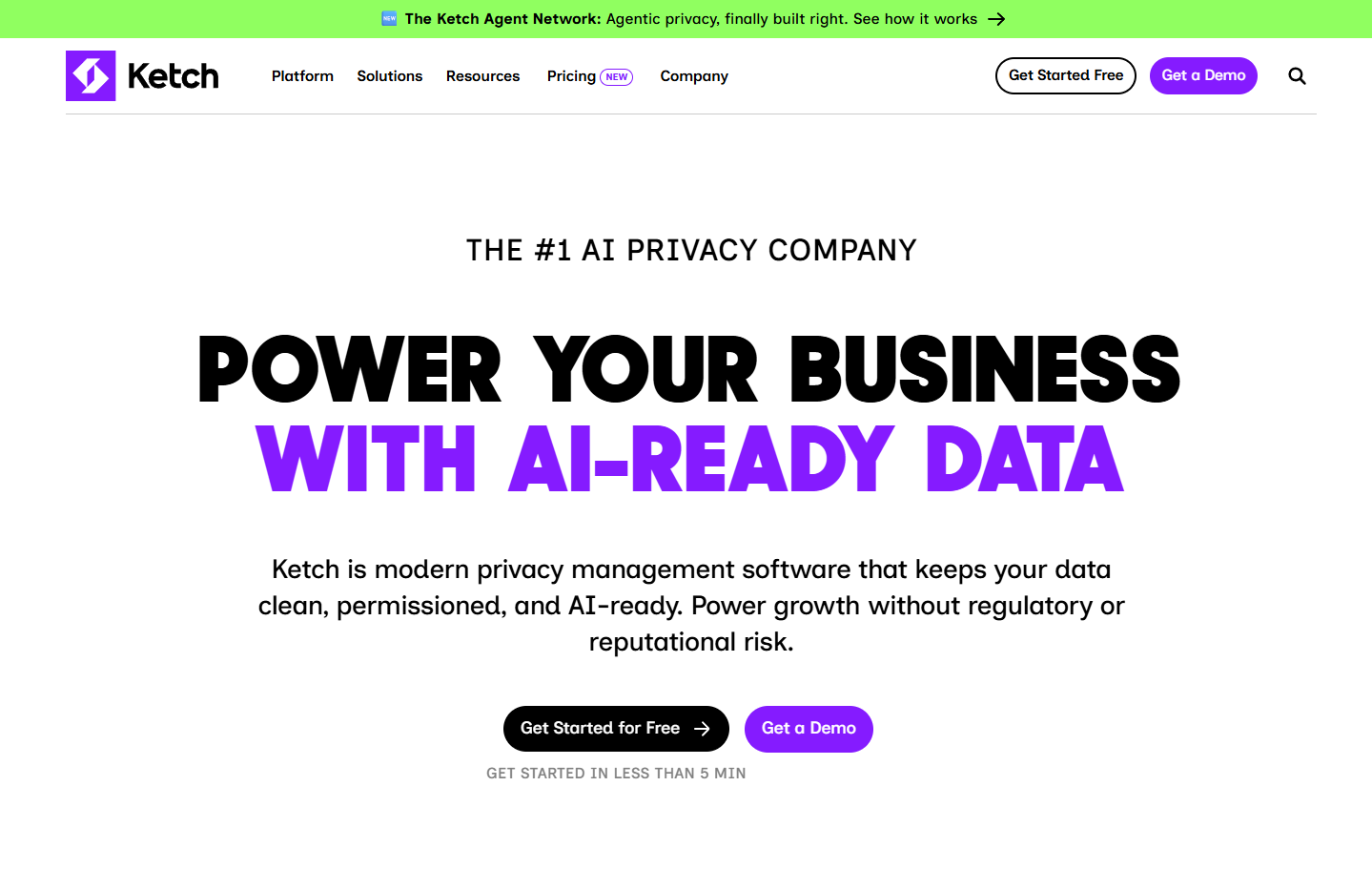
Ketch earns an enterprise-fit composite of 4.2, tying OneTrust. The tie-break goes to OneTrust on the defining decisive sub-factor, DSAR/GRC (OneTrust 5.0, Ketch 4.0). Ketch is the stronger pick for two specific enterprise buyer profiles. The first is teams that want transparent, self-serve entry pricing, rare at this tier. The second is engineering-led organizations that want to enforce consent at the data-layer level, not just at the banner.
Newly scored against our methodology from public evidence. We have not yet published a full Consently review of Ketch.
Gartner Peer Insights rates Ketch 4.9/5 (31 reviews) versus OneTrust’s 4.2 (28 reviews) in the same Privacy UX market. G2 rates Ketch 4.6/5 (140+ reviews) and named it a G2 Grid Leader for Enterprise in Spring 2026. That sentiment differential matters.
Key Features
Ketch pairs a full CMP with a data-layer enforcement architecture, confirmed at ketch.com/pricing.
-
Consent enforcement at the data layer (beyond banner-only blocking)
-
DSR / rights automation (add-on at the Plus tier, included in the Pro tier)
-
Data discovery and classification (Pro tier)
-
Privacy program management (policies, assessments, vendor risk)
-
ISO 27001 + SOC 2 Type II certification
-
Enterprise SSO (Pro tier)
-
IAB TCF 2.2 + GPP + GPC + Google Consent Mode v2
-
Transparent, self-serve pricing (Free / $150 / $499 / custom)
Pros
Ketch combines top user ratings with pricing transparency unusual at this tier.
-
Highest user-satisfaction ratings of any enterprise CMP here: Gartner 4.9, G2 4.6
-
Transparent entry pricing ($499/mo for the Plus tier) with a genuinely useful free tier, unlike every other full-suite enterprise competitor
-
Data-layer consent enforcement, not just banner-level, is a material technical differentiator for engineering teams
-
ISO 27001 + SOC 2 Type II without needing to push into a $10K+ contract first
Cons
Ketch’s limits show up in suite depth and pricing at scale.
-
DSAR/GRC suite depth (4.0) is strong but below OneTrust (5.0) and TrustArc (4.5). DSR is an add-on at the Plus tier and full data mapping arrives only at the custom Pro tier, so complex multi-jurisdiction rights workflows can require the top plan.
-
Enterprise plans beyond $499/mo are quote-based, losing the pricing-transparency advantage at scale
-
Smaller support organization than OneTrust or TrustArc. An r/googleads commenter advised engineering-led teams to “avoid enterprise-focused platforms” and use Ketch for lightweight but full compliance.
Pricing
Ketch publishes four tiers. They are Free (up to 5,000 visitors/mo), Starter at $150/mo (up to 30,000), Plus from $499/mo (up to 100,000), and custom Pro for larger volumes. DSR automation is an add-on at Plus and is included in Pro. Confirmed at ketch.com/pricing. Ketch is one of the only full-suite enterprise CMPs with published pricing.
What Users Say
Gartner reviewers praise the data-layer enforcement architecture and the transparent pricing. G2 reviewers cite “easy to set up” and “fully supports advanced Consent Mode,” and note that enterprise-scale implementations benefit from dedicated engineering integration support.
3. TrustArc: Best for a Mature Governance, DSR, and Assessments Program
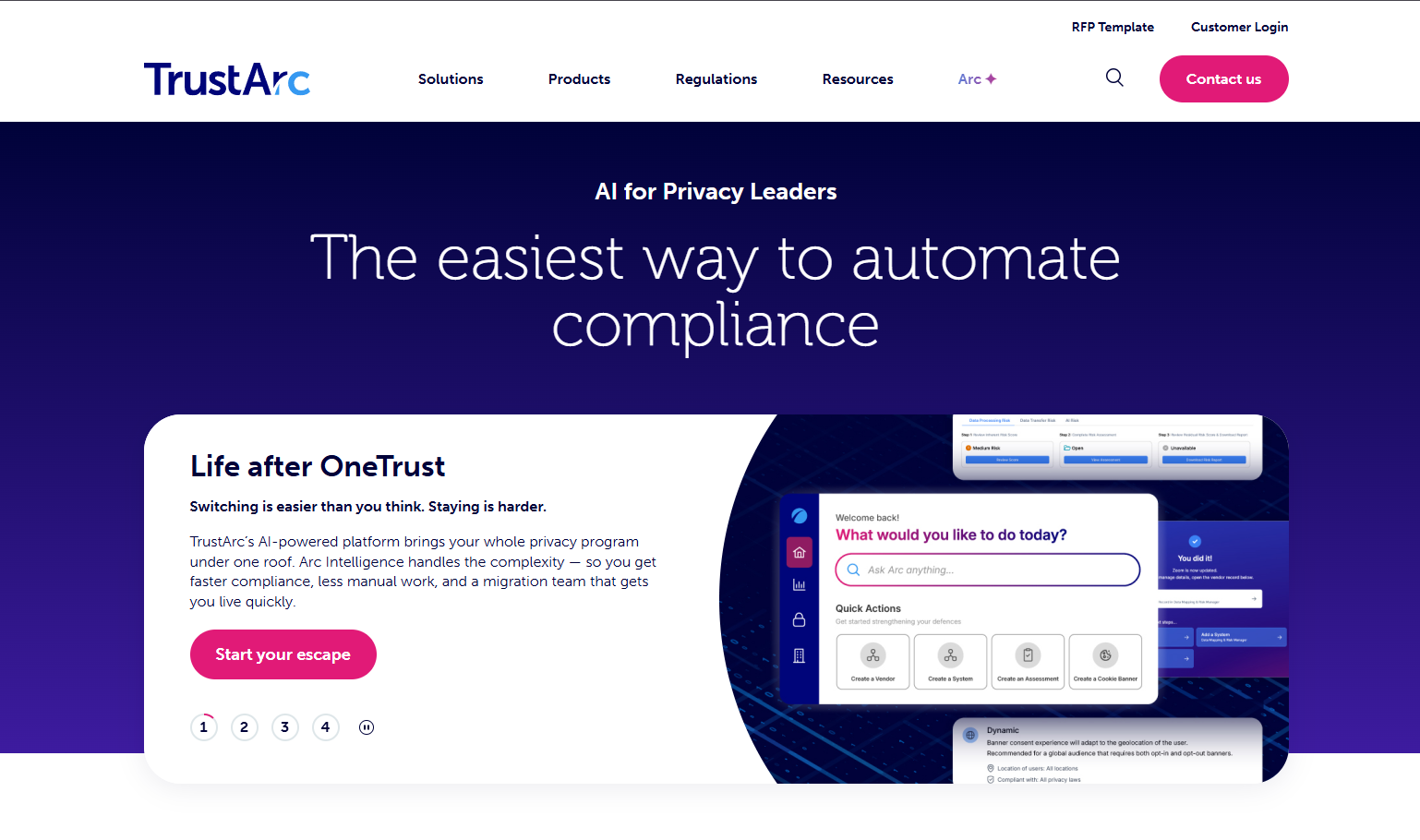
TrustArc earns an enterprise-fit composite of 4.0 on the strength of its DSAR/GRC score (4.5), the second-highest on this list after OneTrust. Its global overall is 3.5, again showing the enterprise-versus-general inversion. TrustArc’s cookie-consent product is not its strength. Its governance, DSR, and privacy-assessment programs are.
Newly scored against our methodology from public evidence. We have not yet published a full Consently review of TrustArc.
TrustArc holds the top G2 Satisfaction Score in the Enterprise Consent Management Platform Grid for ten consecutive quarters. That figure comes from its own product page (G2 data confirmed in the current SERP). It describes itself as the “#1 OneTrust competitor” and positions its Nymity regulatory research as a built-in differentiator.
Key Features
TrustArc leads with governance and regulatory tooling rather than banner UX.
-
Cookie Consent Manager + Individual Rights Manager (DSR automation)
-
Consent and Preference Manager with 60+ language support
-
Privacy assessments (DPIA, risk assessments, vendor questionnaires)
-
Nymity regulatory research database (unique to TrustArc)
-
Trust Center product for publishing compliance documents
-
Multi-domain and multi-brand support
-
IAB TCF 2.2 + Google Consent Mode v2
Pros
TrustArc’s strengths are its mature rights program and enterprise sentiment.
-
Second-highest DSAR/GRC score (4.5) and a mature Individual Rights Manager that enterprise legal teams can operationalize without extensive customization
-
G2 Enterprise Satisfaction Score leader for ten consecutive quarters, the strongest continuous enterprise user-sentiment signal on this list
-
Nymity regulatory research is a built-in differentiator: privacy teams get a continuously updated regulatory library without an extra research subscription
-
G2 reviewers consistently cite “easy to manage multiple international domains” and “hands-on support” as standout attributes
Cons
TrustArc’s drawbacks are pricing opacity and an unconfirmed certification status.
-
Quote-only pricing, with no public pricing page. Entry is likely comparable to OneTrust ($10K+ per year) based on market positioning.
-
ISO 27001 and SOC 2 certifications are not publicly confirmed on TrustArc’s own trust center. The Trust Center product stores customers’ SOC 2 reports, but TrustArc’s own certification status could not be verified this session. Confirm with their sales team before finalizing procurement.
-
Banner and consent UX receives lower marks than its governance suite. The cookie-consent product is not a reason to choose TrustArc.
Pricing
TrustArc uses custom, quote-based pricing with no public pricing page. Contact TrustArc at trustarc.com for a quote.
What Users Say
G2 reviewers highlight strong account management, multi-domain ease, and hands-on support. The sentiment is uniformly enterprise-oriented. The product’s consent-banner experience receives fewer mentions, consistent with its governance-first positioning.
4. Osano: Best for Mid-Market Teams Scaling into a Full Privacy Program
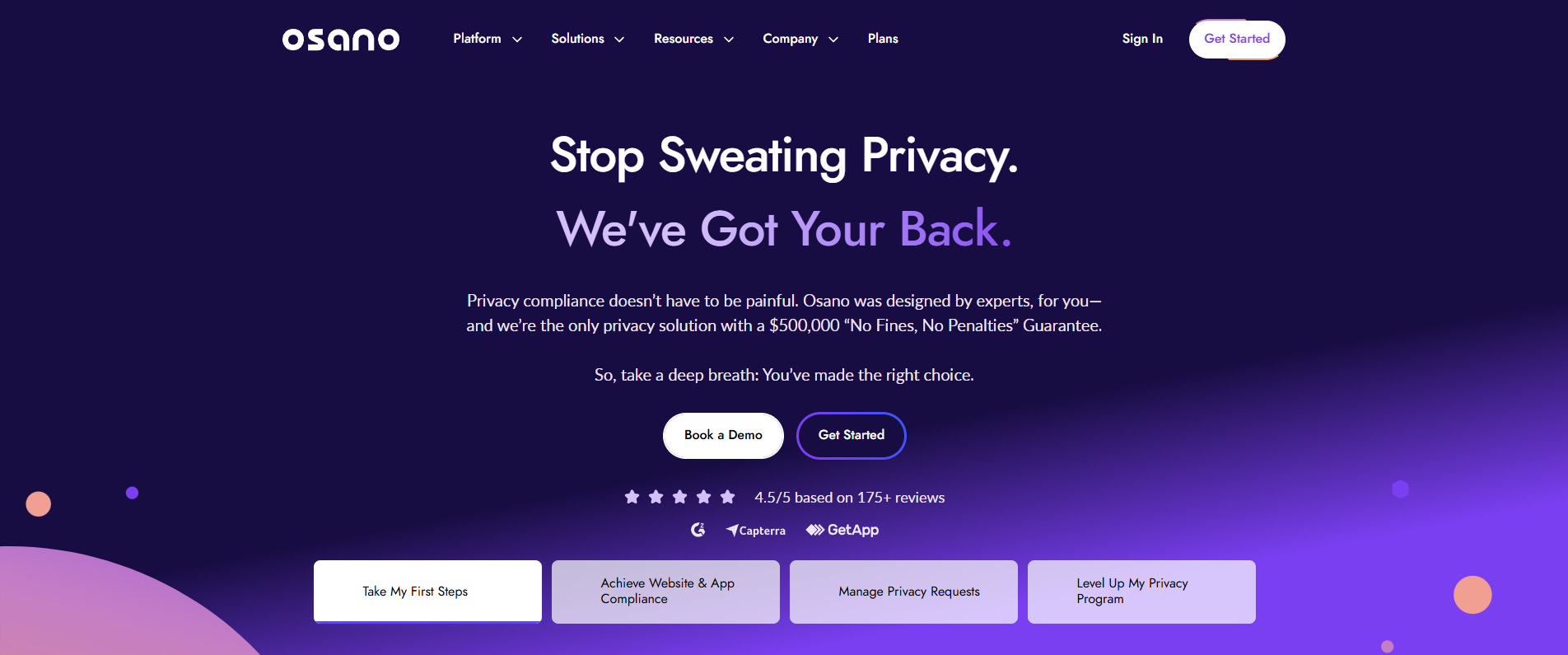
Osano earns an enterprise-fit composite of 4.0 with a DSAR/GRC score of 4.0, making it the most accessible full-suite enterprise option on this list. It starts at $199/mo with a genuine multi-module suite: consent management, DSAR, RoPA, data mapping, vendor risk, cookie consent, and privacy policy management. The entry price and no-fines guarantee make it the pick for mid-market organizations building a privacy program without a six-figure contract.
Read the full Osano review for the complete feature and pricing breakdown.
Key Features
Osano bundles a multi-module privacy suite from a single vendor.
-
Seven-module privacy suite (consent, DSAR, RoPA, data mapping, vendor risk, scanner, policy)
-
No-fines guarantee (Osano reimburses verified GDPR or CCPA fines incurred while using the platform, per documented terms)
-
Google Consent Mode v2 + IAB TCF 2.2 + GPP
-
SAML-based SSO on Plus and higher plans
-
Real-time monitoring and compliance alerts
-
G2 4.2/5 (200+ reviews)
Pros
Osano’s strengths are accessibility and a genuine risk guarantee.
-
The only platform on this list with a documented no-fines guarantee, a meaningful procurement differentiator for risk-averse compliance teams
-
A full seven-module suite starting at $199/mo makes Osano the most accessible genuine governance suite here. Everything else at this feature depth is quote-only.
-
Setup is consistently described as simple: “simple to setup and install, but with options” (TrustRadius)
-
DSAR automation is native, not a bolt-on module requiring extra configuration
Cons
Osano’s limits are banner depth, unconfirmed certs, and surface coverage.
-
Banner customization depth is limited compared to Cookiebot or Usercentrics. “Limited Customization” is the most common G2 con.
-
ISO 27001 and SOC 2 certifications are not publicly confirmed. Osano’s trust and security pages returned a 404 this session. Confirm certification status directly with Osano before a compliance-driven procurement.
-
Cross-device and CTV consent is not a documented strength. Coverage is primarily web and mobile.
Pricing
Osano starts at $199/mo (Plus) and runs to custom enterprise pricing. The starting price is confirmed at osano.com/pricing. SAML-based SSO requires Plus or higher. There is no free trial for the enterprise tier.
What Users Say
G2 reviewers praise the no-fines guarantee and the all-in-one structure. The recurring constructive note is banner customization limits for teams that need pixel-perfect consent UX to match brand standards. See Osano alternatives for comparable options, or Consently vs Osano for a direct side-by-side.
5. Secure Privacy: Best for Audit-Grade, SOC 2-Backed Certified Consent
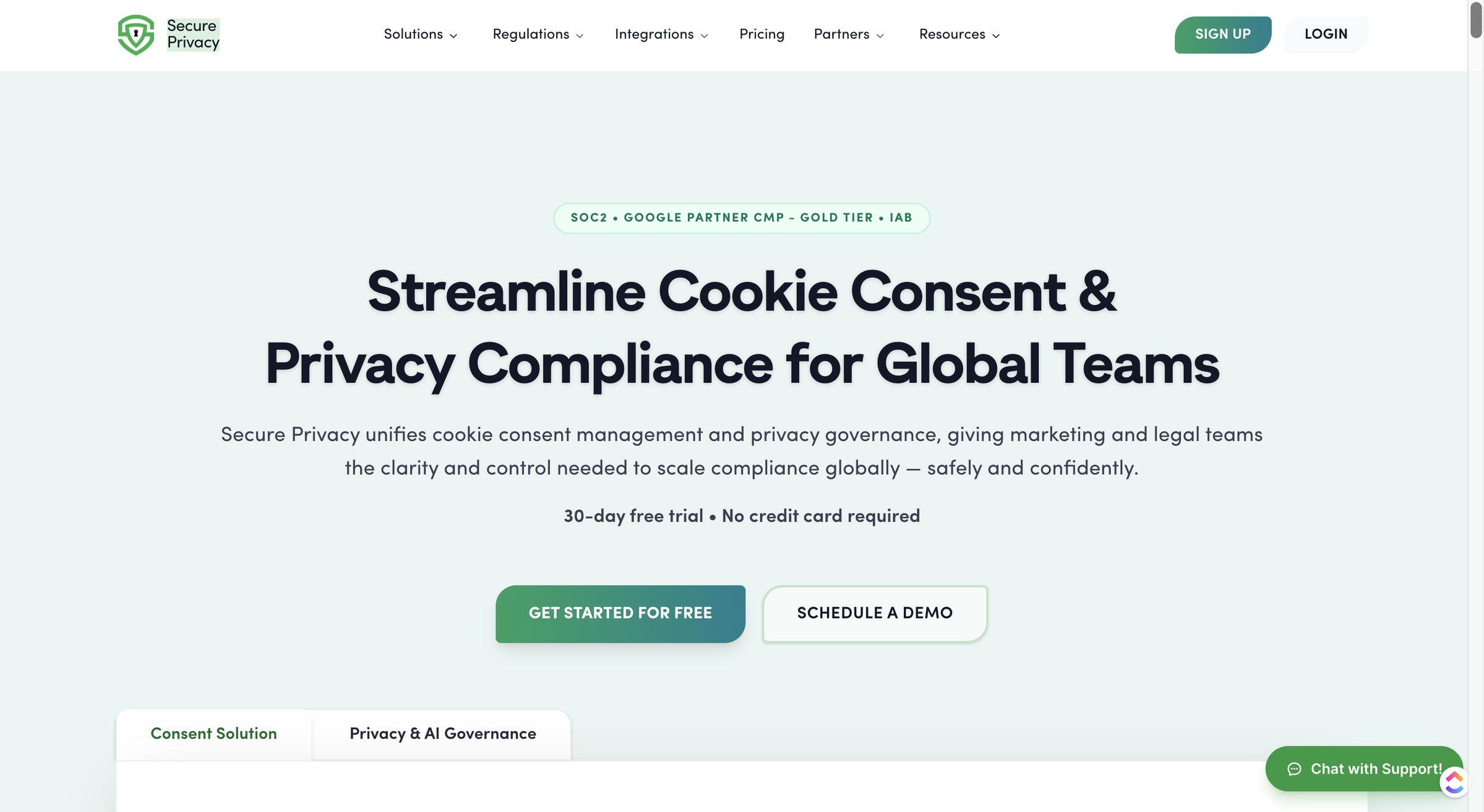
Secure Privacy earns an enterprise-fit composite of 4.0, anchored by a confirmed SOC 2 Type II certification and SSO support. Its DSAR/GRC score is 3.5 because the governance modules are gated as paid add-ons rather than bundled into the base plan. Those modules are DSAR, DPIA, RoPA, and vendor management. For organizations that primarily need audit-defensible, SOC 2-certified consent with optional governance expansion, Secure Privacy is the most cost-effective entry point in the certified tier.
Read the full Secure Privacy review for the detailed breakdown.
Key Features
Secure Privacy pairs certified consent with optional governance modules.
-
SOC 2 Type II certified (confirmed at
-
SSO/SAML on enterprise plans
-
Cookie scanning, auto-blocking, and consent logs
-
DSAR, DPIA, RoPA, and vendor management as add-on modules
-
Tamper-proof, cryptographic consent records (a differentiator for audit-grade log integrity)
-
Free tier with core scanning features
-
IAB TCF 2.2 + Google Consent Mode v2
-
G2 4.9/5 (~115 reviews), Capterra 5.0/5 (82 reviews)
Pros
Secure Privacy’s strengths are its ratings, its certification, and log integrity.
-
Highest aggregate user ratings of any platform on this list: G2 4.9, Capterra 5.0
-
SOC 2 Type II confirmed, making it the most accessible SOC 2-backed CMP by entry price
-
Tamper-proof cryptographic consent logs are a genuine differentiator for highly audited industries (finance, healthcare) where log integrity is itself a compliance requirement
-
The free tier provides real scanning and blocking capability, not a crippled preview
Cons
Secure Privacy’s drawbacks are its modular pricing and interface friction.
-
The governance suite is modular (add-on pricing). Buyers who need DSAR + DPIA + RoPA + vendor management will see costs rise beyond the base plan. Unlike Osano’s bundled approach, Secure Privacy’s governance depth is pay-as-you-expand.
-
G2 reviewer: “a little cumbersome” to view a specific user’s consent record in the interface
-
Banner-only buyers may find the feature set “overwhelming” per G2 (too many compliance options for a simple cookie-banner use case)
Pricing
Secure Privacy starts at $99/mo. The SOC 2-certified tier, SSO, and governance modules (DSAR/DPIA/RoPA) sit at higher plans. Confirmed at secureprivacy.ai/pricing. A free tier is available.
What Users Say
G2 and Capterra reviewers consistently rate Secure Privacy the highest of any CMP on this list. They praise the scanning accuracy, audit-log quality, and support responsiveness. The constructive notes center on the add-on model’s complexity for buyers who want a bundled governance package. See Secure Privacy alternatives for comparable options.
6. Didomi: Best for Global, Multi-Brand Consent and Preference Management at Scale
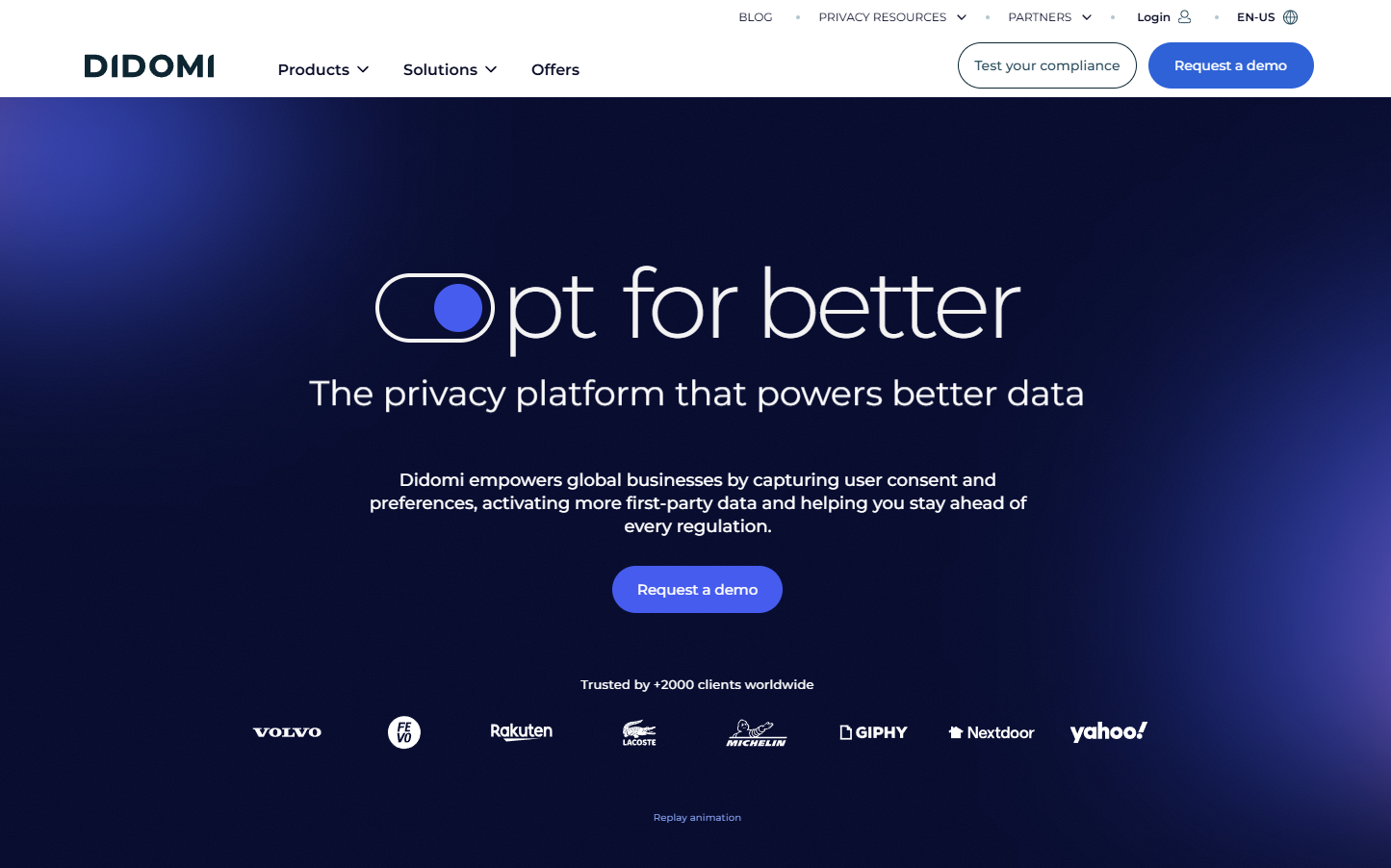
Didomi earns an enterprise-fit composite of 3.9 with an ISO/IEC 27001:2022 certification confirmed at didomi.io/security. Its DSAR/GRC score is 3.0, which just clears the decisive gate. Didomi offers preference management and DSAR support but does not bundle a full data-mapping and vendor-risk suite the way OneTrust or Osano does. Where it leads the field is scale and cross-device preference management for global, multi-brand organizations.
Newly scored against our methodology from public evidence. We have not yet published a full Consently review of Didomi.
Documented customer outcomes from didomi.io include Yahoo (274 million users), Société Générale (30 million customers across hundreds of sites), and Europcar (130 countries). Didomi cites a 99.9999% uptime figure for enterprise-scale deployments.
Key Features
Didomi centers on preference management and global scale.
-
Preference management center (capture beyond cookie consent, including marketing opt-ins and data-use choices)
-
Cross-device and CTV consent natively supported
-
DSAR support via the Privacy Requests module
-
IAB TCF 2.2 + GPP (Global Privacy Platform) + Google Consent Mode v2
-
Gold-tier Google-certified CMP
-
ISO/IEC 27001:2022 certification confirmed
-
Enterprise SSO
-
Consent-rate optimization tools (A/B testing of banner configurations)
-
Multi-brand deployments from a single account
Pros
Didomi’s strengths are preference depth and proven scale.
-
Preference management goes past cookie consent to capture structured marketing and data-use preferences, the strongest choice for organizations needing consent plus preference in one platform
-
Cross-device and CTV native support cover multi-surface enterprise properties that other CMPs handle awkwardly
-
Documented enterprise-scale deployments (Yahoo, Société Générale, Europcar) with 99.9999% uptime provide procurement-defensible proof of scale
-
Consent-rate optimization (A/B banner testing) is documented as delivering “+10% opt-in” for Orange France
Cons
Didomi’s limits are suite depth, an unconfirmed SOC 2, and opaque pricing.
-
DSAR support exists but is not a full data-mapping and vendor-risk suite (scored 3.0 on DSAR/GRC). Organizations with complex rights-request workflows should confirm the Individual Rights module covers their requirements before signing.
-
No SOC 2 Type II found at
-
Quote-only pricing, with no public price page
Pricing
Didomi uses custom, quote-based pricing with no public price page. Contact Didomi at didomi.io for a quote.
What Users Say
Enterprise customers documented on didomi.io cite strong consent-rate outcomes and multi-brand deployment manageability. The “+10% opt-in” Orange outcome and the multi-hundred-site Société Générale deployment are the strongest scale evidence of any vendor on this list.
7. Cookiebot: Best for ISO-Certified Automated Scanning at Enterprise Scale
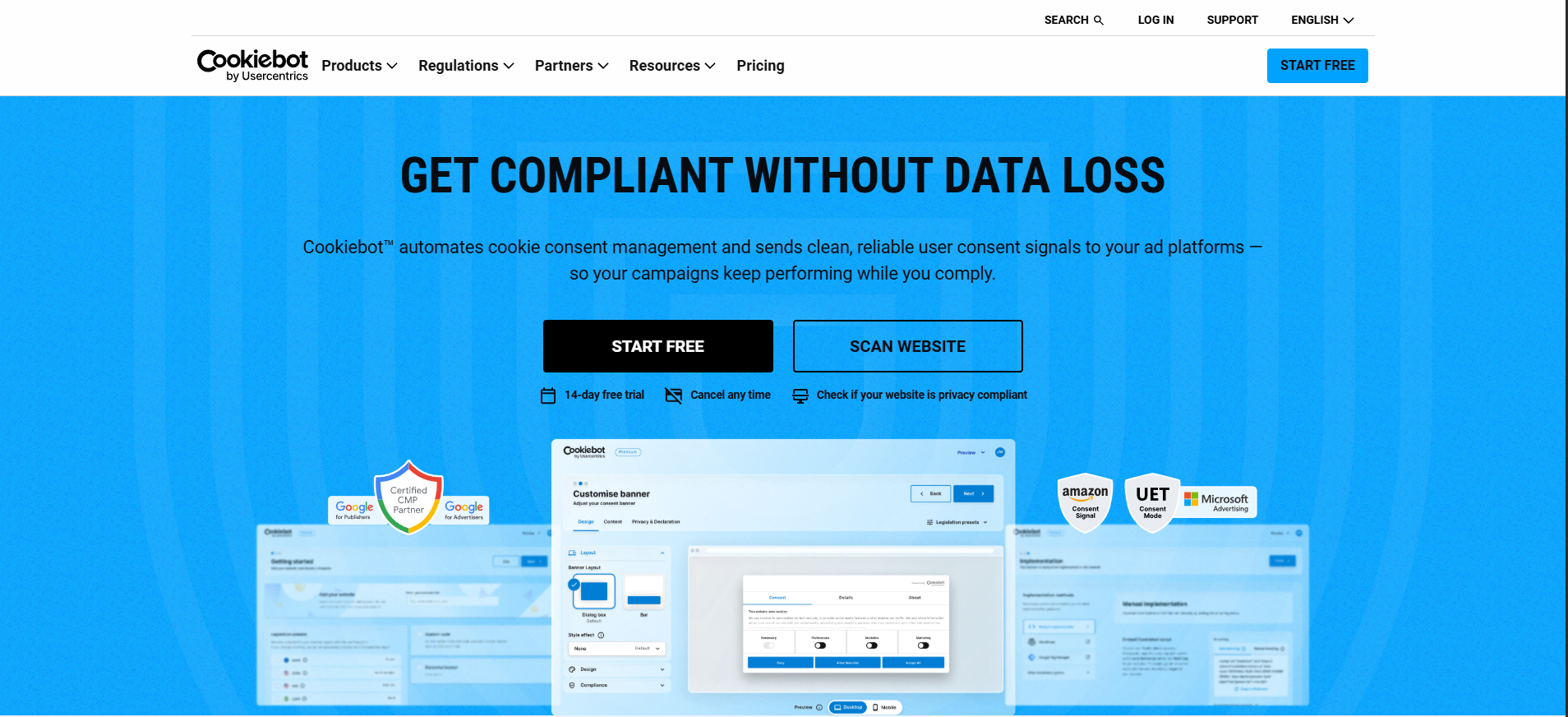
Cookiebot has the highest global overall score on this list at 4.0, yet it ranks seventh for enterprise, with an enterprise-fit composite of 3.9. That inversion is the article’s most important data point to understand.
Cookiebot is a consent-only scanner. It does not have DSAR automation, data mapping, RoPA, or a governance suite. Its DSAR/GRC score is 2.0, which fails the decisive gate. Cookiebot scans and blocks cookies exceptionally well. Even so, it cannot be the top enterprise pick, because it does not address the governance layer enterprises need.
Read the full Cookiebot review for the scanning and compliance detail.
Key Features
Cookiebot focuses on automated scanning and certified consent.
-
Automated weekly and on-demand cookie scanning with categorization
-
ISO 27001 + ISO 27701 certification (one of the few CMPs with ISO 27701, the privacy extension to 27001)
-
Cookie declaration and policy auto-generation
-
IAB TCF 2.2 + Google Consent Mode v2
-
Enterprise SSO (Enterprise plan)
-
Per-domain pricing from $8/mo to $96/mo per domain, scaling by subpage count
Pros
Cookiebot’s strengths are scanning quality and a strong certification stack.
-
Best-in-class automated scanning. G2 reviewers report they “no longer have to worry about compliance,” and TrustRadius reviewers cite the cookie declaration as “awesome, saves so much time.”
-
ISO 27001 + ISO 27701 is a stronger certification stack than most competitors (27701 adds the privacy-extension layer)
-
Enterprise SSO available, satisfying IT requirements without an upgrade cliff
-
A very well-understood product: extensive documentation, broad CMS integrations, and a predictable per-domain pricing model
Cons
Cookiebot’s drawbacks are scope and per-domain cost at scale.
-
No DSAR, no RoPA, no data mapping, no vendor risk. Unlike Osano or OneTrust, Cookiebot does not extend beyond consent. That is a structural gap, not a missing feature to request.
-
Per-domain pricing scales unfavorably for enterprises with many domains. Ten domains at the Enterprise tier would cost roughly $960/mo in direct per-domain fees.
-
Scored 4.0 global overall, but enterprise buyers shopping for a governance platform will find Cookiebot’s scope too narrow
Pricing
Cookiebot runs from $8/mo (1 domain, starter) to $96/mo per domain (enterprise tier), with tiers scaling by subpage count. Full pricing is at cookiebot.com/pricing. A free tier covers low-traffic domains, and the Enterprise plan includes SSO. See Cookiebot alternatives for governance-capable options, or Consently vs Cookiebot for a direct comparison.
What Users Say
G2 and TrustRadius reviewers consistently praise Cookiebot for set-and-forget scanning reliability. The consistent gap noted is that governance teams eventually outgrow it. Cookiebot does not publish enterprise governance contracts or a DSR tool, so it works best for enterprises that have separate GRC tooling.
8. ConsentManager: Best for Ad-Tech and Publisher Consent with TCF Depth
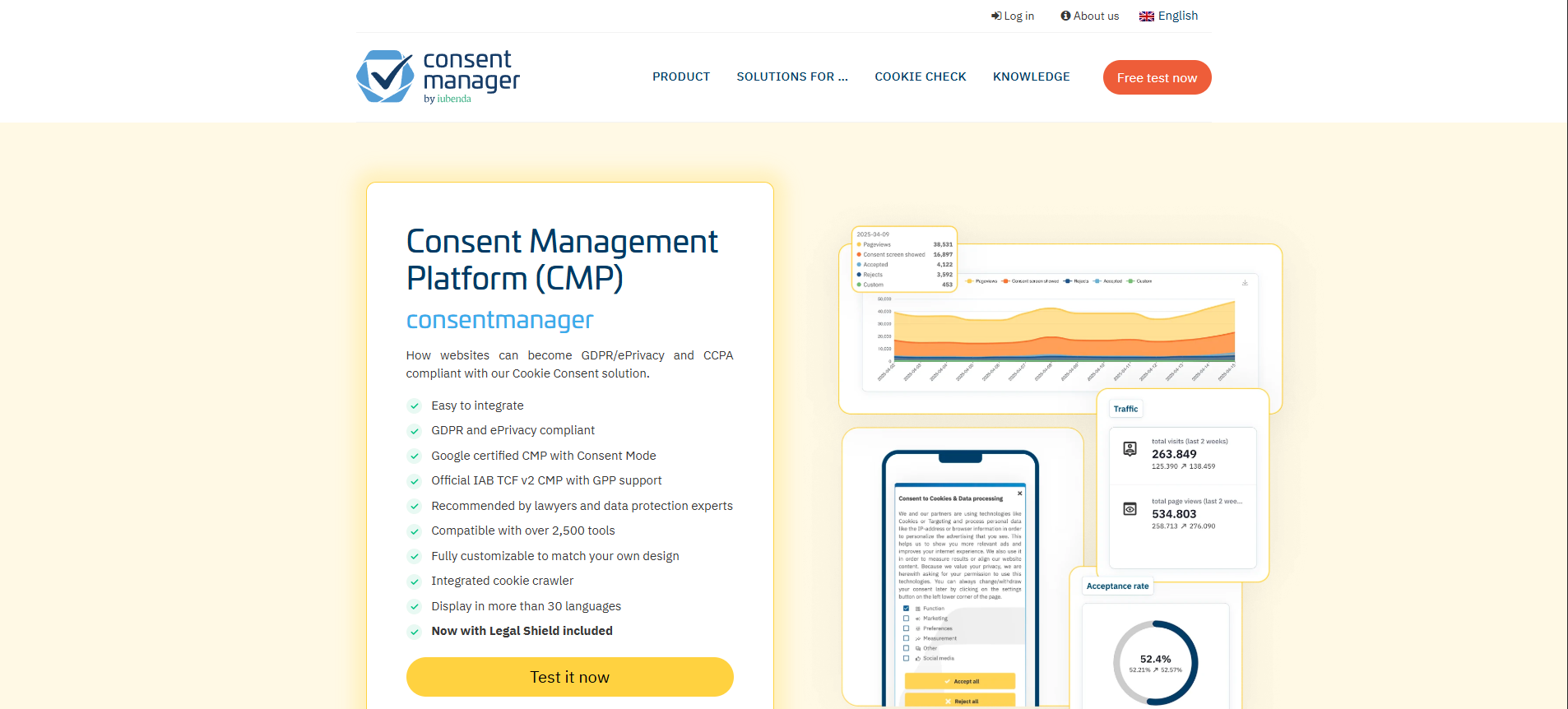
ConsentManager earns an enterprise-fit composite of 3.6. Its DSAR/GRC score is 2.5: it has a basic data-subject-rights tool but lacks a full data-mapping or vendor-risk suite. Its ISO and SOC 2 status could not be confirmed. Where it earns its place on this list is IAB TCF 2.2 and 2.3 depth. ConsentManager holds IAB vendor ID 31 and is one of the few CMPs to implement TCF 2.3 features ahead of broader market adoption.
Read the full ConsentManager review for the complete breakdown.
Key Features
ConsentManager leads on TCF depth and self-serve pricing.
-
IAB TCF 2.2 + TCF 2.3 (among the earliest TCF 2.3 implementations) + IAB GPP
-
Data-subject-rights tool (basic workflow, from the Essential tier)
-
Consent-rate optimization features
-
Crawler-based cookie scanning. Capterra reviewers note it “reliably finds tools” that other scanners miss.
-
SSO on the Professional tier
-
Per-impression pricing model (from €23/mo)
Pros
ConsentManager’s strengths are TCF depth, scanning, and transparent pricing.
-
Deepest TCF implementation on this list for publisher and ad-tech use cases. TCF 2.3 support is ahead of most competitors.
-
Capterra reviewers praise the scanning accuracy. The crawler-based approach “reliably finds tools” that lighter scanners miss.
-
Transparent, self-serve pricing starting at €23/mo with no minimum commitment
-
Consent-rate optimization features built into the standard plans
Cons
ConsentManager’s drawbacks are governance depth and an unconfirmed cert status.
-
DSAR/GRC is a basic tool, not a full governance suite, and it fails the decisive gate (2.5 on DSAR/GRC). Organizations with meaningful rights-request volume need a separate DSAR tool or a governance platform.
-
The reporting UI draws dated-interface feedback on Capterra. Analytics depth lags OneTrust and Usercentrics.
-
ISO 27001 and SOC 2 are not confirmed on public documentation. SSO is only on the Professional tier (€219/mo).
Pricing
ConsentManager runs Free, €23/mo (Starter), €59/mo (Essential), and €219/mo (Professional, with SSO), plus a custom Ultimate tier. Confirmed at consentmanager.net/pricing. Metering is per-impression. See ConsentManager alternatives for governance-capable options.
What Users Say
Capterra reviewers praise the scanning reliability and TCF depth. The consistent limitation is the reporting interface and the gap between the consent tool and a full governance suite.
9. Usercentrics: Best for Marketing-Led Consent with a Customer Success Manager
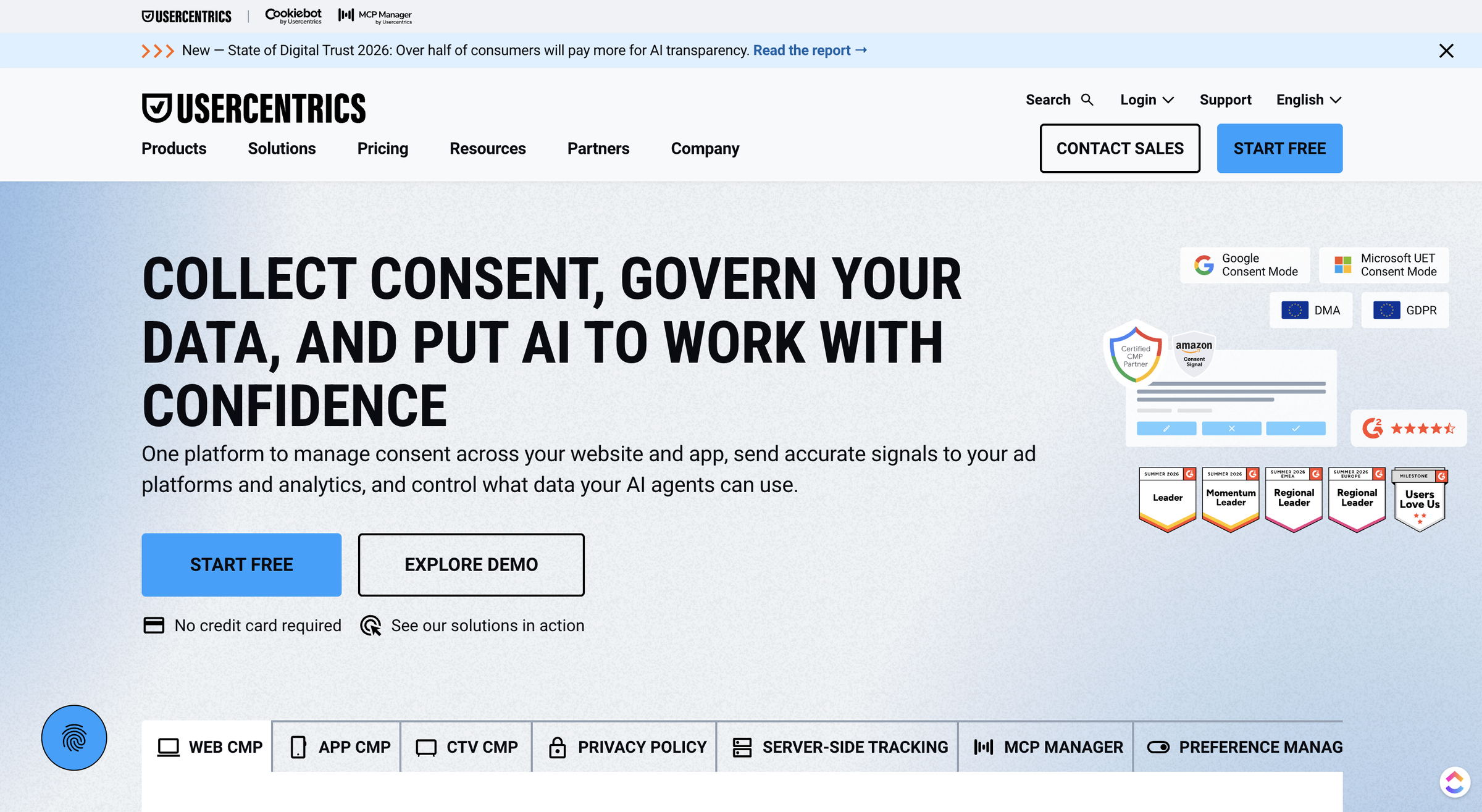
Usercentrics earns an enterprise-fit composite of 3.6. Like Cookiebot, it is primarily a consent-only tool, with no DSAR automation, no data mapping, and no GRC suite. Its DSAR/GRC score is 2.0, so it fails the decisive gate. It does offer the best CSM-supported mid-market experience of the consent-only tools. A dedicated customer success manager comes with Corporate plans, alongside a well-regarded banner A/B testing and consent-rate optimization feature set.
Read the full Usercentrics review for the complete breakdown.
Key Features
Usercentrics centers on consent optimization and managed support.
-
Banner A/B testing and consent-rate optimization (among the most mature of any CMP here)
-
Corporate plan with a dedicated customer success manager
-
SSO on Corporate plans
-
ISO 27001 certification stated across all tiers (confirm scope for the standalone product)
-
IAB TCF 2.2 + Google Consent Mode v2
-
Free plan to €50/mo self-serve; Corporate plan quote-based
Pros
Usercentrics’s strengths are optimization depth and named support.
-
Consent-rate optimization and banner A/B testing are the deepest of any tool on this list that also has self-serve entry pricing
-
The Corporate plan CSM is a genuine enterprise-support differentiator for teams that want a named contact, not just a support queue
-
Self-serve pricing up to €50/mo makes evaluation accessible. Ten G2 price-mention reviews note it is expensive for SMEs but appropriate for enterprise teams.
Cons
Usercentrics’s drawbacks are the missing governance layer and setup friction.
-
No DSAR, no data mapping, no GRC suite. Unlike Osano or Ketch, Usercentrics does not extend beyond consent into governance workflows.
-
Setup difficulty is the most-cited G2 con (20 mentions). “Limited Customization” at self-serve tiers draws 12 mentions.
-
ISO 27001 is stated across all pricing tiers, but confirm the certification scope for the standalone Usercentrics product before using it in a procurement justification.
-
Pricing is described as “too high for SMEs” in 10 G2 reviews.
Pricing
Usercentrics offers self-serve tiers from Free to €50/mo (Business, up to 50,000 sessions), with intermediate Essential (€7), Plus (€15), and Pro (€30) tiers. The Corporate plan is quote-based with SSO and a CSM. Confirmed at usercentrics.com/pricing. See Usercentrics alternatives or Consently vs Usercentrics for alternatives.
What Users Say
G2 reviewers cite consent-rate optimization and the CSM relationship as the two standout values. The recurring constructive feedback is setup complexity and the absence of a governance layer for teams that grow beyond pure consent management.
10. Consently: Best for Cost-Conscious SMBs and Agencies, Not Enterprise Governance
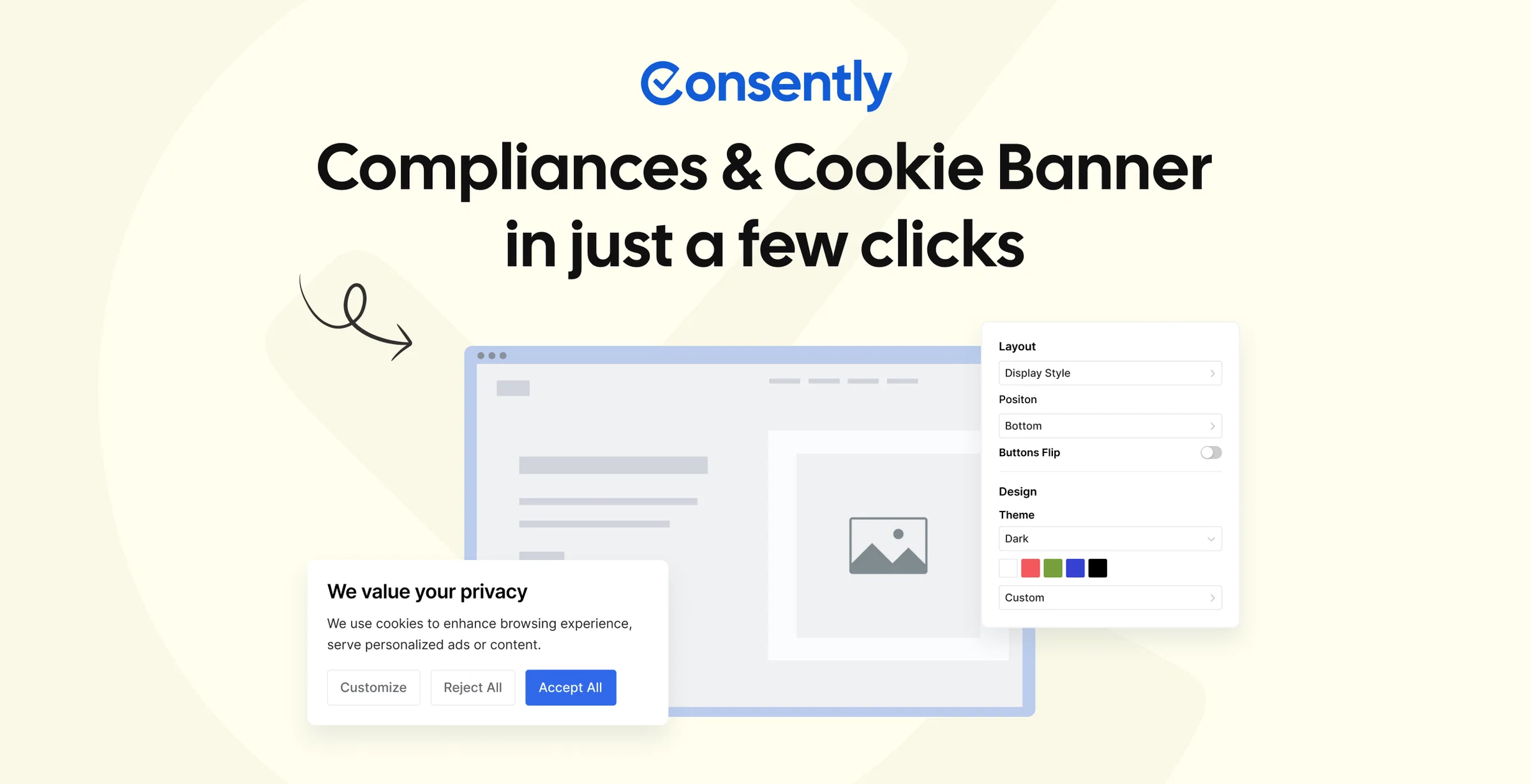
Consently earns an enterprise-fit composite of 3.0 and a global overall of 4.0. It ranks last on this list, and that ranking is earned honestly.
Consently lacks every enterprise-defining capability: no DSAR/GRC suite, no ISO 27001, no SOC 2, no enterprise SAML SSO, no mobile SDK, and no A/B testing. It fails the decisive gate on both sub-factors (DSAR/GRC 1.0, ISO/SOC2+SSO 1.0). A compliance team at a mid-size or large enterprise could not use Consently to satisfy auditor requirements, board-level governance expectations, or enterprise IT procurement checklists.
It is included here at its honest rank because Consently is the publisher of this guide, and honest disclosure is the only credible approach. Read the full Consently review for the complete picture.
Why Consently Is Not an Enterprise Governance Fit (and Who It Is For)
The enterprise-disqualifying gaps, stated plainly:
-
No DSAR or GRC suite. Consently manages the DPA between Consently and its customers. It does not automate data subject access requests, maintain RoPA records, perform data mapping, or handle vendor risk management. These are structural absences, not roadmap items.
-
No ISO 27001 or SOC 2. Consently hosts data on EU Frankfurt servers and provides a Data Processing Agreement with Standard Contractual Clauses. That satisfies GDPR data-residency requirements for the consent-layer data, but it is not a certification that satisfies enterprise IT security procurement questionnaires.
-
No enterprise SAML SSO. Consently offers Google login only. Enterprise IT teams require SAML-based SSO integration with Okta, Azure AD, or a similar identity provider.
-
No Google CMP Partner listing. Consently supports Google Consent Mode v2 technically, but is not yet on the Google-certified CMP partner list.
-
No GPC (Global Privacy Control) signal handling.
Consently is built for cost-conscious SMBs, agencies, and freelancers who need a complete cookie-consent CMP at a flat, predictable price. That CMP includes the banner, scanner, auto-blocking, consent logs, three policy generators, Google Consent Mode v2, and IAB TCF. It does that job well. It is not trying to be an enterprise governance platform, and it would be dishonest to say otherwise.
Key Features
Consently delivers a complete cookie-consent CMP with every feature on every plan.
-
All features on every plan (no feature gating between Basic, Premium, and Enterprise capacity tiers)
-
Automatic cookie scanning and prior blocking of non-essential scripts before consent
-
Customizable banner in 35 languages with HTML language detection
-
Timestamped consent logs plus cookie-scan-result export (both exportable from the dashboard)
-
Three policy generators: cookie policy, privacy policy, and terms and conditions
-
Google Consent Mode v2 (technically integrated, not yet on Google’s certified CMP partner list)
-
IAB TCF 2.3
-
Multi-site dashboard (one account, multiple domains at flat pricing)
-
Live chat support on all plans
Best Use Cases
Consently fits three buyer profiles well, all of them below enterprise scale.
-
SMB single-site compliance: The Basic plan ($59 one-time lifetime, or $99/yr, 1 domain, 100k pageviews/mo) covers a small-business site completely.
-
Agency multi-site: Premium ($199 one-time lifetime, or $199/yr, 5 domains) or the Enterprise capacity tier ($349 one-time lifetime, or $499/yr, 10 domains) covers an agency’s client portfolio at a flat price rather than per-domain billing.
-
Cost-conscious teams escaping per-domain bills: Teams paying Cookiebot or CookieYes per-domain fees can cut costs materially at 5 to 10 domains.
If agency multi-site management is the driver, see the best CMP for agencies guide for a full agency-segment ranking.
Pros
Consently’s strengths are its flat pricing and unified feature set.
-
All features on every plan removes the friction of deciding which tier unlocks compliance-critical features. I can set up scanning, auto-blocking, IAB TCF, and consent logs on the cheapest plan without checking a feature matrix.
-
AppSumo reviewers rate Consently 4.04/5 (28 reviews), consistently praising the clean interface and auto-scanning. “Auto-scanning saves me so much time” is a recurring sentiment.
-
Flat multi-domain pricing is a genuine cost advantage for agencies and multi-site buyers. Five domains for $199/yr beats the per-domain stacking at Cookiebot or CookieYes.
-
Live chat support on all plans, including the $99/yr Basic tier, which is unusual at this price point.
Cons
Consently’s drawbacks are exactly the enterprise gaps that place it last here.
-
No DSAR, GRC, RoPA, data-mapping, or vendor-risk suite. This is the primary enterprise disqualifier, stated plainly.
-
No ISO 27001 or SOC 2 Type II certification. EU Frankfurt hosting with a DPA is GDPR-appropriate for the consent layer, but does not satisfy enterprise security audit requirements.
-
No enterprise SAML SSO. Google login only.
-
No native mobile SDK and no A/B banner testing.
-
No white-label or client sub-accounts for agencies that need branded portals.
-
GPC (Global Privacy Control) signal handling is not supported.
-
The Google CMP Partner listing is pending, not confirmed.
Pricing
Consently leads with a flat, capacity-based annual pricing.
-
Basic: $99/yr, 1 domain, up to 100,000 pageviews/mo
-
Premium: $199/yr, up to 5 domains, up to 1M pageviews/mo
-
Enterprise: $499/yr, up to 10 domains, up to 3M pageviews/mo (this is a capacity tier, not an enterprise-governance tier)
14-day free trial, no credit card required
See full details at consently.net/pricing. If the SMB or agency use case fits, start a free Consently trial with no credit card and full feature access for 14 days.
What Users Say
AppSumo reviewers highlight the clean interface, auto-scanning reliability, and the value of flat multi-domain pricing for agency workflows. “Auto-scanning saves me so much time” is a genuinely recurring observation, not a cherry-picked quote. G2 and Capterra have near-zero organic reviews for Consently at this writing. That reflects its October 2025 launch date and DR 17 rather than user dissatisfaction. For SMB and agency use cases, the AppSumo cohort is the most representative signal available.
What Is the Best Enterprise Consent Management Platform?
OneTrust is the best enterprise consent management platform in 2026, with an enterprise-fit composite of 4.2. Its global overall is only 3.6, the lowest of any product here, yet it tops the enterprise list. The enterprise composite and decisive gate reward exactly what OneTrust does best. That set is DSAR automation, RoPA, data mapping, vendor risk, ISO 27001, SOC 2 Type II, and cross-surface consent from one vendor. No other platform here matches its 5.0/5.0 scores on both decisive sub-factors.
Cookiebot has the highest global overall at 4.0, yet ranks seventh for enterprise. It is an excellent consent-only scanner with ISO 27001 and ISO 27701, but it has no DSAR, no governance suite, and no path to GRC. The enterprise-fit scoring makes that gap explicit, not buried.
Per need, the alternates are:
-
Transparent pricing + engineering-led teams: Ketch (enterprise-fit 4.2, ISO 27001 + SOC 2, $499/mo published Plus tier, Gartner 4.9/5)
-
Mature governance and DSR program: TrustArc (enterprise-fit 4.0, top G2 Satisfaction Score 10 quarters running, Nymity research built in)
-
Mid-market scaling into a full suite: Osano (enterprise-fit 4.0, no-fines guarantee, seven-module suite from $199/mo, most accessible full-suite entry)
-
SOC 2-certified audit-grade consent: Secure Privacy (enterprise-fit 4.0, SOC 2 Type II confirmed, highest aggregate ratings G2 4.9 / Capterra 5.0)
-
Global multi-brand + preference management: Didomi (enterprise-fit 3.9, ISO 27001:2022 confirmed, CTV + cross-device, marquee enterprise deployments)
Consently is not a fit for enterprise governance and should not appear on an enterprise shortlist. It belongs on an SMB or agency shortlist. CookieYes is similarly a consent-only banner tool not suited to enterprise governance requirements. For the full category comparison, see best consent management platforms. For a pricing breakdown across the category, see consent management platform pricing. If SMB or agency use is your actual need, start a free Consently trial from the pricing section above.
FAQs
How much does an enterprise consent management platform cost?
Enterprise CMP pricing ranges from $199/mo (Osano Plus, the most accessible full-suite entry) to $10,000+ per year for quote-based platforms. OneTrust’s approximate floor is a $10,000/yr minimum (in effect since Q2 2026), and Vendr’s median for OneTrust contracts is approximately $11,500/yr. TrustArc and Didomi are similarly quote-based with no published pricing. Ketch is the outlier, publishing a $499/mo Plus plan, the only full-suite enterprise platform with transparent entry pricing.
What are the best OneTrust alternatives for enterprise?
The best OneTrust alternatives for enterprise are Ketch, TrustArc, and Osano. Ketch scores enterprise-fit 4.2 with transparent pricing and Gartner-leading ratings. TrustArc scores 4.0 with top G2 satisfaction and a mature DSR program. Osano scores 4.0 with a no-fines guarantee and a seven-module suite from $199/mo. All three are full-suite governance platforms that pass the decisive gate.
Do enterprises need a Google-certified CMP?
Yes, if the enterprise runs Google Ads or Google Analytics with Consent Mode v2 active. A Google-certified CMP ensures consent signals pass correctly through the Google tag stack for conversion modeling and analytics. Gold-tier Google-certified CMPs on this list include Didomi, Cookiebot, and Usercentrics. OneTrust and Ketch are Google-certified partners. Consently supports Consent Mode v2 technically but is not yet on the Google-certified CMP partner list.
What is the difference between a CMP and a privacy or GRC platform?
A CMP handles the consent layer: show a banner, record consent, block scripts before consent fires. A privacy or GRC platform adds the downstream obligations: DSAR/Individual Rights Management, RoPA/Article 30 records, data inventory and mapping, vendor risk assessments, and policy management. OneTrust, Osano, TrustArc, and Ketch span both. Cookiebot, Usercentrics, and Consently are consent-only and do not extend into the GRC layer.
Can a consent management platform handle DSARs and data subject requests?
Only full-suite governance platforms automate DSARs. On this list, OneTrust, Osano, TrustArc, Secure Privacy (as add-ons), and Ketch all have DSAR/rights-request automation. Consent-only tools (Cookiebot, Usercentrics, ConsentManager, and Consently) do not handle DSARs. Those organizations need a separate rights-request tool or a dedicated GRC platform.
Which CMP is best for a multi-brand or multi-domain enterprise?
Didomi and OneTrust are the strongest choices for multi-brand at scale. Didomi’s documented deployments (Société Générale, Yahoo, Europcar) demonstrate hundreds-of-sites and hundreds-of-millions-of-users scale. OneTrust’s multi-property consent orchestration covers web, mobile, and CTV across brand portfolios. Metering models matter: OneTrust meters by average daily visitors, and Didomi by custom contract terms. Both require enterprise contracts.
Is there a free enterprise consent management platform?
Free tiers exist (Ketch, Cookiebot, ConsentManager, Secure Privacy, Usercentrics), but enterprise governance (DSAR, ISO/SOC 2, SSO, multi-surface) is always a paid tier. Ketch’s free tier is the most generous at this compliance depth, including core consent and data classification with no time limit. No free tier on this list includes DSAR automation, ISO 27001 certification, or SAML SSO.