Enzuzo is the best consent management platform for ecommerce in 2026, scoring 4.2 on our ecommerce-fit evaluation. It leads on pre-consent pixel and tag blocking and Google Consent Mode v2 for ad-measurement recovery. Coverage spans Shopify, WooCommerce, BigCommerce, and custom carts.
We scored 10 platforms by re-weighting our methodology for online stores, with pixel blocking and multi-store support as decisive factors.
Below: a score-ranked quick list, a comparison table showing global vs ecommerce-fit scores, and a scored section per platform.
Disclosure: Consently publishes this guide and appears at rank 6 of 10 by its ecommerce-fit score of 4.0.
What Is the Best Cookie Consent Platform for Ecommerce?
Enzuzo (ecommerce-fit 4.2) is the best overall cookie consent platform for cross-platform ecommerce stores. It is the strongest certified choice that works across Shopify, Webflow, and custom carts and passes the ad-recovery gate. Consentmo (4.2) is the deepest native Shopify pick. Cookiebot (4.0) holds the highest global score and the most certified scanning. Below are all 10, ranked by the ecommerce-fit score.
-
Enzuzo: best overall for multi-store ecommerce brands (ecommerce-fit 4.2)
-
Consentmo: best native Shopify consent app (ecommerce-fit 4.2)
-
Cookiebot: best certified scanning for established stores (ecommerce-fit 4.0)
-
Secure Privacy: best for regulated, audit-grade ad recovery (ecommerce-fit 4.0)
-
Cookie Script: best fast, self-serve banner for lean stores (ecommerce-fit 4.0)
-
Consently: best value pick for budget multi-store ecommerce, now with a native Shopify app (ecommerce-fit 4.0)
-
Pandectes: best Shopify-native alternative for high-volume stores (ecommerce-fit 3.9)
-
ConsentManager: best for ad-heavy stores and publisher-commerce (ecommerce-fit 3.9)
-
CookieYes: best budget banner for single stores (ecommerce-fit 3.8)
-
Osano: best for stores that need a full privacy program (ecommerce-fit 3.8)
The list is ranked by the ecommerce-fit score. It re-weights the seven standard CMP dimensions for online stores, then adds pixel/tag auto-blocking and Consent Mode v2 (weighted 18) and multi-store/multi-domain coverage (weighted 7). The global overall is shown alongside, so you can see where ad-recovery and multi-store weighting shift the rank. For more details, see how we score every platform.
What Is a Cookie Consent Platform for Ecommerce, and Why Do Stores Need One?
A cookie consent platform collects, records, and manages visitor consent for cookies and tracking technologies. For an online store, it is more than a GDPR checkbox. Ad pixels and analytics tags fire on every product page, cart, and checkout. A platform that fails to block non-essential trackers before consent exposes the store to non-compliant tracking and CIPA liability. One that miscategorizes checkout cookies as non-essential breaks orders.
The decisive capability for an ad-driven store is what a consent management platform does after a visitor rejects. Google Consent Mode v2 feeds modeled conversion data back to Google Ads and GA4, so measurement keeps working even without tracking consent. Without it, stores operating in the EU lose conversion data and retargeting audiences.
What Should an Ecommerce Store Look for in a Cookie Consent Platform?
Five criteria separate a cookie consent platform built for stores from one that just passes legal review. The most decisive is ad-measurement recovery, because an ecommerce store’s revenue depends on it.
Pixel and Tag Auto-Blocking Before Consent
Every marketing pixel, including Meta, Google, and TikTok, must be blocked until a visitor gives consent. If pixels fire before consent, the store is tracking without permission. In the US, that exposure runs under CIPA and state wiretap statutes, not just GDPR. Prior blocking (blocking the script from executing, not just reading a consent cookie) is the enforceable standard.
Some tools block the tag after it calls home. That is not prior blocking. Cookiebot, Secure Privacy, and Consentmo offer certified prior blocking with documented accuracy. Consently blocks before consent by default but has a documented prior-blocking gap where some scripts can fire before consent unless wrapped manually. A minority of Consentmo stores report that pixel tracking dropped by more than 95% post-install, suggesting misconfigured blocking. Test every tool on your own store before launch.
Google Consent Mode v2 and Ad-Measurement Recovery
Consent Mode v2 lets Google model conversions and audiences even when a visitor rejects cookies. It sends behavioral signals (without personal data) so Google Ads and GA4 can fill in the measurement gap. Google has required Consent Mode v2 for EU and UK ad traffic since March 2024. For a store spending on Google Ads, this is revenue protection, not optional compliance.
Certification tiers matter: Cookiebot holds Gold-tier CMv2 certification from Google; Secure Privacy holds Gold-tier Advanced; Consentmo holds Silver. Enzuzo, CookieYes, and Cookie Script are certified CMv2 partners. Consently ships CMv2 default-on but holds only Additional Consent AC v2 certification, with the full Google CMP Partner listing pending.
A WooCommerce store owner in r/woocommerce captured the core intent. Updating for Consent Mode v2, they needed “some sort of cookie management software that is reliable.” Certification is the evidence of reliability.
Multi-Store and Multi-Domain Coverage
A store that grows adds storefronts, regional domains, and subbrands. Per-domain billing stacks fast. Cookiebot counts each subdomain as a separate billable domain and can auto-upgrade a plan when a scan finds more subpages. CookieYes charges per domain plus a pageview overage fee. Secure Privacy bills $15 to $249 per domain at every paid tier.
Flat multi-domain economics look different. Enzuzo bundles 4, 10, or 20 domains by tier. Consently charges $199 per year, with shared pageviews and no overage. For a store running three to ten storefronts, flat pricing can cut the annual bill sharply versus per-domain rivals. If you need a single store for free, see the best free cookie consent options.
Platform Fit (Shopify, WooCommerce, BigCommerce, Custom)
A native app and a head-script install are not equivalent. A native Shopify app installs from the Shopify App Store in one click. It reaches the Customer Privacy API for checkout and cart surfaces, and bills through Shopify invoices. Consentmo, Pandectes, Enzuzo, CookieYes, and Consently ship native Shopify apps.
Script-installed CMPs (Cookiebot, Cookie Script) work on any platform but cannot reach the Customer Privacy API and require a manual head script or GTM tag. Consently is cross-platform too, and its brand-new native Shopify app now reaches the Customer Privacy API on Shopify.
For a Shopify-first store, a native app is usually the better fit. For a multi-platform operator running Shopify and WooCommerce or a custom cart, a cross-platform script tool is more flexible.
For the deep Shopify-native comparison, see best Shopify cookie consent apps.
Checkout-Safe Blocking and Consent-Rate UX
The most common failure mode in WooCommerce and Shopify is miscategorizing session, cart, or order cookies as non-essential. When those are blocked before consent, product images fail to load, prices disappear, and orders break. Every tool in this list allows you to mark cookies as Essential.
Review the scanner output before going live and manually verify that the cart and checkout flow still work after enabling prior blocking.
Consent rates swing widely by banner design and region. The average cookie banner acceptance rate is about 31%, ranging from 4% to 85%, and sits near 32% in the United States (Cookie Banner, 2026). Every consenting visitor recovered is usable ad and analytics data, so the banner’s opt-in UX is a revenue lever, not just a compliance control.
ConsentManager ships built-in A/B testing and machine-learning consent-rate optimization aimed at lifting opt-in rates. A higher consent rate means more usable tracking data and better ad performance.
How Do the Best Ecommerce Cookie Consent Platforms Compare?
The table below ranks all 10 platforms by ecommerce-fit composite. The “Score” column is each platform’s global overall from our standard seven-dimension review. The “Ecommerce-fit” column is the ranking key for this list.
| Rank | Product | Score | Ecommerce-fit | Pixel/tag block + CMv2 | Multi-store / platform | Native app? | Entry price | Best for (ecommerce) |
|---|---|---|---|---|---|---|---|---|
| 1 | Enzuzo | 3.9 | 4.2 | Yes (certified CMv2 + Microsoft Consent Mode + GTM blocking) | 4/10/20 domains; cross-platform | Yes (Shopify, Webflow) | Free; $7/mo (Starter) | Multi-store ecommerce brands |
| 2 | Consentmo | 4.1 | 4.2 | Yes (Silver CMv2 + Google/Meta/MS script blocking, free) | Multi-store custom; Shopify-only | Yes (Built for Shopify) | Free; $9/mo (Standard) | Native Shopify stores |
| 3 | Cookiebot | 4.0 | 4.0 | Yes (Gold CMv2 + certified prior blocking) | Per domain; subdomains billed separately | No (script/plugin) | Free; ~$8/mo per domain | Certified scanning, established stores |
| 4 | Secure Privacy | 3.9 | 4.0 | Yes (Gold CMv2 Advanced + pre-consent blocking) | Per domain ($15 to $249/domain) | No (script) | Free; $15/mo per domain | Regulated, audit-grade ad recovery |
| 5 | Cookie Script | 4.0 | 4.0 | Yes (CMv2 every plan + script blocking) | Per-domain bundles (2/5/10) | No (script/GTM) | Free; EUR8/mo (2 domains) | Fast self-serve lean stores |
| 6 | Consently | 4.0 | 4.0 | Improved (native Shopify CPA gating; general auto-blocking still maturing) | Flat: 5 domains $199/yr, 10 for $499/yr | Yes (native Shopify app, brand-new; also WP plugin, script, GTM) | 14-day trial; $99 to $499/yr | Budget multi-store, now native on Shopify |
| 7 | Pandectes | ~3.9 (est.) | 3.9 | Yes (CMv2 + advanced blocking, Premium+) | Shopify Plus + multistore; Shopify-only | Yes (Shopify) | Free; $9/mo (Plus) | High-volume Shopify stores |
| 8 | ConsentManager | 3.9 | 3.9 | Yes (dual TCF + CMv2 + consent-rate ML) | Per views; Essential 3, Pro 20 domains | No (script/SDK) | Free; EUR23/mo | Ad-heavy and publisher-commerce |
| 9 | CookieYes | 3.8 | 3.8 | Yes (certified CMv2 + auto-block every plan) | Per domain + pageview overage | Yes (Shopify) | Free; $10/mo per domain | Budget single stores |
| 10 | Osano | 3.9 | 3.8 | Partial (CMv2 + AI blocking; no rule sharing) | 3 domains then sales | No (script) | Free; $199/mo (3 domains) | Full privacy program |
1. Enzuzo: best overall for multi-store ecommerce brands
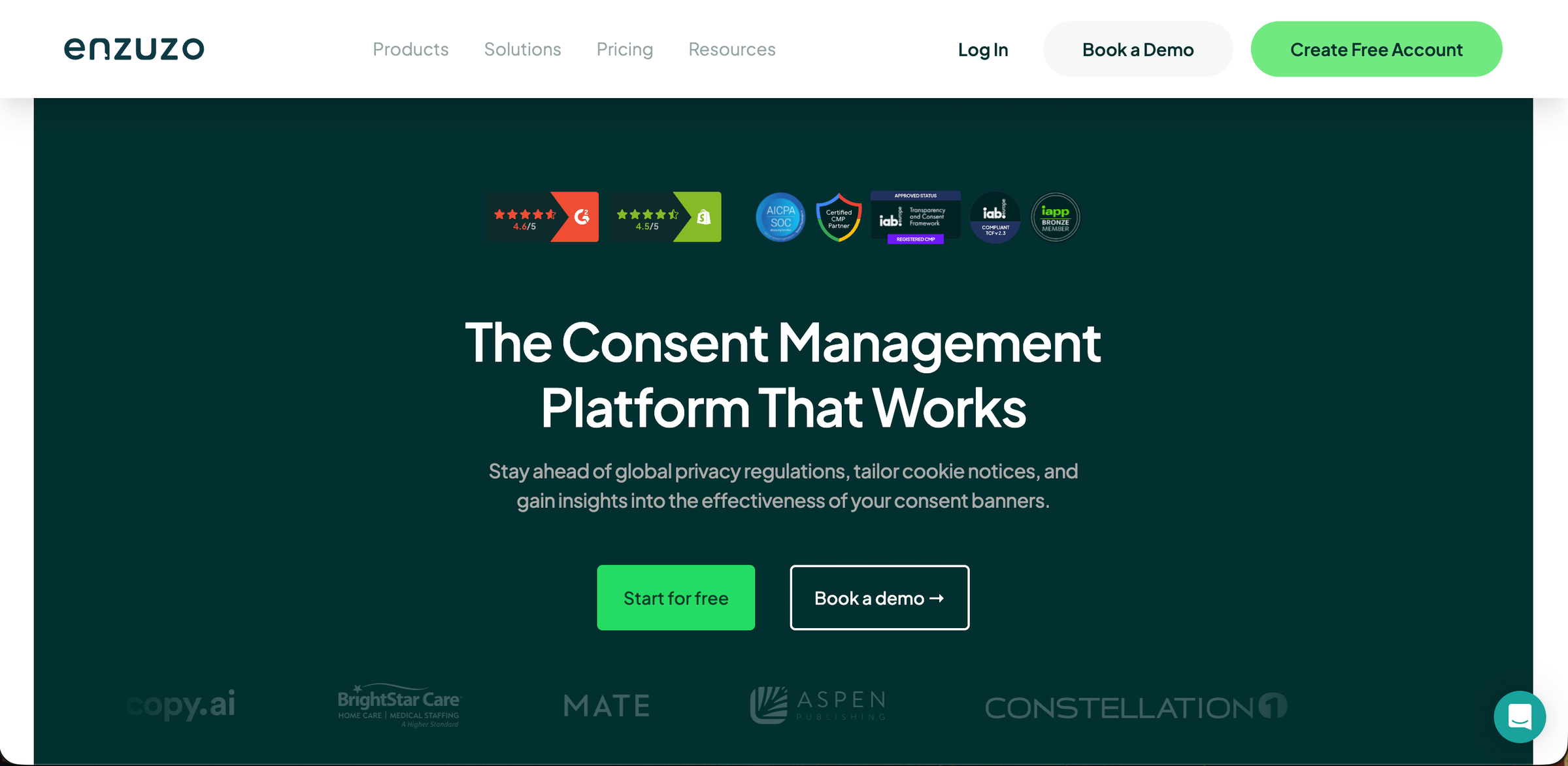
Enzuzo scores 3.9 out of 5 globally and 4.2 on our ecommerce-fit score, making it the top pick on this list. It is the strongest cross-platform fit that passes the ad-recovery gate. It earns both decisive sub-factor scores at the top: 5.0 for pixel/CMv2 and 5.0 for multi-store/platform.
Key Features
Enzuzo pairs certified ad-recovery with native store apps across the feature set below.
-
Google-certified Consent Mode v2 plus Microsoft Consent Mode signaling for ad-measurement recovery across two ad platforms
-
Native Shopify and Webflow apps, plus GTM tag blocking for custom carts and WooCommerce
-
Domain tiers at 1, 4, 10, and 20 domains with visitor caps by tier (5,000 to 30,000 monthly visitors)
-
Six legal-document generators covering privacy policy, terms of service, DSAR, EULA, return policy, and DPA
-
End-to-end DSAR management with a compliance-deadline inbox (45 days for California, 30 days for Europe)
-
Geo-targeting on Growth and above for EU opt-in versus US opt-out banners
Pros
The strengths below are what earn Enzuzo both decisive sub-factor scores at 5.0.
-
Certified ad-recovery across Google and Microsoft in one tool (native CMv2 plus Microsoft Consent Mode)
-
Native Shopify and Webflow apps with one-click install, no head-script required
-
Domain-bundle pricing (4/10/20 domains by tier) gives predictable multi-store billing
-
Six legal generators cover the full compliance paperwork job without a second subscription
-
Genuine DSAR automation at SMB pricing, a capability most budget tools omit
Cons
These limitations are real and currently true, drawn from store-owner reviews.
-
Visitor caps force tier jumps: 5,000 monthly visitors on Free and Starter, 10,000 on Growth, 30,000 on Pro; fast-growing stores face frequent upgrades
-
Geo-targeting is locked behind the Growth plan ($22/mo), not available on the free or Starter tiers
-
Banner languages sit at around 25, and one Shopify reviewer reported only one language showing live where multiple were promised
-
Policy generators are templated. One App Store reviewer asked, “How on earth do I add a custom bit of copy to the Privacy Policy?” and could not
Pricing
Enzuzo prices by domain count and monthly visitors across five tiers.
-
Free: 1 domain, 5,000 monthly visitors, 3 DSARs per month
-
Starter: $7/mo, 1 domain, 5,000 visitors
-
Growth: $22/mo, 4 domains, 10,000 visitors, geo-targeting, full DSAR
-
Pro: $59/mo, 10 domains, 30,000 visitors
-
Agency: $99/mo, 20 domains
What Users Say
Shopify App Store reviewers credit the GDPR peace-of-mind and one-click setup. On the negative side, a store owner (Pure TheraPro Rx) flagged that the templated policy generator blocks custom copy additions. That is the main friction point for stores with non-standard policy language. Read the full Enzuzo review or see Enzuzo alternatives if the visitor cap is a concern.
2. Consentmo: best native Shopify consent app
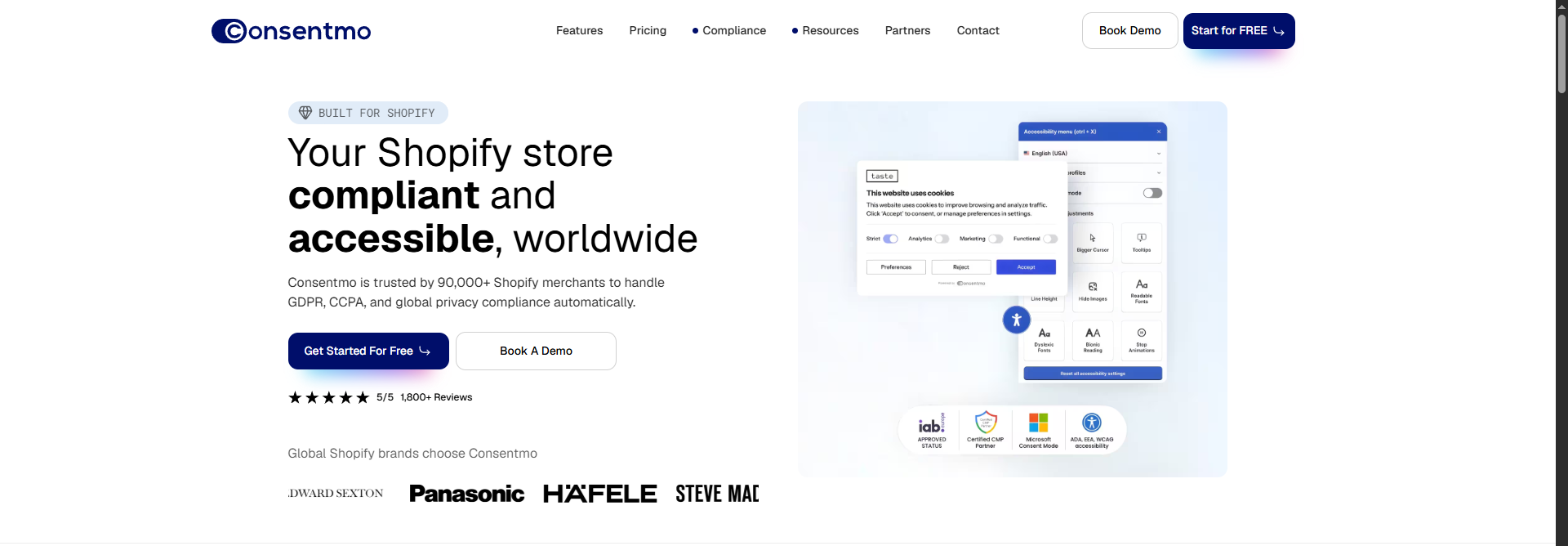
Consentmo scores 4.1 out of 5 globally and 4.2 on our ecommerce-fit score, the deepest native Shopify pick. It ranks second here, not first, only because it is Shopify-exclusive. A multi-platform operator cannot use it off Shopify at all.
Key Features
Consentmo concentrates its depth inside the Shopify ecosystem, as the features below show.
-
Built-for-Shopify certified app, installed from the Shopify App Store with Shopify-invoice billing
-
AI Tracker Manager that claims coverage of more than 98% of known cookies, scripts, tracking pixels, local and session storage, and iframes
-
Script blocking for Google, Meta, and Microsoft pixels included on the free tier
-
Silver-certified Google Consent Mode v2 plus GPC on the free plan, Microsoft Consent Mode on paid
-
Geotargeting across 282 regions on Plus ($34/mo), auto-translating banners into 40-plus languages
-
ISO 27001 certified (2026); IAB TCF 2.3 locked to Enterprise ($59/mo)
-
Compliance Score: a 14-point real-time dashboard grade with a “Fix All Issues” button
Pros
These strengths reflect Consentmo’s deep Built-for-Shopify integration and generous free tier.
-
Genuinely generous free tier: certified CMv2, script blocking, and DSAR pages at $0, unlimited impressions
-
Deep Built-for-Shopify integration, no code, no head-script, no GTM
-
Strong 5.0 rating across more than 1,850 Shopify App Store reviews at time of writing
-
Compliance Score surfaces gaps and links directly to the fix in-dashboard
-
ISO 27001 and certified CMv2 at no cost for early-stage stores
Cons
These limitations are real and currently true, including a Shopify-only ceiling.
-
Shopify-exclusive with zero support outside Shopify: no WooCommerce, Webflow, Wix, Squarespace, or custom site
-
A minority of stores report severe pixel breakage. One App Store reviewer wrote, “my pixel tracking is completely off by more than 95%.” Another saw Meta Ads retargeting recover after disabling the app. Test pixels after install.
-
Most “worldwide” features gate to Plus ($34/mo): geotargeting, analytics, full CSS styling, and accessibility
-
IAB TCF 2.3 is locked to the $59 Enterprise tier
-
One banner language on the free plan is a real constraint for stores already selling across regions
Pricing
Consentmo prices in four Shopify-billed tiers, with most worldwide features on Plus.
-
Free: $0, certified banner + script blocking + DSAR, unlimited impressions, 1 language, 1 scan per month
-
Standard: $9/mo, multi-language, unlimited scans
-
Plus: $34/mo, geotargeting across 282 regions, analytics, accessibility widget, full CSS
-
Enterprise: $59/mo, IAB TCF 2.3, checkout banner (Shopify Plus), cross-domain consent
What Users Say
One App Store merchant called it “very easy to manage consent in all regions,” reflecting the everyday experience for most stores. The documented negative tail is pixel-breakage complaints (low frequency, high impact when it occurs). Read the full Consentmo review or see Consentmo alternatives for cross-platform options.
3. Cookiebot: best certified scanning for established stores
Cookiebot scores 4.0 out of 5 globally and 4.0 on our ecommerce-fit score. It holds the highest global score in this roundup, and its per-domain billing model is what drops it to third on the ecommerce lens.
Key Features
Cookiebot leads on certified scanning and ad-recovery depth across the features below.
-
Automated scanning against a 13,000-plus cookie repository, updated monthly, covering HTTP and JavaScript cookies, HTML5 local storage, pixel tags, and web beacons
-
Gold Tier Google CMP Partner certification with Consent Mode v2
-
Certified prior blocking of non-essential scripts before consent
-
Geotargeted banners across 47-plus languages
-
Branded cookie declaration auto-generated from each scan
Pros
These strengths are why Cookiebot holds the highest global score in this roundup.
-
The most certified ad-recovery in the field: Gold-tier CMv2 plus certified prior blocking (pixel/CMv2 sub-factor 5.0)
-
Brand trust and scale: 600,000-plus customers, ISO 27001 and 27701, Google Gold Tier, more than a decade of operation
-
Set-and-forget: monthly scans run automatically, cookie declaration updates in place
-
Broad platform reach via script, WordPress plugin, Shopify plugin, and Google Tag Manager
Cons
These limitations are real and currently true, concentrated on per-domain economics.
-
Per-domain billing: each subdomain counts as a separate billable domain, so a store with subdomain storefronts pays per subdomain. A G2 reviewer said costs “can become expensive when dealing with multiple domains.”
-
The scanner sets your plan size. A scan that finds more subpages than your plan allows triggers an automatic tier upgrade, with no manual confirmation step
-
No native cart app (script or plugin only, no native Shopify App Store presence)
-
No terms-and-conditions generator: stores that need T&C alongside a cookie policy need a second tool
-
Trustpilot sits at 3.4 across 290-plus reviews, skewed by billing-surprise complaints
Pricing
Cookiebot prices per domain, tiered by the number of subpages a scan finds.
-
Free: 1 domain, up to 50 subpages, 1 language, manual blocking only
-
Paid tiers: approximately $8 to $96/mo per domain, tiered by subpage count
-
Daily scanning add-on: +EUR99/mo
What Users Say
G2 and TrustRadius reviewers consistently credit the scanning quality and certification depth. The negative signal concentrates on multi-domain cost surprises and the auto-upgrade trigger. Read the full Cookiebot review or see Cookiebot alternatives if per-domain billing is a concern.
4. Secure Privacy: best for regulated, audit-grade ad recovery
Secure Privacy scores 3.9 out of 5 globally and 4.0 on our ecommerce-fit score. It leads on certified, audit-grade ad recovery and governance depth. Its per-domain billing is its binding limit for multi-store operators.
Key Features
Secure Privacy stacks certifications and governance modules across the features below.
-
Google CMP Partner, Gold Tier, with Advanced Consent Mode v2
-
SOC 2 Type II certification alongside ISO 27001 and IAB TCF certification
-
Accurate automatic scanner with pre-consent blocking, tamper-proof consent logs with export
-
Governance suite covering DSAR, DPIA, vendor and risk management, and Article 30 RoPA
-
More than 70 banner languages, 95-plus country coverage
-
Meta Consent Mode support alongside Google Consent Mode v2
Pros
These strengths are why Secure Privacy leads on audit-grade ad recovery here.
-
The most certification-stacked CMP on this list: SOC 2 Type II, Gold-tier CMv2 Advanced, IAB TCF, Google CMP Partner (pixel/CMv2 sub-factor 5.0)
-
Governance modules cover the full compliance program for regulated stores (DSAR, DPIA, RoPA)
-
Strongest review aggregates at this price range: Capterra 5.0 across 82 reviews, G2 4.9 across 115
-
Accurate scanner with pre-consent blocking documented and verified
Cons
These limitations are real and currently true, led by per-domain billing.
-
Per-domain billing stacks fast: five domains on the Business plan runs roughly $3,540 per year, which is why multi-store/platform scores 2.0 here
-
No native cart app; script installation only
-
English-only admin dashboard despite 70-plus banner languages: multiple reviewers cite this as friction for non-English-speaking admin teams
-
The $59 Business to $249 Advanced tier gap is wide, forcing a large jump if Business-tier features are insufficient
-
Complexity exceeds a cookie-only store’s needs; reviewers describe it as “a lot of customization options, which can be overwhelming” for simple setups
Pricing
Secure Privacy prices per domain across four tiers, billed monthly or annually.
-
Free: up to 10 domains, 500 consents per month
-
Small: $15/mo per domain
-
Business: $59/mo per domain (custom CSS, cross-domain consent)
-
Advanced: $249/mo per domain (full governance, advanced white-label)
What Users Say
G2 reviewers call it the “most cost-effective cookie compliance solution available” at the lower tiers. Capterra reviews flag the English-only admin as a practical friction point. Read the full Secure Privacy review or see Secure Privacy alternatives if per-domain billing or the English-only dashboard is a disqualifier.
5. Cookie Script: best fast, self-serve banner for lean stores
Cookie Script scores 4.0 out of 5 globally and 4.0 on our ecommerce-fit score. It is the fastest self-serve banner here for stores that install by GTM or head script. It trails Secure Privacy on the tie-break because its pixel/CMv2 sub-factor scores 4.5 versus Secure Privacy’s 5.0.
Key Features
Cookie Script optimizes for fast, self-serve deployment across the features below.
-
Headless scanner with a 100,000-plus cookie database covering around 80% of a typical site’s cookies
-
Google Consent Mode v2 on every paid plan, including the free tier
-
Script blocking (automatic, non-essential scripts held before consent) on STANDARD and above
-
GTM template for fast, no-code deployment
-
Per-domain bundles in fixed steps: 2, 5, 10, 20, 50, 100, and 200 domains
-
Trustpilot 4.7 across 391-plus reviews, G2 4.6 across 505-plus reviews
Pros
These strengths reflect Cookie Script’s speed and consistent production reliability.
-
CMv2 on every plan, including free, so ad measurement recovery works from day one
-
Fast GTM setup: a developer can go live in minutes with the GTM template
-
Strong review base (Trustpilot 4.7, G2 4.6) reflects consistent reliability in production
-
42 banner languages; broad regulation coverage including GDPR, CCPA, LGPD, and ePrivacy
Cons
These limitations are real and currently true, led by the per-domain bundle model.
-
Per-domain bundles force unused slots: three sites means buying the five-domain bundle (2, 5, 10 are the only steps near that count)
-
Cannot mix plan tiers in one account: an agency CEO on G2 called this “unnecessary administrative overhead”
-
IAB TCF, consent records, banner analytics, cross-domain consent, and the API are all locked to the top PLUS plan
-
No native cart app; script or GTM only
-
No terms-and-conditions generator; cookie and privacy policies only
Pricing
Cookie Script prices in per-domain bundles, with all listed prices for two domains.
-
Free: 2 domains, 10-page scan per domain
-
LITE: EUR8/mo, 2 domains, 100-page scan
-
STANDARD: EUR15/mo, 2 domains, 1,000-page scan, script blocking
-
PLUS: EUR19/mo, 2 domains, 3,000-page scan, IAB TCF, consent records, API
What Users Say
A G2 COO called the automatic scanning “reliable” and credited it with eliminating manual cookie auditing. The consistent negative theme is the bundle-step model and the inability to mix tiers across sites in one account. Read the full Cookie Script review or compare directly with Consently vs Cookie Script.
6. Consently: best value pick for budget multi-store sites on a script install
Consently scores 4.0 out of 5 globally and 4.0 on our ecommerce-fit score. It is our own product, and we rank it by the same ecommerce-fit method, not first.
Consently now ships a native Shopify App Store app. It enforces consent through Shopify’s Customer Privacy API, lifting its pixel-gating and platform-fit sub-factors. That ties it with the certified 4.0 cluster, Cookiebot, Secure Privacy, and Cookie Script.
Because we never rank ourselves ahead of a tie, we place Consently last in that group at rank 6. Our scanner is still maturing, with a documented prior-blocking gap on script installs, which keeps the pixel sub-factor at 4.0, not higher.
Why Consently Fits Budget Multi-Store Ecommerce
Consently’s strongest edge is pricing structure. For a store operator running three to ten storefronts, flat multi-domain pricing changes the economics compared to per-domain rivals. Five domains cost $199 per year ($16.58/mo total, not per domain). Pageviews are shared across all domains, with no overage or auto-upgrade. Ten domains cost $499 per year.
Every feature ships on every plan. Google Consent Mode v2 is on by default. IAB TCF 2.3 support is included on the Basic plan. Three policy generators cover a cookie policy, a privacy policy, and a terms and conditions document. No feature-gating forces a tier jump to reach essential compliance tools.
The wedge is price packaging and multi-domain economics, not a technical moat. Consently fits a budget store operator on Shopify, WooCommerce, Wix, Squarespace, or a custom cart. Shopify stores can now use the native Shopify App Store app. WooCommerce stores install the official WordPress plugin, and others use a head script or GTM.
Key Features
Consently ships every feature on every plan across the inventory below.
-
Google Consent Mode v2 default-on, Additional Consent AC v2, and IAB TCF 2.3 included on all plans
-
Cookie scanner covering cookies, trackers, scripts, and iframes, with automatic prior blocking and scan-result export
-
Four banner styles with deep customization, 35 languages, and WCAG 2.2 AA accessibility
-
Consent-log CSV export and cookie-scan export on all plans, plus consent analytics
-
Three policy generators: cookie policy, privacy policy, and terms and conditions
-
Multi-site dashboard: manage all stores from one account, clone configuration across sites
-
Native Shopify App Store app (Customer Privacy API), official free WordPress.org plugin, one-line script, GTM template, and Cloudflare Zaraz install paths
-
EU hosting (Frankfurt), live chat support on all plans
See every feature on every plan for the full feature inventory.
Best Use Cases for Ecommerce
Consently fits three specific ecommerce scenarios.
-
A budget Shopify store on the native Shopify app, a WooCommerce store on the official WordPress plugin, or a Wix or custom-cart store on a head-script or GTM install, that needs Consent Mode v2, IAB TCF 2.3, and three policy generators without per-domain bills
-
An operator running five to ten storefronts from one dashboard on a flat annual plan, where per-domain pricing from Cookiebot or CookieYes would cost several times more
-
A store that wants every feature included on the entry plan, with no geo-targeting gate, no tier-gated scanning depth, and no paywalled extras
Shopify stores can now install Consently’s native Shopify App Store app, which enforces consent through the Customer Privacy API. The app is brand-new and unproven, with few installs and no reviews yet. A Shopify-first store that needs a battle-tested native app may still prefer Consentmo, Pandectes, or Enzuzo.
For Consently’s Shopify and multi-platform depth, see Consently for ecommerce stores for the full feature-by-use-case breakdown.
Pros
These strengths center on flat multi-store pricing and an all-inclusive feature set.
-
Flat multi-store pricing: 5 domains at $199/yr, 10 domains at $499/yr, shared pageviews, no overage, no auto-upgrade
-
Every feature on every plan: CMv2, IAB TCF 2.3, geo-targeting, consent logs, and all three generators included from day one
-
Google Consent Mode v2 default-on from first install; no configuration step required
-
Three policy generators including terms and conditions, which several rivals in this list omit
-
Live chat support on all plans, including the entry tier
-
Native Shopify App Store app (Customer Privacy API) plus official free WordPress.org plugin, one-line, GTM, and Cloudflare Zaraz install paths
-
EU hosting (Frankfurt) and WCAG 2.2 AA accessibility on the banner
-
AppSumo reviewers called the interface “clean, easy to use” and said auto-scanning “saves me so much time”
Cons
These limitations are verified and currently true. The scanner gap in the first item is the main reason Consently sits at the bottom of the 4.0 tie, not higher. They are stated plainly, not softened.
-
A maturing scanner with a documented prior-blocking leak: some ad and marketing scripts can fire before a visitor gives consent unless manually wrapped. This is a real risk for Meta, Google, and TikTok pixels on a store running EU traffic. Consently’s own feedback board confirms “advanced script blocking” is still in development. An ad-driven store that cannot accept any prior-blocking gap on script installs should pick Cookiebot, Secure Privacy, or Consentmo instead.
-
The native Shopify app is brand-new and unproven: it enforces consent through the Customer Privacy API, but has few installs and no reviews yet. Consentmo, Pandectes, and Enzuzo run far more mature Shopify apps.
-
Unlinked funnel and cart pages need manual addition to the scan list: the scanner does not automatically detect pages outside the standard crawl path
-
No permanently free tier: a 14-day free trial, no credit card, but no free-forever plan for core consent features after the trial
-
Certifications incomplete: Google CMP Partner listing is pending; ISO 27001 and SOC 2 are not held
Pricing
Consently prices by capacity on a monthly or yearly subscription.
-
Basic: $99/yr ($8.25/mo billed annually), 1 domain, 100,000 pageviews/mo
-
Premium: $199/yr ($16.58/mo billed annually), 5 domains, 1,000,000 pageviews/mo, multi-site dashboard, priority support
-
Enterprise: $499/yr ($41.58/mo billed annually), 10 domains, 3,000,000 pageviews/mo
Pageviews are shared across all domains, with no overage, no auto-upgrade, and no per-domain bill. Start a free 14-day Consently trial, no credit card.
See Consently pricing for the full tier comparison.
What Users Say
AppSumo reviews sit at 4.04/5 across 28 reviews (early base). Positive signals credit ease of use and auto-scanning. The honest note: the independent review base is young and thin, with near-zero organic presence on G2, Capterra, or Reddit. Test pixel-blocking reliability on your own store before launch; the documented prior-blocking gap above applies until the scanner matures.
Read the full Consently review for the complete scorecard and evidence.
7. Pandectes: best Shopify-native alternative for high-volume stores
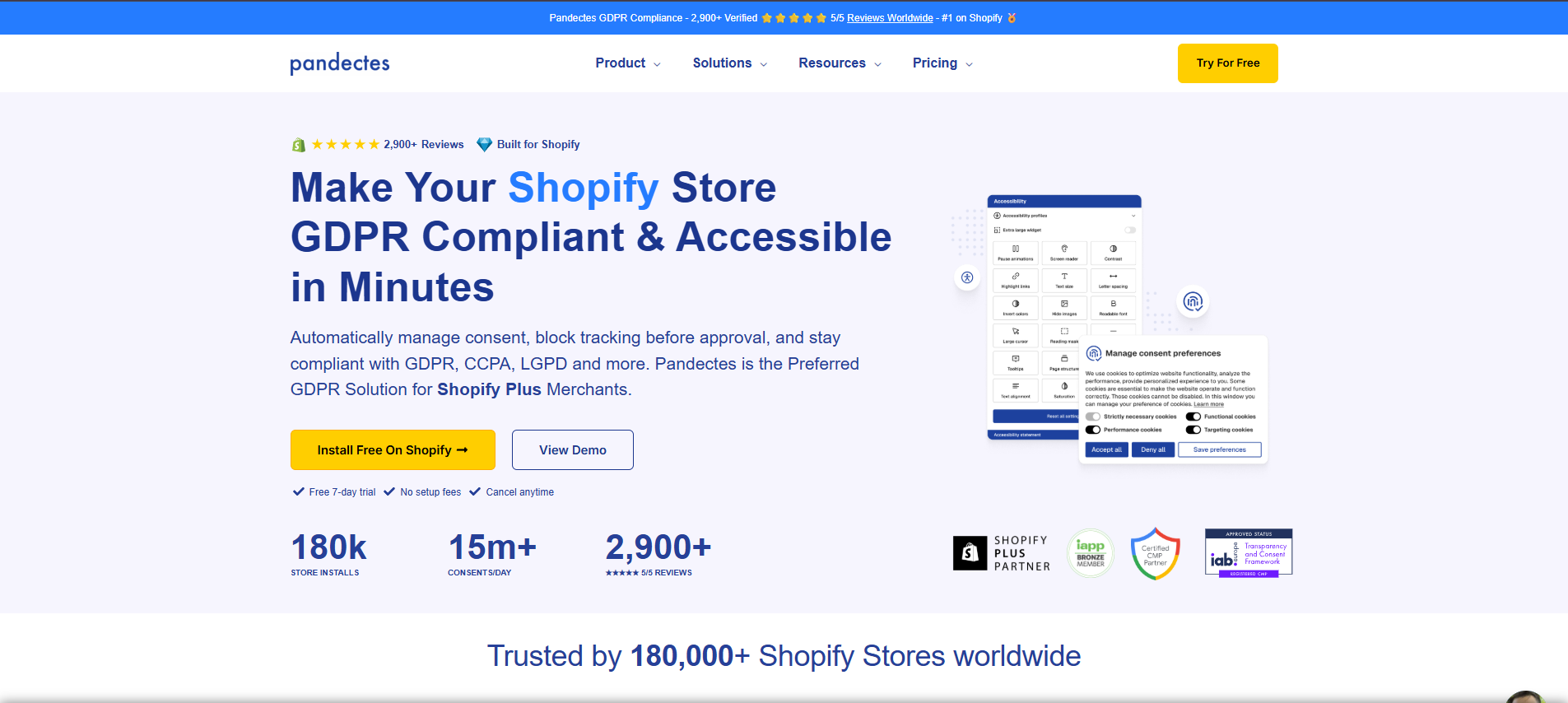
Pandectes scores approximately 3.9 out of 5 on our ecommerce-fit score. We have not yet published a full Consently review of Pandectes. Its global score is an estimate from public evidence and is flagged as provisional. The ecommerce-fit composite reflects two verified facts: strong pixel/CMv2 capability (4.5) and a Shopify-only platform reach (3.0).
Key Features
Pandectes builds deep Shopify-native blocking and scale support across the features below.
-
Native Shopify app with more than 2,900 five-star Shopify App Store reviews at time of writing
-
Google Consent Mode v2 on all plans
-
Advanced script, iframe, and pixel blocking with custom rules (Premium and above)
-
Shopify Plus and multistore support on the Enterprise plan
-
Free plan available; paid plans run $9 to $49/mo
Pros
These strengths reflect Pandectes’s native Shopify fit for high-volume stores.
-
The most reviewed Shopify GDPR app by App Store rating volume at time of writing
-
Native Shopify integration with deep access to Shopify checkout surfaces
-
Advanced pixel/tag blocking with custom rules for high-volume stores that need fine-grained control
-
Shopify Plus and multistore support on Enterprise ($49/mo)
Cons
These limitations are real and currently true, led by a Shopify-only ceiling.
-
Shopify-only: no WooCommerce, BigCommerce, Webflow, Squarespace, or custom site. The multi-store/platform sub-factor scores 3.0 here, not 5.0, because of this single-ecosystem limit
-
Advanced blocking features (custom rules, iframe blocking) are gated to Premium ($29/mo) and above
-
No Consently review published yet. The global score (~3.9) is an estimate from public evidence; treat it as provisional until a full review is available
-
No policy generators bundled
Pricing
Pandectes prices in four Shopify-billed tiers, verified live on 2026-06-24.
-
Free: $0/mo, basic consent banner, CMv2
-
Plus: $9/mo
-
Premium: $29/mo, advanced blocking with custom rules
-
Enterprise: $49/mo, Shopify Plus and multistore support
What Users Say
The Shopify App Store aggregate (2,900-plus five-star ratings at time of writing) reflects consistent praise for ease of setup and native Shopify fit. No single verbatim quote from independent reviews was captured; treat the App Store aggregate as the primary sentiment signal. Pandectes has no review or comparison page in our network yet; see its Shopify App Store listing for the current rating and user comments.
8. ConsentManager: best for ad-heavy stores and publisher-commerce
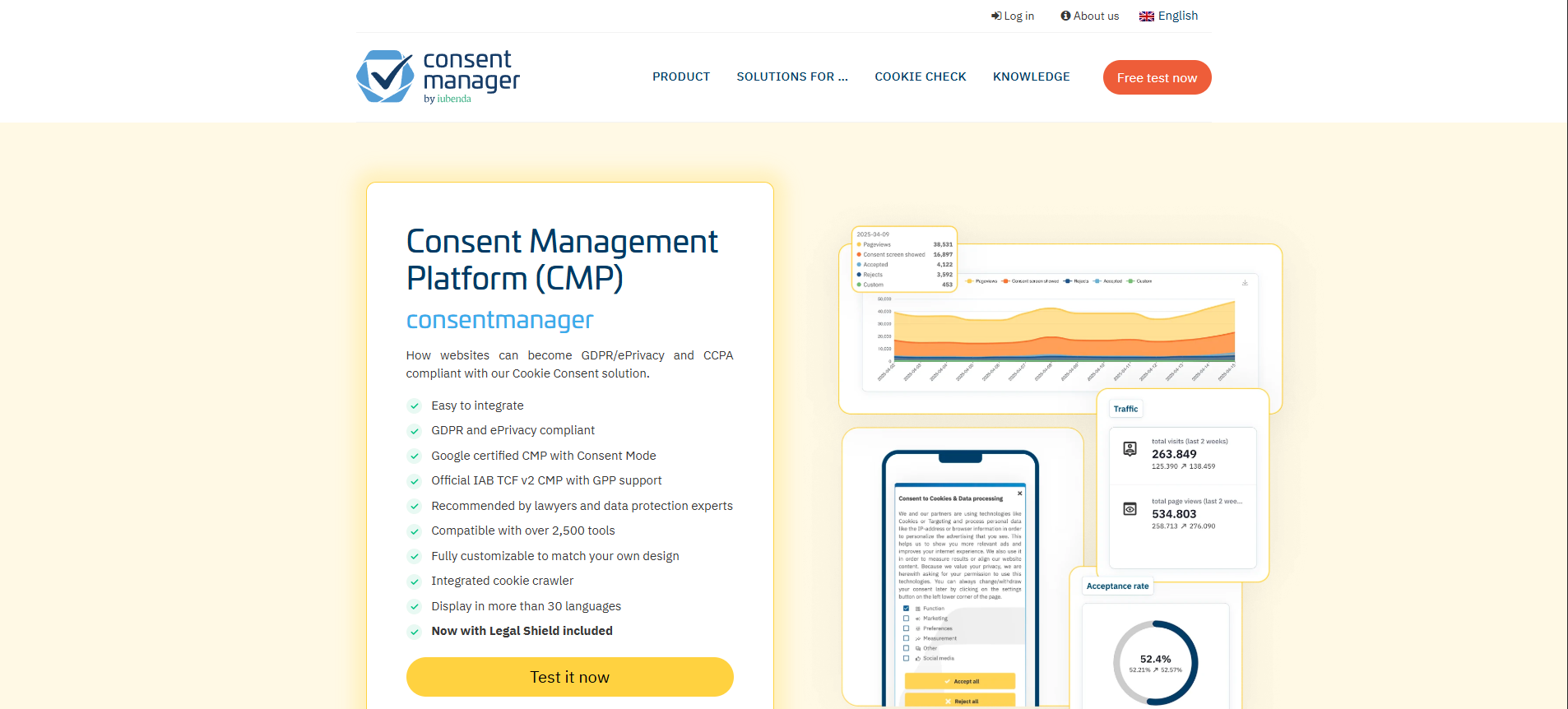
ConsentManager scores 3.9 out of 5 globally and 3.9 on our ecommerce-fit score. It is the best fit for stores that run programmatic advertising or need consent-rate optimization alongside compliance.
Key Features
ConsentManager builds a certified ad-tech and consent-rate stack across the features below.
-
Dual IAB TCF v2.2 and v2.3 certification as a registered IAB CMP (ID 31)
-
Cookie Crawler with a 3-million-plus cookie database and automatic script blocking
-
Built-in A/B testing with machine-learning consent-rate optimization aimed at lifting opt-in rates and ad revenue
-
Google Consent Mode v2, server-side and client-side, plus mobile and CTV SDKs
-
White-label deployment on the Ultimate plan
-
EU data residency; consent data stored on EU servers
Pros
These strengths target ad-driven stores that optimize opt-in rates and ad revenue.
-
The certified ad-tech stack for ad-driven stores: dual TCF certification, CMv2, and ML consent-rate optimization in one platform
-
A/B testing and ML optimization directly target the store’s opt-in rate and measurable ad revenue
-
Crawler “reliably finds tools” and the support is “fast enough,” per G2 and Capterra reviewers
-
EU data residency with ISO-backed data handling
Cons
These limitations are real and currently true, led by config-heavy onboarding.
-
Config-heavy onboarding: around nine documented stages including vendor mapping, which is genuine work for a non-technical operator
-
IAB TCF and A/B testing are gated to the EUR59 Essential plan; free and Starter tiers get neither
-
Per-view metered billing can compound for high-traffic stores (Essential handles three domains; Pro handles 20 with per-view charges)
-
Privacy-policy generator only; no cookie policy or terms-and-conditions generator
-
No native cart app; script or SDK only
Pricing
ConsentManager prices per view across five tiers, with TCF gated to Essential.
-
Free: 1 site, 3,000 views per month
-
Starter: EUR23/mo
-
Essential: EUR59/mo, 3 domains, A/B testing, IAB TCF
-
Professional: EUR219/mo, 20 domains
-
Ultimate: custom (white-label)
What Users Say
G2 reviewers credit support responsiveness and the crawler’s reliability. One Capterra reviewer cited difficulty with the app SDK integration. Read the full ConsentManager review or compare directly with Consently vs ConsentManager.
9. CookieYes: best budget banner for single stores
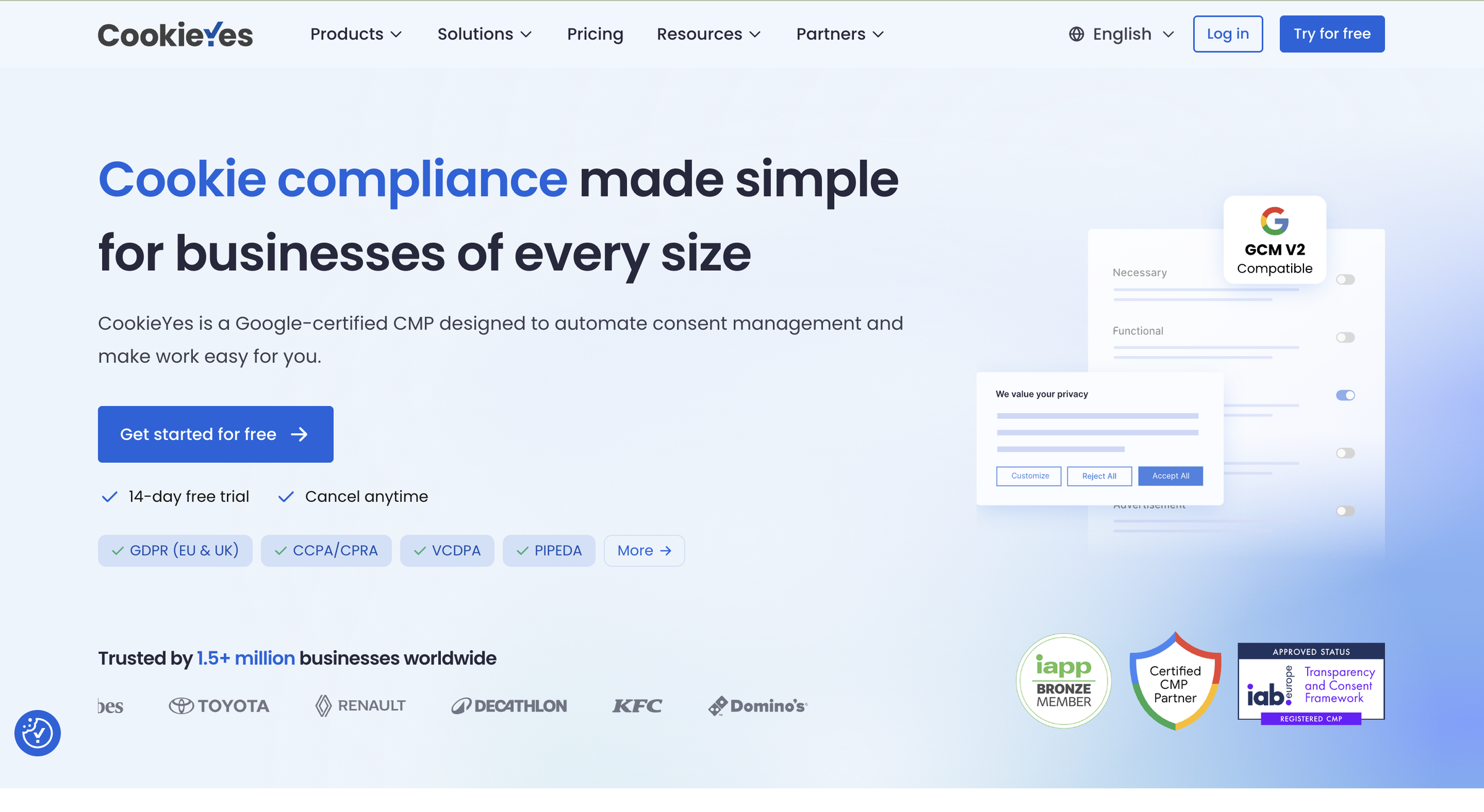
CookieYes scores 3.8 out of 5 globally and 3.8 on our ecommerce-fit score, the cleanest budget single-store pick. Its per-domain pricing and pageview overage make it an expensive choice as soon as you run more than a couple of sites.
Key Features
CookieYes keeps setup simple with certified blocking across the features below.
-
Google-certified Consent Mode v2 banner with auto-blocking on every plan, including free
-
Scanner backed by a 100,000-plus cookie database
-
Native Shopify, WordPress, and Wix apps plus one-line script for other platforms
-
Two policy generators: privacy policy and cookie policy (no T&C)
-
More than 1.5 million sites use it
Pros
These strengths reflect CookieYes’s easy setup and strong support reputation.
-
Certified CMv2 and auto-blocking on every plan, including free (pixel/CMv2 4.5)
-
Easiest setup of any paid tool here: one-line script, WordPress plugin, Shopify app, or Wix app
-
Outstanding support: Trustpilot 4.8, Capterra reviews consistently credit the team’s responsiveness
-
A genuinely useful free plan for a small store (5,000 pageviews, 1 domain)
Cons
These limitations are real and currently true, led by per-domain pricing and overage.
-
Per-domain pricing plus pageview overage ($0.30 per 1,000 over the cap on Basic and Pro) compounds fast for stores running multiple domains
-
Core customization features are gated: custom banner colors and CSS require Basic ($10/mo); IAB TCF, GPC, and geo-targeting require Pro ($25/mo)
-
The free tier has narrowed in recent years: a
-
No terms-and-conditions generator
Pricing
CookieYes prices per domain across four tiers, each with a pageview cap.
-
Free: 5,000 pageviews, 1 domain
-
Basic: $10/mo per domain, 30,000 pageviews, custom colors
-
Pro: $25/mo per domain, 200,000 pageviews, IAB TCF, geo-targeting, GPC
-
Ultimate: $55/mo per domain, unlimited pageviews, priority support
What Users Say
Capterra reviewers consistently praise setup ease and support speed. The negative tail at WordPress.org centers on the free tier’s recent narrowing and the per-domain model’s cost impact for agencies or multi-site owners. Read the full CookieYes review or see CookieYes alternatives for flat multi-domain options.
10. Osano: best for stores that need a full privacy program
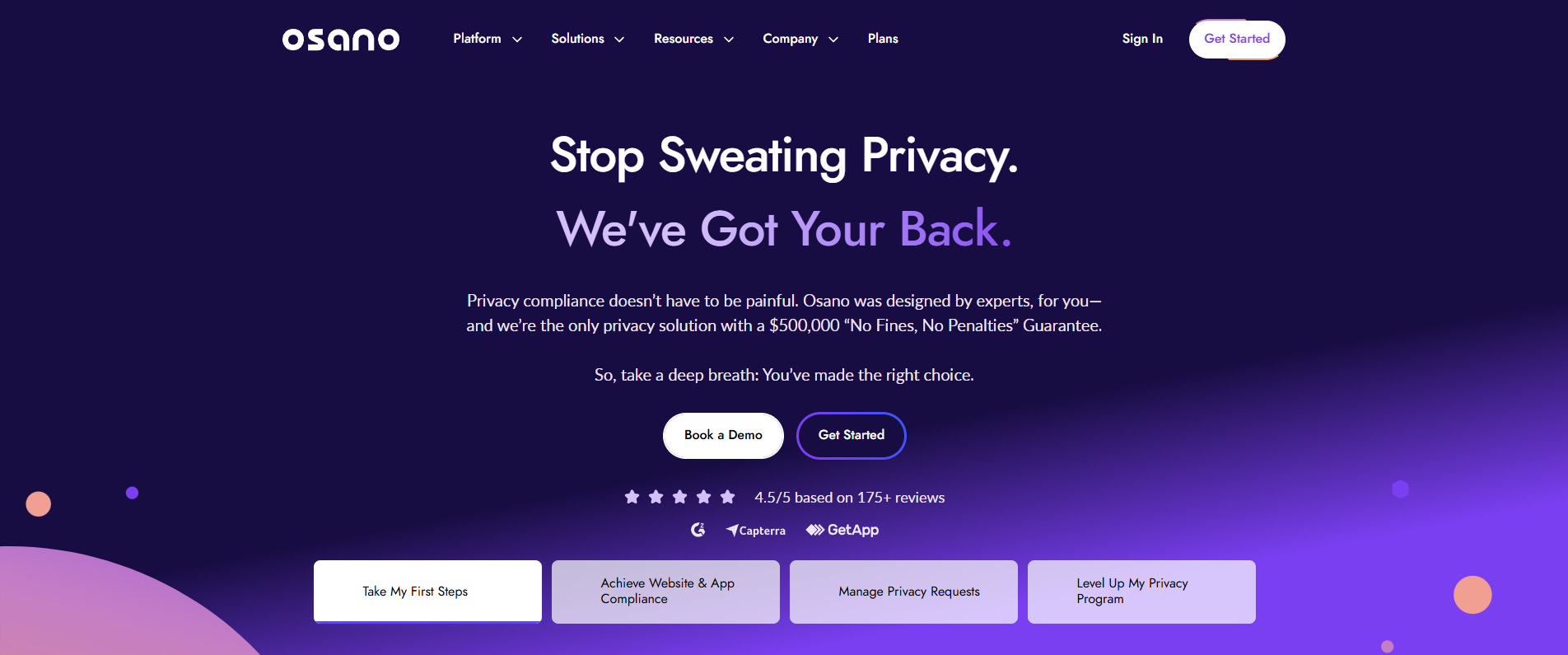
Osano scores 3.9 out of 5 globally but 3.8 on our ecommerce-fit score, because it lacks multi-store economics and a native cart app. The gap between the global score and the ecommerce score shows how the ecommerce-weighted composite works. Osano’s platform and multi-store limits (multi-store/platform 1.5) drag it below tools with narrower compliance depth but stronger multi-store reach.
Key Features
Osano covers a full privacy program beyond consent across the features below.
-
One-line JavaScript CMP with AI scanning and auto-blocking
-
Google Consent Mode v2, IAB TCF, and GPP (Global Privacy Platform) with GPC support
-
DSAR automation, data mapping with RoPA, privacy assessments, and vendor risk management
-
$500,000 “No Fines, No Penalties” guarantee on enterprise Start, Trust, Scale, and Basic Privacy plans
-
40-plus languages; 50-plus country coverage
Pros
These strengths reflect Osano’s privacy-program breadth and brand backing.
-
The only self-serve platform here that covers the full privacy program: consent plus DSAR, data mapping, and vendor risk
-
Strong support and brand backing: $25 million Series B in 2023, Public Benefit Corporation structure
-
AI scanning and auto-blocking with strong measured page-speed performance
-
The CMv2, TCF, and GPP stack covers both EU and US privacy simultaneously
Cons
These limitations are real and currently true, led by weak multi-store economics.
-
The entry paid tier is $199/mo for three domains and 30,000 monthly visitors. A store that only needs a cookie banner rarely justifies that spend.
-
Self-serve caps at three domains, then routes to a sales conversation
-
No way to share rules across configurations. One G2 reviewer noted this creates repetitive setup work across store accounts, the direct driver of the multi-store/platform sub-factor score of 1.5
-
The $500,000 guarantee excludes the Free and Plus self-serve tiers, which are the tiers most small stores actually use
-
No native cart app; script-only
Pricing
Osano prices a free tier and a $199 self-serve tier, then routes to sales.
-
Free: 1 domain, 5,000 monthly visitors
-
Plus: $199/mo, 3 domains, 30,000 monthly visitors, 2 users
-
Basic Privacy and enterprise plans: custom pricing
What Users Say
One founder on r/webdev called Osano “legitimately good for sub-$1M ARR” and credited the entry plan with handling GDPR and CCPA adequately. G2 reviewers praise support and ease of use for the full privacy-program buyer. The documented negative patterns are the $199/mo entry cost for cookie-only stores and the repetitive multi-config setup. Read the full Osano review or compare directly with Consently vs Osano.
What Is the Best Cookie Consent Platform for Ecommerce?
Enzuzo (ecommerce-fit 4.2, global 3.9) is the top pick for cross-platform ecommerce stores. It delivers certified Consent Mode v2 and real DSAR automation without locking the store into a single platform ecosystem. Below is the per-need breakdown:
-
Deepest native Shopify app: Consentmo (ecommerce-fit 4.2), Built-for-Shopify certified, CMv2 and script blocking free, 282-region geotargeting on Plus
-
Most certified scanning and ad recovery: Cookiebot (ecommerce-fit 4.0, global 4.0), the highest global score on this list and the Gold-tier CMv2 standard
-
Regulated, audit-grade ad recovery: Secure Privacy (ecommerce-fit 4.0), SOC 2 Type II, Gold-tier CMv2 Advanced, and governance depth for legal-team accountability
-
Ad-heavy and publisher-commerce stores: ConsentManager (ecommerce-fit 3.9), dual IAB TCF and consent-rate ML for ad-revenue-dependent operations
Cookiebot’s position is worth naming explicitly. It holds the highest global score here (4.0) but lands at ecommerce-fit 4.0 in third place. Its per-domain billing model scores 2.0 on the multi-store sub-factor. The composite reflects a real buyer difference, not a ranking artifact.
Consently fits budget multi-store operators across Shopify, WooCommerce, Wix, Squarespace, or custom carts. Shopify stores can now use its brand-new native Shopify app, WooCommerce stores get the official WordPress plugin, and others install by script or GTM.
It offers flat multi-domain pricing and every feature on every plan, undercutting per-domain tools at the three-to-five-store level. That is the specific case where Consently earns its rank-6 ecommerce-fit score of 4.0.
For the broader field, see best consent management platforms or best cookie consent tools. For the deep Shopify-native comparison, the platform-fit section above links our dedicated Shopify guide.
FAQs
What is the best cookie consent platform for an ecommerce store?
Enzuzo tops our ecommerce-fit ranking at 4.2 for cross-platform multi-store stores. It is certified for Consent Mode v2 and Microsoft Consent Mode, ships native Shopify and Webflow apps, and bundles up to 20 domains. Consentmo also scores 4.2 and is the deepest native Shopify pick. Cookiebot holds the highest global score (4.0) for certified scanning depth.
Which cookie consent tools have a native Shopify app?
Consentmo (Built for Shopify, certified), Pandectes, Enzuzo, CookieYes, and Consently ship native Shopify apps installable from the Shopify App Store. Cookiebot, Cookie Script, Secure Privacy, ConsentManager, and Osano install by head script or GTM instead. Consently’s Shopify app is brand-new and uses the Customer Privacy API, though it is less proven than Consentmo’s mature app. A Shopify-first store should weigh a native app over a script install for Customer Privacy API access.
Why does Google Consent Mode v2 matter for ecommerce?
Consent Mode v2 lets Google model conversions and audiences even when a visitor rejects cookies, preserving Google Ads and GA4 measurement in the EU. Without it, an ad-driven store loses conversion attribution and retargeting capability for consenting visitors entirely after a reject. For stores spending on Google Ads, the measurement gap is a direct revenue impact, not a legal footnote.
How do I stop cookie consent from blocking my checkout?
Categorize checkout, cart, session, and order-processing cookies as Essential in your CMP’s cookie manager. Essential cookies always load regardless of consent. Miscategorizing them as Analytics or Marketing is the usual cause of blocked product images, prices, or broken order submissions on WooCommerce and Shopify. Review the scanner output after setup, and test the full checkout flow end-to-end with prior blocking enabled.
What is the cheapest cookie consent for multiple stores?
By flat list price, Consently undercuts per-domain rivals at the three-to-ten-store level. It covers 5 stores for $199 (one-time or yearly) and 10 stores for $349 one-time ($499/yr), with shared pageviews and no overage. Enzuzo bundles 4, 10, or 20 domains by tier starting at $22/mo for four domains. Per-domain tools (Cookiebot, CookieYes, Secure Privacy) stack in cost as you add stores and can cost several times more by the fifth domain.
Do I need pixel blocking for my Meta and Google ads?
Yes. Marketing pixels (Meta, Google, TikTok, and others) must be blocked from executing until the visitor consents. Otherwise the store is tracking without permission, which creates CIPA and wiretap exposure in the US and GDPR liability in the EU. Cookiebot, Secure Privacy, and Consentmo offer certified prior blocking from their ad-recovery documentation. Test any tool on your own store to verify no pixels fire before consent on the actual checkout path.
Is Consently good for ecommerce?
Yes on cost and feature coverage. It offers flat multi-store pricing, a one-time lifetime option, and every feature on every plan. The three-generator bundle adds Consent Mode v2 and IAB TCF 2.3 on a budget. Consently now also ships a brand-new native Shopify app that enforces consent through the Customer Privacy API.