

The strongest Complianz alternatives in 2026 are Cookiebot, CookieYes, WPConsent, and Consently, depending on which Complianz limitation you are escaping. Teams leave Complianz for three structural reasons. Those are WordPress and Shopify lock-in, plugin conflicts that silently break the banner, and a scanner and wizard gated behind paid tiers. Every tool below is scored against those triggers, from free to enterprise and WordPress-only to CMS-agnostic.
Below: a quick list, why teams switch, the switching criteria, a comparison table, and detailed picks with migration steps. The goal is to find your fit without reading ten vendor sites.
Best Complianz Alternatives at a Glance
These nine tools are ordered by switching-fit tier first, then by independent review score within each tier. Each entry names the specific Complianz problem it solves.
-
Cookiebot: best for a single site that needs maximum certification depth, cloud-based so no WordPress plugin conflict is possible
-
CookieYes: best for WordPress users who want easier setup and stronger support, with the largest cloud install base
-
WPConsent: best for WordPress agencies who want to stay on WordPress but drop Complianz, built by the WPForms team
-
Consently: best for multi-platform teams leaving WordPress or Shopify lock-in, with every feature on every plan
-
Termly: best for teams that need policy documents alongside cookie consent, with ten document generators
-
iubenda: best for legal-first teams who want lawyer-maintained documents across multiple jurisdictions
-
Real Cookie Banner: best for WordPress developers who want a self-hosted alternative with no cloud dependency
-
CookieFirst: best for EU-hosted compliance with ISO 27001 Amsterdam infrastructure
-
CookieHub: best for non-profits and resellers that can use session-metered pricing
Disclosure: This guide is written by the Consently team. Consently competes with Complianz and every tool on this list. It appears in the ranking, scored by the same rubric as everyone else, never self-ranked first.
How we score: Every product carries the overall score from our published review methodology, which weights Compliance, Scanning, Banner, Setup, Pricing, Performance, and Support. The list is ordered by switching-fit tier, then that score. Read the full method at how we review consent management software.
Why People Switch from Complianz
Teams leave Complianz primarily over WordPress and Shopify lock-in and plugin conflicts that break the banner. Complianz still earns its reputation. It carries 1 million-plus active installs and a 4.7/5 rating on WordPress.org. It is IAB TCF certified (CMP ID 332), runs A/B testing on every plan, and logs unlimited pageviews and consents. It is a capable, well-built WordPress tool the iubenda Group has backed since its 2024 acquisition. For a single WordPress site where all of that matters, it remains one of the strongest options in the category.
The switching pressure comes from three specific friction points, detailed below.
-
Plugin conflicts causing banner failures: A 2025 WordPress.org support thread titled “Unfortunately no longer a good solution” captured the most common exit scenario. The banner stops appearing in certain browser configurations, support cannot identify the root cause, and the user leaves. The poster’s conclusion was direct: “reliability is crucial for GDPR solutions.” Complianz operates deeply inside the WordPress stack, so conflicts with caching plugins, page builders, or JavaScript optimizers can break the banner silently.
-
Platform lock-in: Complianz’s own pricing page states the plugin is “currently available exclusively for WordPress,” with a separate Shopify app. Any team running WooCommerce alongside a Webflow landing page, a Wix storefront, or another non-WordPress property must run a second consent tool. That operational split becomes a compliance liability when consent records diverge across tools.
-
Configuration complexity and the scanner paywall: The setup wizard is detailed, and for non-technical WordPress users the number of options creates real friction. The cookie scanner and policy generators are included on paid plans, but the free WP.org version requires more manual configuration. Complianz earns respect from developers who invest in its configuration, less so from owners who want a working banner in under an hour.
Honest carve-out: Complianz remains the right tool for a single WordPress site. That holds especially for a site with a developer who can tune the wizard and resolve plugin conflicts. The alternatives below are strongest when your stack crosses platforms, when plugin conflicts break the banner, or when you want every feature without tier-gating.
Our full Complianz review covers its scorecard and setup in detail.
How to Choose a Complianz Alternative
Identify which Complianz switching trigger is actually driving your evaluation, then weigh alternatives against the criteria below. Each maps to a real reason teams leave.
Platform breadth: WordPress-only vs. CMS-agnostic
The plugin lock-in trigger lives here. If you run WooCommerce alongside Webflow, Wix, or a custom stack, you need a tool that deploys via a single snippet across every platform. A WordPress-only plugin will not do. WPConsent and Real Cookie Banner stay WordPress-only, so they do not solve the lock-in problem.
Setup speed and conflict risk
The reliability trigger maps to setup model. Cloud-based CMPs (Cookiebot, CookieYes, Consently) load a hosted script and sidestep the plugin-conflict failure mode that breaks Complianz banners. Count the steps from signup to a working, compliant banner, and whether a developer is required.
Policy document breadth
If your Complianz plan does not generate the legal documents you need, document breadth is the deciding criterion. Termly ships ten generators and iubenda maintains lawyer-written documents across jurisdictions, while most cookie-first CMPs generate a cookie policy only.
Pricing model: flat vs. per-domain vs. per-session
Match the billing model to your portfolio. Each billing model suits a different stack. Options include flat multi-domain bundles (Consently), flat per-site annual pricing (WPConsent, Termly), per-domain subscriptions (Cookiebot, CookieYes, iubenda), and session-metered pricing (CookieHub).
Certification stack and IAB TCF entry point
Confirm the tool carries IAB TCF certification, Google Consent Mode v2, and GDPR opt-in consent mode, and check at which plan IAB TCF unlocks. Cookiebot, WPConsent, Consently, and Complianz include IAB TCF on every paid plan; CookieYes, Termly, iubenda, and CookieHub gate it to a higher tier.
How These Complianz Alternatives Compare
The table below lists Complianz as the reference row, with every alternative scored on the same criteria. One fact worth surfacing first: switching from Complianz does not automatically diversify your vendor. Complianz, CookieFirst, and iubenda all sit under the iubenda Group, so three of these ten tools share one parent. The cleanest break from that concentration is Cookiebot (Usercentrics), CookieYes, WPConsent (Awesome Motive), Termly, CookieHub, or Consently.
| Tool | Starting price (paid) | Platforms | IAB TCF | Policy docs | Free tier | L1 score |
|---|---|---|---|---|---|---|
| Complianz (reference) | $59/yr (1 site) | WordPress, Shopify | Yes (all plans) | Yes (all plans) | Yes (WP.org, limited) | 3.9/5 |
| Cookiebot | €7/mo (1 domain) | Any (snippet), WP, Shopify, Wix | Yes (paid plans) | No | Yes (50 subpages) | 4.0/5 |
| CookieYes | $10/mo (1 domain) | Any (snippet), WP, Shopify, Wix | Pro and above | No | Yes (5K pv/mo) | 3.8/5 |
| WPConsent | $99/yr (1 site) | WordPress only | Yes (all plans) | Cookie policy | No | Not yet reviewed |
| Consently | $99/yr (1 domain) | Any (snippet), WP, Shopify, Wix | Yes (all plans) | Yes (all plans) | 14-day trial | n/a (author) |
| Termly | $10/mo (1 site) | Any (snippet), WP | Yes (Pro+) | Yes (10 generators) | Yes (1 policy, 10K views) | 3.8/5 |
| iubenda | $5.99/mo (1 site) | Any (snippet), WP, Shopify | Advanced and above | Yes (lawyer-maintained) | 14-day trial | 3.6/5 |
| Real Cookie Banner | PRO (devowl.io) | WordPress only | Yes (PRO) | No | Yes (WP.org, limited) | Not yet reviewed |
| CookieFirst | €9/mo (1 domain) | Any (snippet), WP | Yes (paid plans) | Cookie policy only | Yes (1 script) | 3.8/5 |
| CookieHub | €6/mo (1 domain) | Any (snippet), WP | Business (€30/mo) | No | Yes (1K sessions/mo) | 3.9/5 |
Prices and features verified June 2026. Complianz data is from complianz.io/pricing. L1 scores come from our independent reviews, scored on the methodology linked under the quick list above. WPConsent and Real Cookie Banner have not yet been reviewed with the full methodology. As the author, Consently is not self-scored. Visit each product's site for current rates.
1. Cookiebot: Best for Maximum Certification Depth (4.0/5)
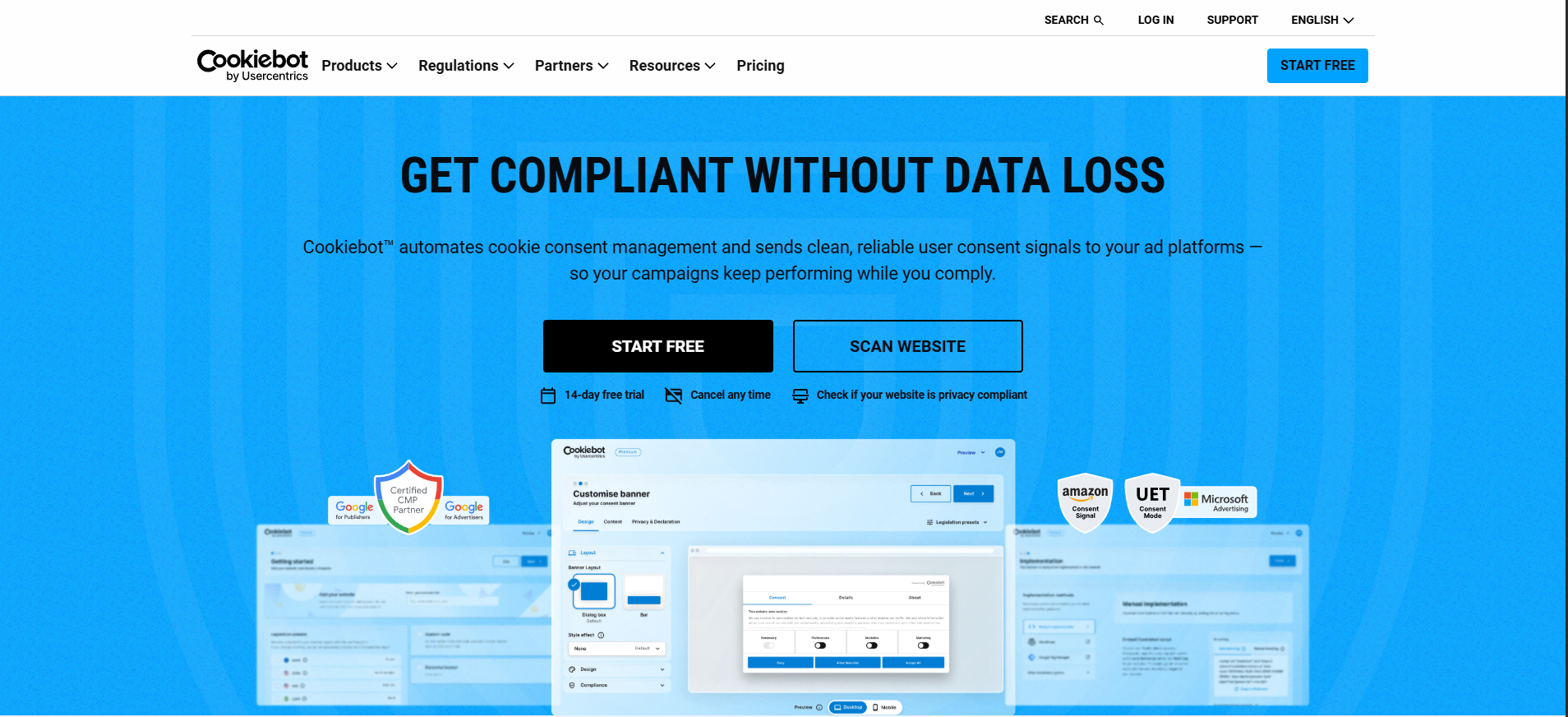
Cookiebot, by Usercentrics, is the most-certified option on this list and the highest scorer in this pool at 4.0 out of 5. It is the strongest pick for a single site that wants a defensible, independently certified compliance posture and a set-and-forget scanning workflow. Because it loads as a hosted script, it sidesteps the plugin-conflict failure mode that drives WordPress teams away from Complianz.
Best for: Single sites and compliance-led teams that prioritize certification depth and automatic scanning over multi-site cost.
Key Features
Cookiebot's feature set centers on certification depth and automatic scanning.
-
Google Gold Tier CMP Partner status, ISO 27001 and ISO 27701 certified
-
Automatic monthly domain scanning backed by a 13,000-plus cookie repository
-
IAB TCF on every paid plan, no top-tier gate
-
Google Consent Mode v2 on all plans
-
Banner in 47-plus languages with geo-targeting
-
Deploys via WordPress plugin, Shopify app, or JavaScript snippet on any platform
-
Covers 600,000-plus customers and 2.4 million websites and apps
Pros
Cookiebot's strengths cluster around compliance credibility and conflict-free deployment.
-
IAB TCF included on every paid plan, unlike CookieYes and Termly which gate it to a higher tier
-
Certification depth is unmatched in this pool: Google Gold Tier, ISO 27001, and ISO 27701
-
Cloud-hosted script eliminates the plugin-conflict banner failures that drive Complianz exits
-
Automatic monthly scans with the largest cookie repository here
Cons
Cookiebot's weaknesses are concentrated in its billing model.
-
Per-domain pricing, and each subdomain counts as a separate billable domain: example.com, it.example.com, and uk.example.com are three subscriptions, not one
-
A scan that crosses a subpage threshold upgrades your tier automatically, producing surprise invoices
-
A base price increase in August 2025 raised entry costs
-
No native A/B testing or consent optimization at the self-serve tier
Pricing
Free: EUR 0 (1 domain, 50 subpages). Premium Lite: EUR 7/mo (1 domain). Premium Small: EUR 15/mo/domain for 4-plus domains, or EUR 30/mo for 1 to 3 domains (350 subpages, IAB TCF). Premium Medium: EUR 30/mo/domain (3,500 subpages). Pricing scales by domain with no flat multi-domain bundle.
What Users Say
Cookiebot is recommended most by compliance managers in regulated industries and companies with multi-jurisdiction presence. Reviews praise the regulation depth and automatic scanner quality. The most cited frustration is cost at multi-domain scale. One TrustRadius reviewer described "bogus variances of monthly charges." It holds 4.2/5 on G2 from 178 reviews and 4.3/5 on Capterra from 52 reviews.
Migrating from Complianz to Cookiebot
Add Cookiebot via the WordPress plugin, the Shopify app, or a JavaScript snippet in your site's <head>. Run Cookiebot's first automatic scan to rebuild your cookie category list. Configure Google Consent Mode v2 via Cookiebot's GTM template. Deactivate and remove the Complianz plugin after the scan completes, and you confirm the banner fires correctly. Consent records do not transfer between platforms, so a re-consent event is normal and expected.
Our full Cookiebot review covers the pricing math and verified user evidence in detail.
If the per-domain model is the sticking point, see other tools in Cookiebot's class and a direct Consently versus Cookiebot comparison.
Cookiebot is also a frequent pick in any best consent management platform comparison.
2. CookieYes: Best for Easier Setup and Stronger Support (3.8/5)
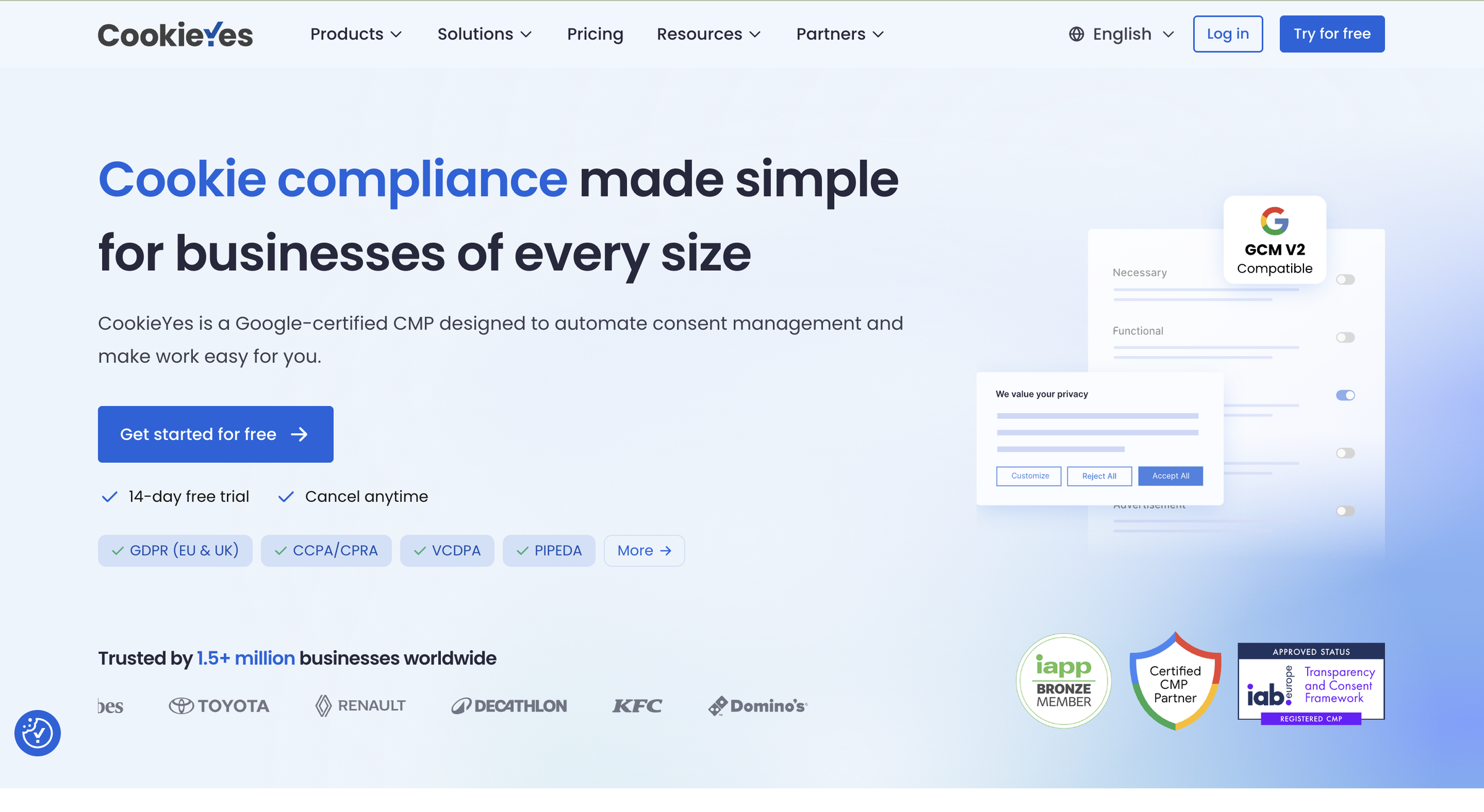
CookieYes is the most widely installed cloud alternative to Complianz on WordPress, with more than 1.5 million active installs. It scores 3.8 out of 5. It is the best fit for Complianz users frustrated by configuration complexity and weak support. Its dashboard is simpler, and its support is the most praised feature in its category. It runs as a WordPress plugin, Shopify app, Wix app, or snippet.
Best for: WordPress users who want the fastest setup path and the strongest support, and can absorb per-domain pricing.
Key Features
CookieYes pairs a simple cloud setup with broad platform coverage.
-
Per-domain pricing across four tiers: Free, Basic, Pro, Ultimate
-
IAB TCF v2.3 and Global Privacy Control on the Pro plan and above
-
Google Consent Mode v2 and Microsoft UET Consent Mode on all plans
-
Auto-blocking of non-essential cookies before consent
-
Deploys as a WordPress plugin, Shopify app, Wix app, or snippet
-
1.5 million-plus active installs, the largest cloud base here
Pros
CookieYes earns its reputation on support and setup speed.
-
Customer support is the standout attribute, earning the most praise of any feature on G2
-
Noticeably smoother setup than Complianz: one Capterra reviewer found it really easy to set up
-
Real free tier (5,000 pageviews per month per domain) lets you test before paying
-
Clean, intuitive dashboard that eases multi-site administration per G2 reviewers
Cons
CookieYes's drawbacks are mostly pricing and gating decisions.
-
Per-domain, per-month pricing gets expensive fast for agencies with many client sites
-
IAB TCF v2.3 and Global Privacy Control are gated to the Pro plan ($25/mo/domain)
-
Pageview cap carries a $0.30 per 1,000 overage fee, a common G2 complaint
-
No terms-and-conditions generator: the policy suite is privacy and cookie policy only
Pricing
Free: $0/domain (5,000 pageviews/mo). Basic: $10/mo/domain ($120/yr). Pro: $25/mo/domain ($300/yr), adds IAB TCF v2.3. Ultimate: $55/mo/domain ($660/yr). Versus Complianz at $59/yr for one site, CookieYes Basic costs $120/yr per domain, but adds a free tier and a smoother setup flow.
What Users Say
CookieYes reviews highlight exceptional support speed and a clean, easy-to-navigate dashboard. The most cited complaint is that per-domain pricing adds up quickly across multiple sites, and several reviewers mention auditing cookie categorization after scans. It holds 4.8/5 on G2 from 298 reviews and 4.8/5 on Trustpilot from 330 reviews.
Migrating from Complianz to CookieYes
CookieYes published a dedicated Complianz migration guide covering its step-by-step switching flow. Install the CookieYes WordPress plugin, configure your banner, and scan your site to rebuild the cookie category list. Activate Google Consent Mode v2, then test that the new banner fires in all browsers. Deactivate Complianz only after you confirm the CookieYes banner works. Consent records do not transfer, so returning visitors re-consent.
For the full evaluation, see our CookieYes review covering scanner accuracy and where the free plan stops being enough. For a wider view, see other tools in CookieYes's class and how Consently stacks up against CookieYes directly.
3. WPConsent: Best for WordPress Agencies Staying on WordPress (not yet reviewed)
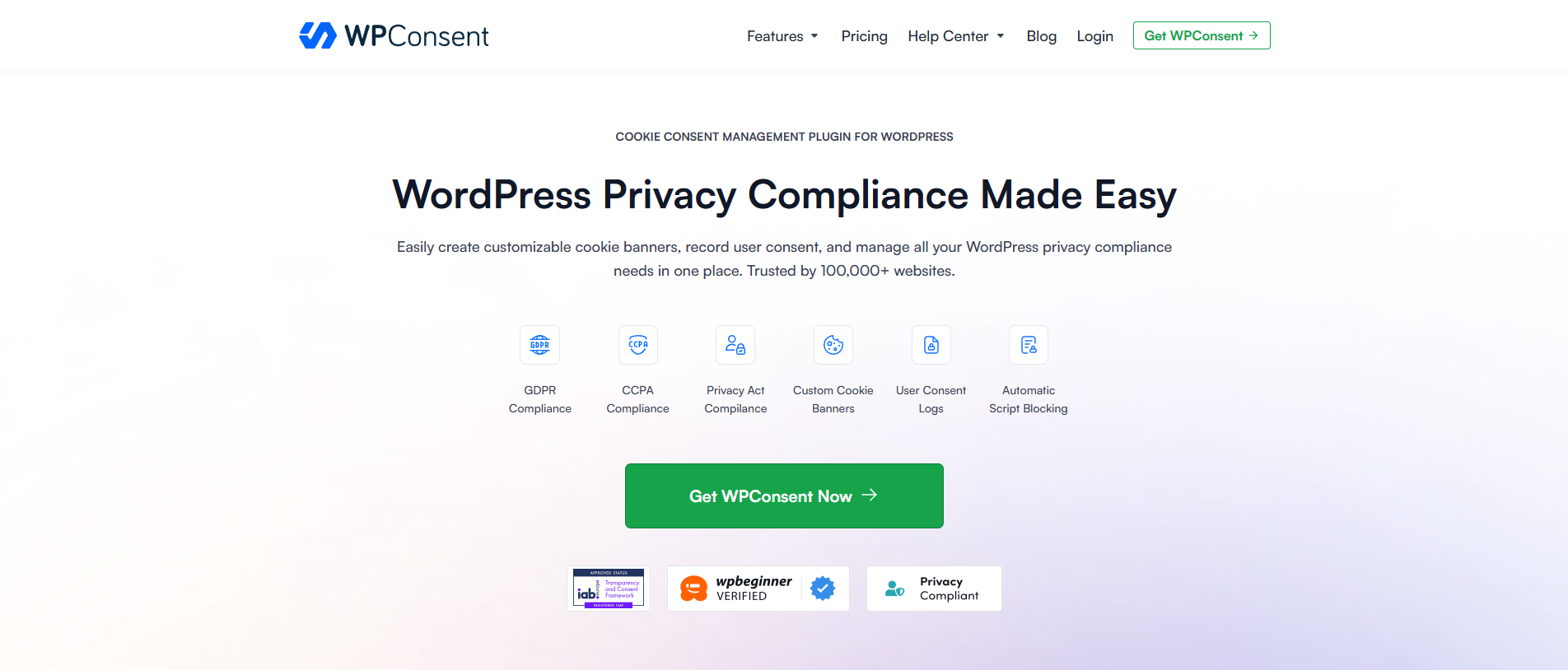
WPConsent is a WordPress-only consent plugin from the same team behind WPForms and MonsterInsights, and it has not yet been reviewed with our full methodology. It is the strongest pick for WordPress agencies and developers who want to drop Complianz but stay inside the WordPress ecosystem. Its integration focus is deliberate, auto-configuring consent for the trackers WordPress sites actually run.
Best for: WordPress-only agencies and developers who want clean plugin-ecosystem fit and predictable per-site cost.
Key Features
WPConsent's feature set is built tightly around the WordPress ecosystem.
-
WordPress-only plugin built by the WPForms and MonsterInsights team
-
Auto-configures consent for Google Analytics, the Facebook Pixel, WooCommerce, and 20-plus other services
-
Unlimited pageviews and unlimited scans on every plan
-
Self-hosted consent logs, so no data leaves your server
-
IAB TCF v2.2 included on all plans
-
Google Consent Mode v2 and auto-blocking included
Pros
WPConsent's strengths come from its native WordPress integration and flat pricing.
-
Auto-configures consent for 20-plus services, removing the manual tracker mapping Complianz requires
-
Unlimited pageviews and unlimited scans on every plan, with no usage caps
-
Self-hosted consent logs keep data on your own server
-
IAB TCF v2.2 included on all plans, with no top-tier gate
Cons
WPConsent's limitations stem from its WordPress-only scope and thin track record.
-
WordPress-only: if you run Webflow, Wix, Squarespace, or a custom stack, it does not solve the platform lock-in problem
-
No free tier; a 14-day money-back guarantee substitutes
-
The "introductory pricing" label on the pricing page signals renewal pricing may differ
-
Limited third-party sentiment evidence: it does not yet appear in independent review aggregators at the scale of Complianz or CookieYes, a real due-diligence gap
Pricing
Basic: $99/yr (1 site). Plus: $199/yr (5 sites). Pro: $399/yr (25 sites). Elite: $599/yr (100 sites). All plans include unlimited pageviews, unlimited scans, IAB TCF v2.2, and self-hosted logs. There is no free tier; a 14-day money-back guarantee applies.
What Users Say
WPConsent does not yet appear in independent review aggregators at the scale of Complianz or CookieYes, so third-party sentiment evidence is limited. The product trades on the WPForms team's reputation for clean, well-supported WordPress plugins. Buyers should weigh the thin public review base as a due-diligence gap and test the plugin against their own stack during the money-back window.
Migrating from Complianz to WPConsent
Install the WPConsent plugin from your WordPress dashboard and run its setup, which auto-detects Google Analytics, the Facebook Pixel, WooCommerce, and other supported services. Review the auto-configured consent categories and customize your banner. Deactivate and remove Complianz after confirming the WPConsent banner fires correctly across browsers. Consent records do not transfer between plugins, so returning visitors see a fresh consent notice.
4. Consently: Best for Multi-Platform Teams Leaving Lock-In (3.7/5)
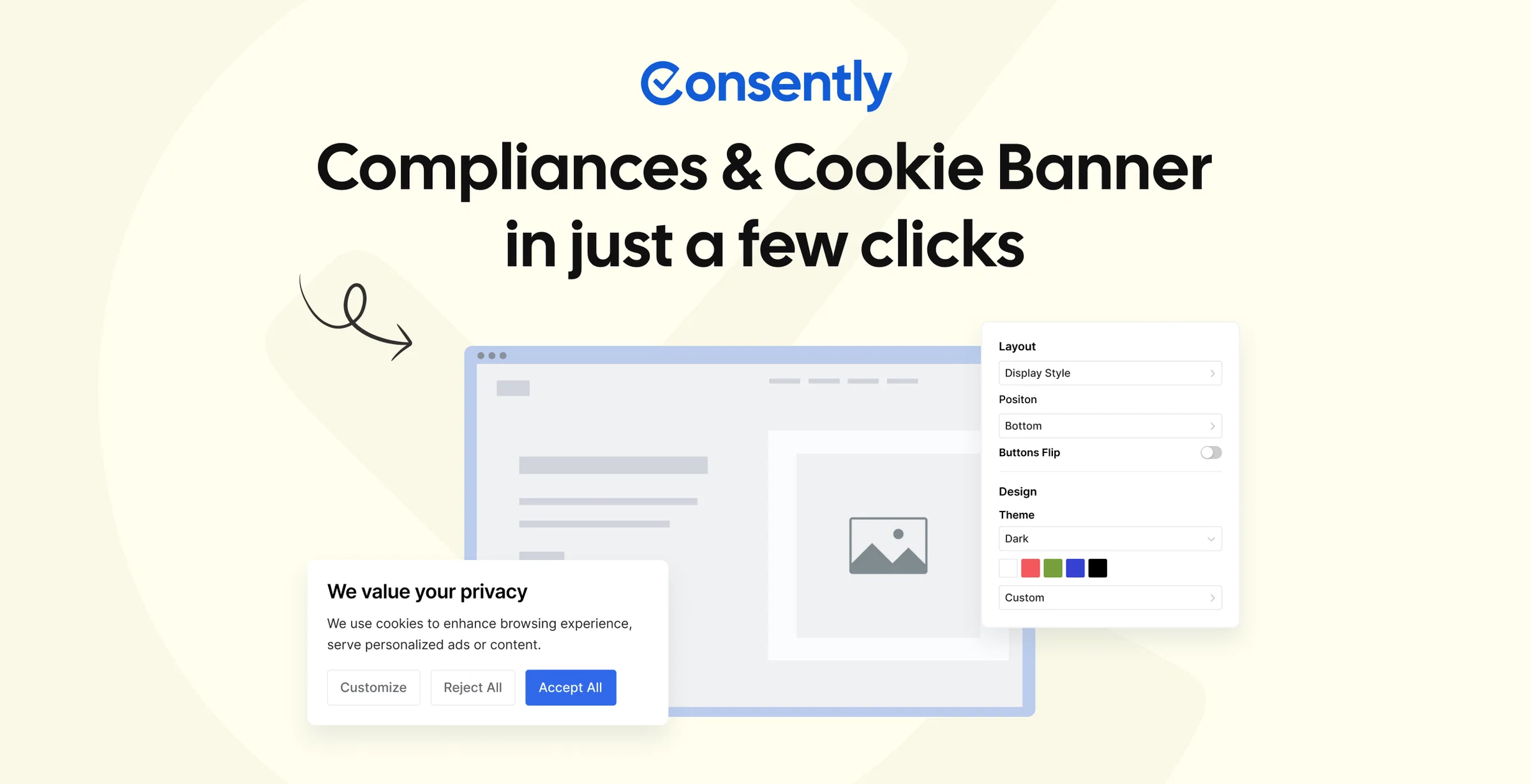
Consently is the most direct answer to Complianz's platform lock-in problem. It scores 3.7 out of 5 on the same rubric applied to every tool here (see the disclosure under the quick list). It is the best fit for teams leaving WordPress or Shopify lock-in who need one tool across every platform. It runs on any website via a single embed snippet, plus native plugins for WordPress, Shopify, and Wix. One consent log and one billing line manage the whole mixed-CMS stack.
Best for: Multi-platform teams running WordPress alongside other stacks, or expecting to grow beyond WordPress.
Key Features
Consently's feature set is designed around cross-platform coverage and flat pricing.
-
One embed snippet for any platform, plus native WordPress, Shopify, and Wix plugins
-
Every feature on every plan: no feature-gating by tier
-
IAB TCF, Google Consent Mode v2, and policy generation included on all plans
-
Automatic cookie scanning and prior blocking of non-essential scripts
-
Multi-language banners across 35 languages
-
EU Frankfurt data hosting
-
Live chat support on all plans, 14-day trial with no credit card
Pros
Consently's strengths are its architecture and its all-features-every-plan model.
-
One dashboard, one consent log, and one billing line across a mixed-CMS stack, which Complianz's WordPress-and-Shopify architecture cannot match
-
Every compliance feature on every plan: IAB TCF and Google Consent Mode v2 are not gated to a higher tier
-
Flat multi-domain pricing: five domains for $199/yr beats most per-domain models at that scale
-
Three policy generators and EU Frankfurt data hosting included on the entry plan
Cons
Consently's weaknesses reflect its youth and a few missing capabilities.
-
Younger product: launched October 2025 with a lower domain rating (DR 17) and fewer install-base years than Complianz on WordPress.org
-
Google CMP Partner status is pending approval, not yet confirmed
-
No mobile SDK and no banner A/B testing, two areas Complianz covers
-
No Global Privacy Control signal detection
-
Smaller, newer review base than tools in market for several years
Pricing
Basic: $99/yr ($8.25/mo, 1 domain, 100K pv/mo). Premium: $199/yr ($16.50/mo, 5 domains, 1M pv/mo). Enterprise: $499/yr ($41.50/mo, 10 domains, 3M pv/mo). Every feature is on every plan, and the 14-day trial needs no credit card.
See Consently pricing for the current tiers.
What Users Say
Consently's AppSumo launch generated 27 reviews averaging 4.0/5. Praise focuses on the flat all-inclusive pricing and the setup simplicity. Reviewers compare it favorably to CMPs where the most-needed feature is always one tier up. Criticism covers scanner queue times during peak load and the absence of a CSV export for the cookie list. AppSumo buyers are deal-motivated, so feedback skews toward price-value impressions.
Migrating from Complianz to Consently
Migration is a three-step swap.
-
Install the Consently WordPress plugin or add the embed snippet to your theme or via Google Tag Manager.
-
Run Consently's automatic scanner to rebuild your cookie category list, which covers the same cookie and tracker categories as Complianz's hybrid scanner.
-
Deactivate Complianz and remove its embed code if you added it outside the plugin.
Previous Complianz consent records do not transfer, which is standard for any consent-platform switch, so a fresh consent notice goes out to returning visitors. The 14-day trial needs no credit card, so you can run the migration in parallel before cutting over.
For a feature-by-feature breakdown against the tool you are leaving, see Consently vs Complianz.
5. Termly: Best for Policy Documents Alongside Cookie Consent (3.8/5)
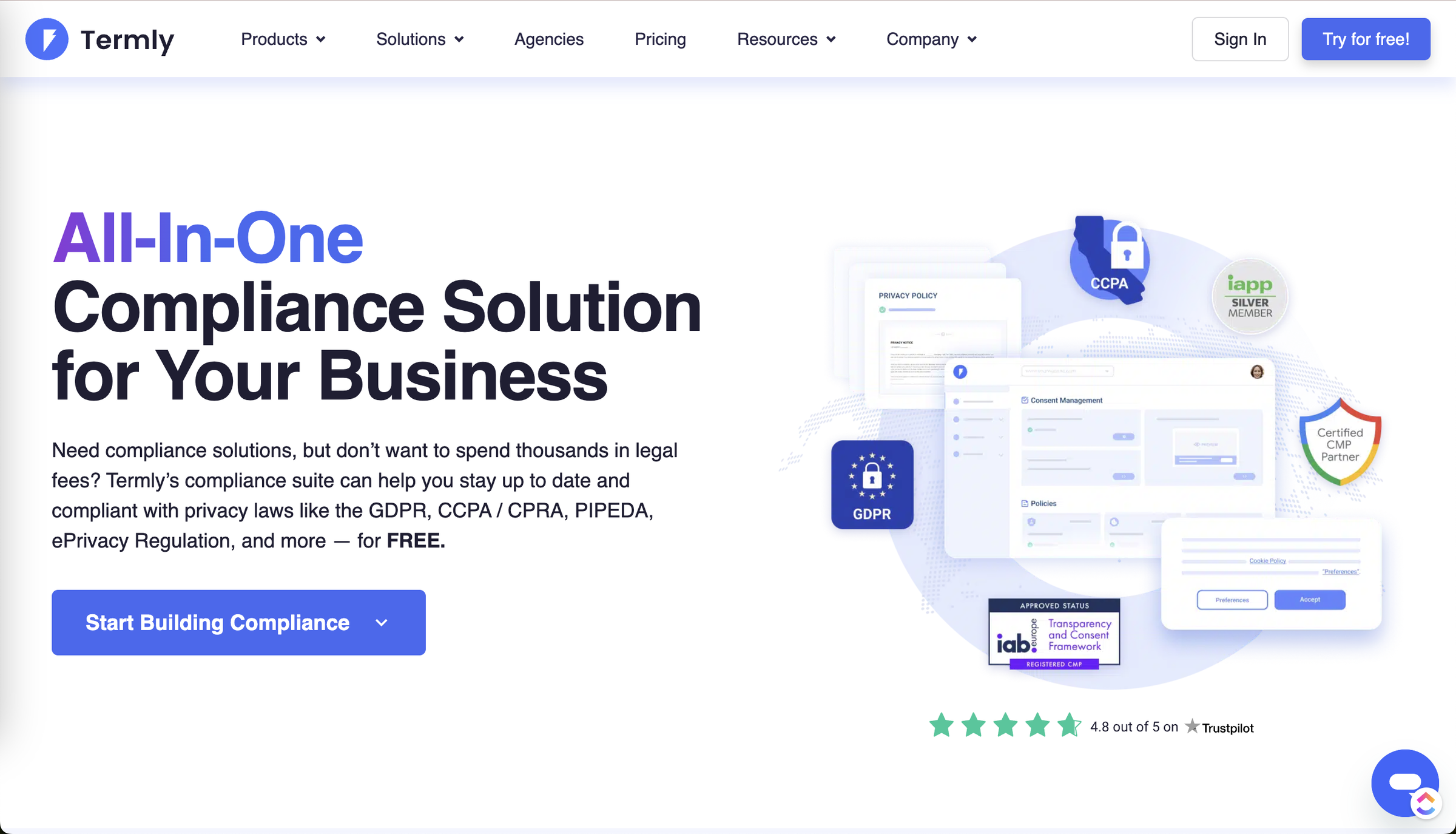
Termly scores 3.8 out of 5, and its clearest advantage over Complianz is document breadth. It is the best fit for Complianz users who need a policy document library, not just a cookie banner. Where Complianz generates a privacy statement, disclaimer, and processing agreement, Termly ships ten generators maintained by its in-house legal team that auto-update when laws change.
Best for: Teams that need a broad, auto-updated legal document suite bundled with their cookie consent tool.
Key Features
Termly's feature set is anchored by its legal document generators.
-
Ten policy generators: privacy policy, cookie policy, terms and conditions, EULA, disclaimer, return and refund policy, shipping policy, accessibility statement, impressum, and NDA
-
Documents maintained by an in-house legal team with automatic updates when laws change
-
IAB TCF 2.3, Google Consent Mode v2, custom banner styling, and multi-language support on Pro+
-
DSAR form on all plans
-
Deploys via snippet or WordPress plugin
-
Phone support, unique in this tier
Pros
Termly's strengths are document breadth and support access.
-
The broadest legal document suite here: ten generators versus Complianz's three documents
-
Lawyer-maintained policies that auto-update when regulations change
-
Real free plan with genuine utility: a script auto-blocker and one basic policy
-
Phone support is unique in this tier, with a 30-day money-back guarantee
Cons
Termly's drawbacks are tier-gating and per-site pricing.
-
IAB TCF 2.3 and multi-language support require Pro+ ($15/mo/site): Starter ($10/mo) lacks both
-
Per-site billing means a five-site operator pays five times the listed rate
-
The free plan is gated: one legal policy, 10,000 monthly banner views, quarterly scans, and a Termly watermark
-
No A/B testing or consent analytics below Enterprise
Pricing
Free: $0 (1 policy, 10,000 banner views/mo, quarterly scans). Starter: $10/mo/site ($120/yr). Pro+: $15/mo/site ($180/yr), adds IAB TCF 2.3, unlimited views, weekly scans, and multi-language. Versus Complianz's $59/yr for one site, Termly Pro+ costs $180/yr for that same site, a premium justified only if you need the document suite.
What Users Say
Termly reviews heavily cite policy generation quality and phone support accessibility. Users with US-centric compliance needs praise the coverage of state laws that other CMPs do not handle. The most common criticism is per-site pricing at scale and the limited features on the Starter plan. It holds 4.3/5 on G2 from 45 reviews and 4.7/5 on Capterra from 80 reviews.
Migrating from Complianz to Termly
Create a Termly account, add your domain, and run the scanner to build your cookie list. Generate your policies, then embed Termly's script or install the WordPress plugin. Configure Google Consent Mode v2 via GTM, and configure matching cookie categories from your Complianz setup. Deactivate Complianz after confirming Termly's banner fires. Termly's help center has a dedicated migration section. Consent records do not transfer, so returning visitors re-consent.
Our Termly review covers scanner accuracy and the free-tier limits that catch people off guard. See also other tools in Termly's class and a Consently versus Termly comparison.
6. iubenda: Best for Legal-First Teams Needing Lawyer-Maintained Docs (3.6/5)
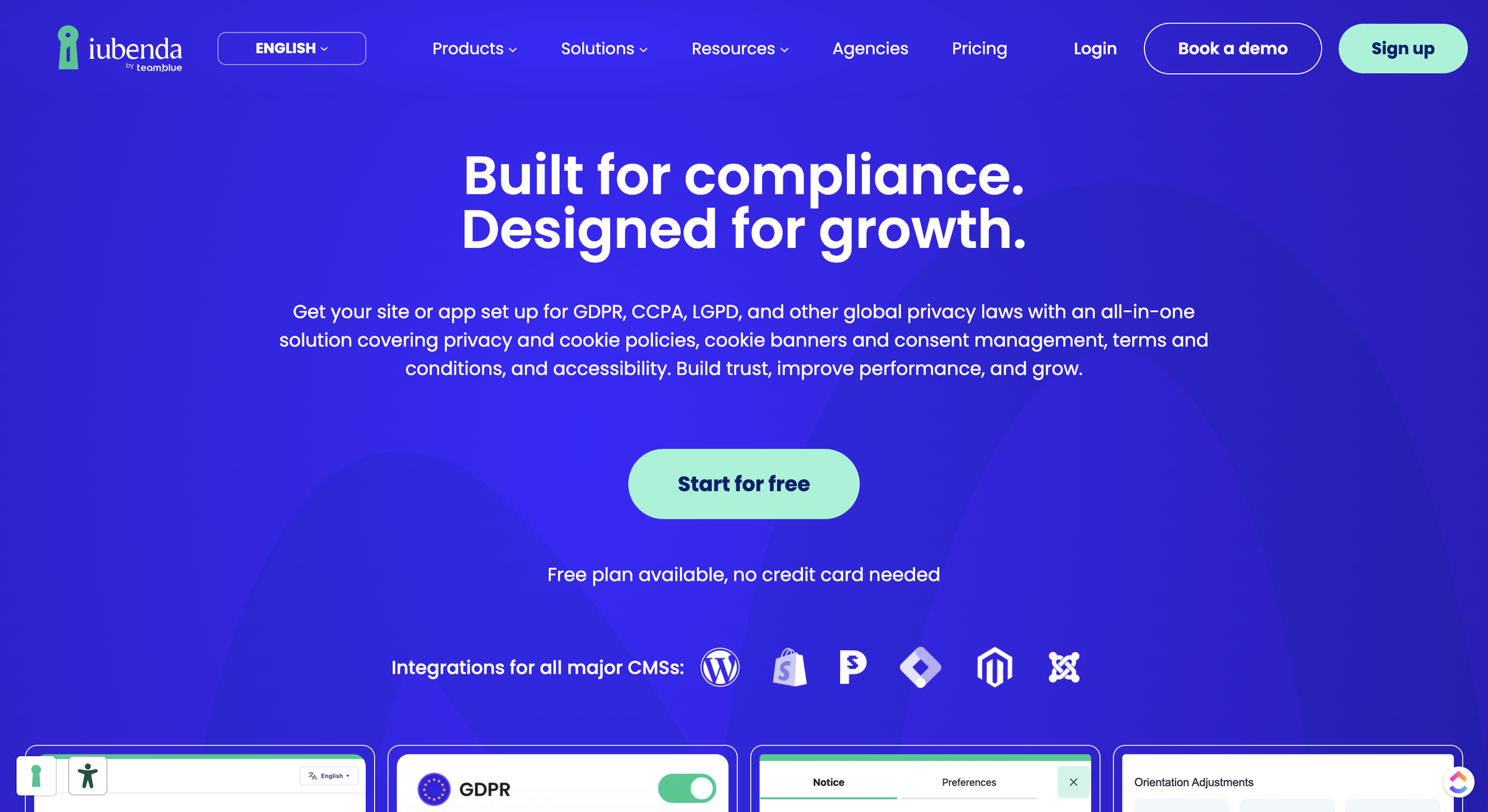
iubenda scores 3.6 out of 5 and is the most document-complete tool on this list. It is the best fit for legal-first teams that prioritize lawyer-maintained documents across jurisdictions over simple cookie consent setup. Its legal team maintains privacy policies, cookie policies, terms and conditions, and data processing agreements, covering multi-jurisdiction scenarios that generative-AI policy tools cannot reliably handle.
Best for: Legal-first teams that need lawyer-maintained, multi-jurisdiction documents and can absorb setup friction.
Key Features
iubenda's feature set is built around lawyer-maintained legal documents.
-
Lawyer-maintained privacy policies, cookie policies, terms and conditions, and data processing agreements
-
Multi-jurisdiction legal coverage updated as laws change
-
IAB TCF on all plans, including Essentials
-
Google Consent Mode v2
-
Per-site pricing with pageview caps and language limits by tier
-
Mobile SDK and full white-label on the Ultimate tier
Pros
iubenda's strengths are legal depth and an accessible IAB TCF entry point.
-
The deepest, most credible legal document library here, earning a G2 Industry Leader and Momentum Leader badge for 2026
-
IAB TCF available from the entry Essentials plan, with no top-tier gate
-
Lawyer-maintained documents that cover scenarios generative-AI tools cannot reliably handle
-
Established EU vendor with 100,000-plus customers
Cons
iubenda's weaknesses are setup friction and per-site cost.
-
Lowest ease-of-setup score here: 5.0 out of 10 on G2, with GTM integration widely described as chaotic
-
Per-site pricing escalates fast: five sites on Advanced is about $1,500/yr versus Complianz's $179/yr for five sites
-
Essentials is capped at 25K pageviews, 20 services, and one language
-
Owned by the iubenda Group, the same parent as Complianz: switching does not diversify your vendor
Pricing
Essentials: $5.99/mo/site ($71.88/yr), 25K pageviews, 20 services, one language. Advanced: $24.99/mo/site ($299.88/yr), 50K pageviews, 30 clauses, all languages, geo-targeting. Ultimate: $99.99/mo/site ($1,199.88/yr), 150K pageviews, mobile SDK, full white-label. A 14-day free trial is available.
What Users Say
iubenda reviews praise the breadth and quality of its lawyer-maintained legal documents and its EU compliance credibility. The most common criticism is the steep learning curve and chaotic configuration, reflected in the 5.0 out of 10 G2 ease-of-setup score. Per-site cost at scale is the other recurring complaint. It scores 9.0 out of 10 on G2 for ease of use, a sharp contrast with its setup score.
Migrating from Complianz to iubenda
Create an iubenda account and add each site as a separate subscription. Generate your legal documents through iubenda's guided flow, then configure the cookie banner and run a scan. Connect Google Consent Mode v2 through GTM, budgeting extra time for the integration that reviewers find chaotic. Deactivate Complianz after confirming the iubenda banner fires.
Consent records do not transfer, so returning visitors re-consent.
Our iubenda review gives the full picture, and other tools in iubenda's class and a Consently versus iubenda comparison cover the lighter-weight options.
7. Real Cookie Banner: Best for Self-Hosted WordPress with No Cloud Dependency (not yet reviewed)
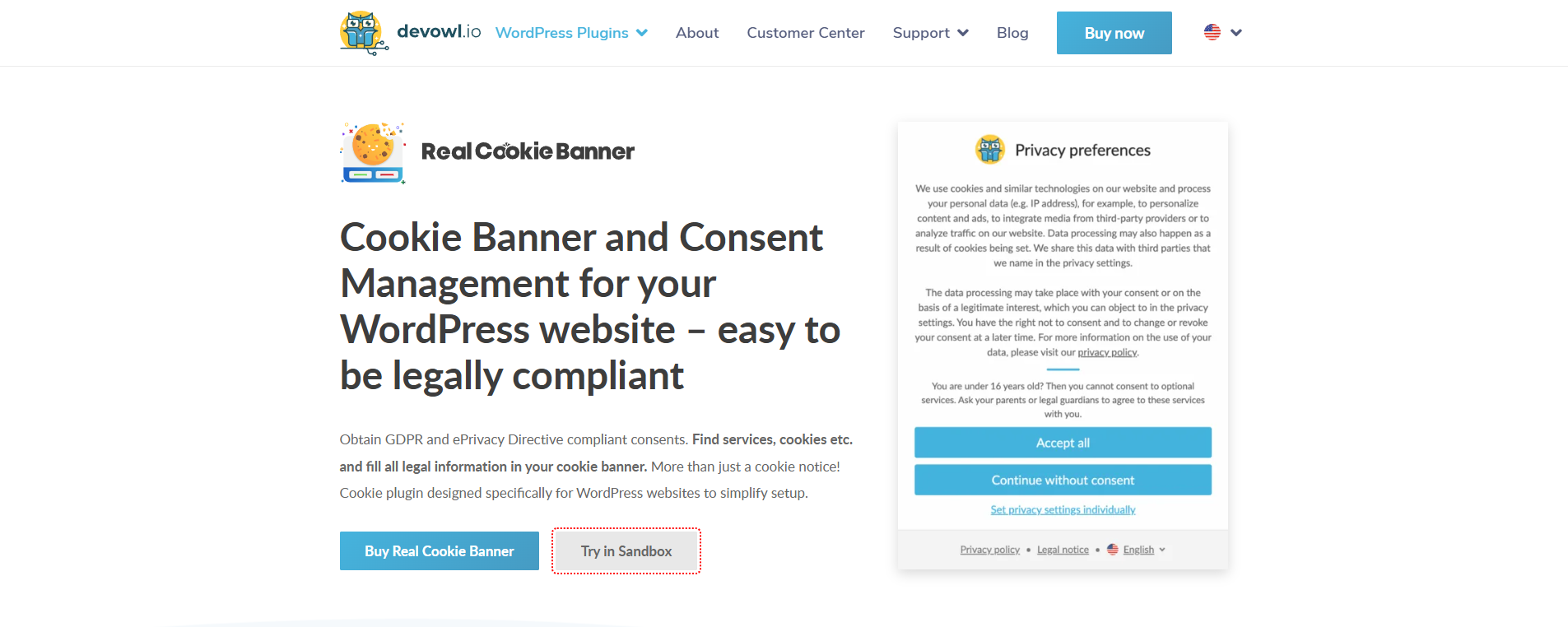
Real Cookie Banner (devowl.io) is the WordPress-only, self-hosted option for teams that treat any cloud dependency as a compliance risk. It has not yet been reviewed with our full methodology. It is the best fit for WordPress developers who want all consent data to stay on their own server. That architecture eliminates a class of data-processing questions cloud-based CMPs introduce.
Best for: WordPress developers who want a self-hosted plugin with no third-party cloud dependency.
Key Features
Real Cookie Banner's feature set is built around self-hosted WordPress compliance.
-
WordPress-only, fully self-hosted: all consent data stays on your server
-
PRO adds 40-plus cookie templates and 25-plus content blocker templates
-
Cookie consent statistics in PRO
-
Advanced GTM and Matomo Tag Manager integration in PRO
-
WordPress Multisite support in PRO
-
Free WordPress.org version covers GDPR and ePrivacy compliance
Pros
Real Cookie Banner's strengths come from its self-hosted, no-cloud architecture.
-
Self-hosted architecture keeps all consent data on your own server, a compliance-clarity advantage some developers prefer
-
Eliminates the cloud-dependency data-processing questions that cloud CMPs introduce
-
A free sandbox lets you test the PRO version before purchase
-
The free WordPress.org version delivers genuine GDPR and ePrivacy compliance
Cons
Real Cookie Banner's limitations are its WordPress scope and opaque pricing.
-
WordPress-only: like Complianz, it does not solve the platform lock-in problem for non-WordPress stacks
-
PRO pricing is shown only at checkout on devowl.io, not on a public pricing page, and was not available via standard web fetch
-
The free version omits most convenience features (templates, presets, statistics, Multisite)
-
Not yet reviewed in independent aggregators at scale, a due-diligence gap
Pricing
The free version is available on WordPress.org with GDPR and ePrivacy compliance and limited features. PRO is a paid single-site license whose price is shown at checkout on devowl.io rather than on a public pricing page. A free sandbox at try.devowl.io lets you trial PRO before purchase.
What Users Say
Real Cookie Banner has not yet been reviewed with our methodology. Its public review presence is concentrated on the WordPress.org plugin listing rather than the major B2B aggregators. The self-hosted, no-cloud architecture is its consistent draw among developers who treat data residency as a compliance question. Buyers should trial the PRO sandbox and confirm the checkout price before committing.
Migrating from Complianz to Real Cookie Banner
Install Real Cookie Banner from WordPress.org or upload the PRO plugin, then run its scanner to detect cookies and services. Apply the relevant cookie and content-blocker templates, and customize your banner. Connect GTM or Matomo Tag Manager if you use them. Deactivate and remove Complianz after confirming the new banner fires across browsers.
Consent records do not transfer, so returning visitors see a fresh consent notice.
8. CookieFirst: Best for EU-Hosted, ISO 27001 Infrastructure (3.8/5)
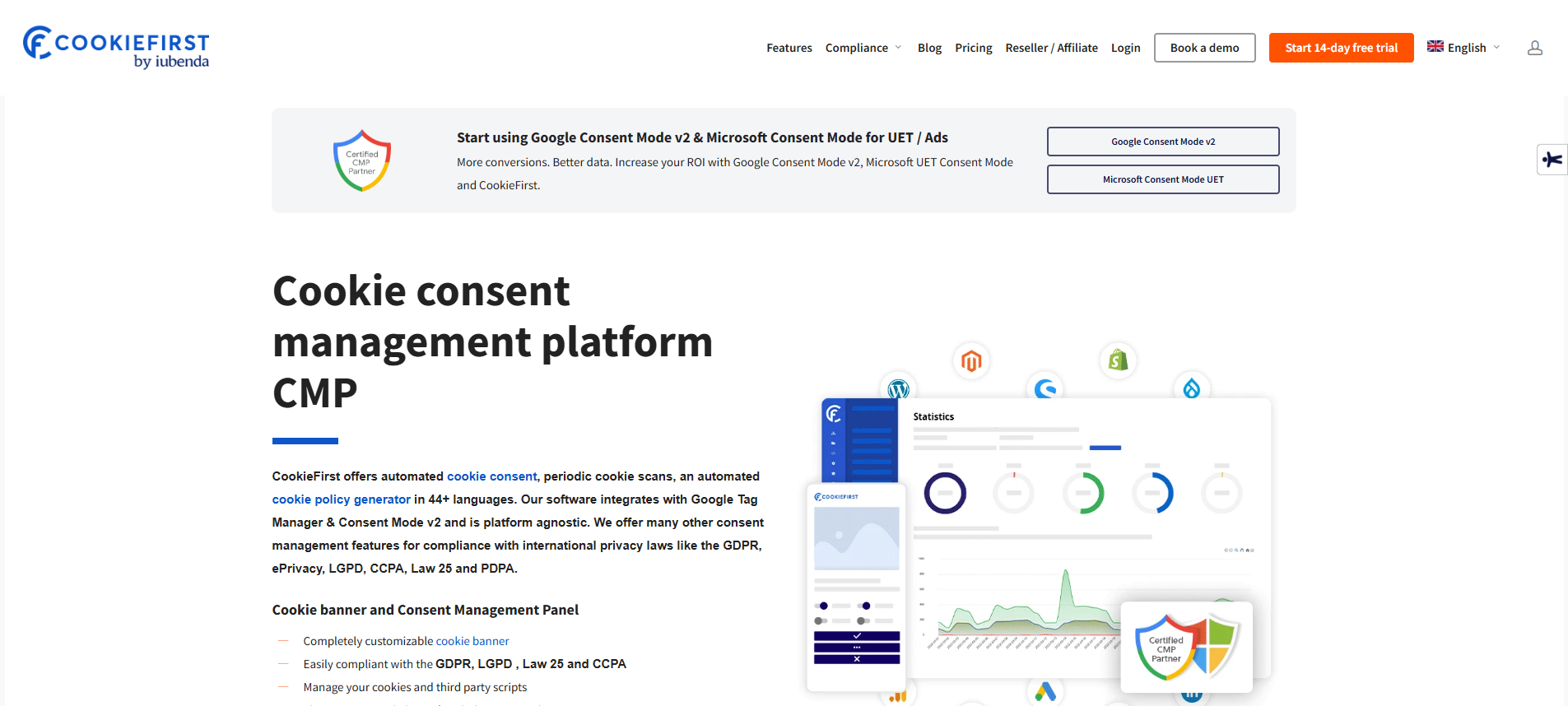
CookieFirst scores 3.8 out of 5, and its infrastructure differentiator is concrete. It is the best fit for EU-focused teams that want ISO 27001-certified, Amsterdam-hosted infrastructure for a single multilingual site. It runs on any platform via snippet and on WordPress via plugin, scans cookies monthly, and supports banners in 40-plus languages.
Best for: EU compliance teams for whom data residency and certified infrastructure are a legal requirement.
Key Features
CookieFirst's feature set is anchored by EU hosting and certifications.
-
Data hosted on DigitalOcean's AMS3 datacenter in Amsterdam (ISO 27001, SOC 1 Type II, SOC 2 Type II, PCI-DSS)
-
Google Certified CMP Partner
-
IAB TCF 2.2 on all paid plans
-
Google Consent Mode v2 and Microsoft UET Consent Mode
-
Monthly cookie scanning, auto-blocking, and 40-plus languages
-
Deploys via snippet or WordPress plugin
Pros
CookieFirst's strengths are data residency and simple per-domain pricing.
-
Concrete EU data residency: Amsterdam hosting with ISO 27001, SOC 1, SOC 2, and PCI-DSS certifications
-
IAB TCF 2.2 on every paid plan, with no top-tier gate
-
Simple per-domain pricing with no fixed bundles
-
White-label banner and panel plus a 24-hour support SLA on the Plus tier
Cons
CookieFirst's drawbacks are limited document generation and shared ownership with Complianz.
-
Generates a cookie policy only, not a privacy policy or terms
-
Owned by iubenda (team.blue) since January 20, 2025: CookieFirst, Complianz, and iubenda share one parent, so switching does not diversify your vendor
-
Free tier is very limited: 1 script, a one-time scan, and one language
-
No native mobile SDK and no DSAR management
Pricing
Free: EUR 0 (1 script, one-time scan, single language). Basic: EUR 9/mo (EUR 99/yr), all scripts, monthly scans, multiple languages. Plus: EUR 19/mo (EUR 209/yr), white-label banner and panel, 24-hour support SLA. IAB TCF 2.2 is on all paid plans. Enterprise is custom.
What Users Say
CookieFirst historically scores well on straightforward setup and white-label options at Basic pricing. Its EU hosting and certification stack are the consistent draw for procurement teams. Post-iubenda acquisition, some community discussion reflects uncertainty about long-term roadmap and support, which buyers needing certainty should weigh explicitly.
Migrating from Complianz to CookieFirst
Both tools embed via a script tag, so the mechanics are similar. Create a CookieFirst account, add your domain, run a cookie scan, and configure your banner. Remove Complianz's embed or deactivate its plugin, then insert CookieFirst's tag. Configure Google Consent Mode v2 via a GTM template. CookieFirst's setup documentation is available in English and several EU languages. Consent records do not transfer, so returning visitors re-consent.
Our CookieFirst review covers all dimensions and other tools in CookieFirst's class, and a Consently versus CookieFirst comparison weighs the iubenda-ownership angle.
9. CookieHub: Best for Non-Profits and Resellers on Session Pricing (3.9/5)
CookieHub scores 3.9 out of 5, and its structural advantages are its discount programs. It is the best fit for non-profits and resellers that need a Google-certified CMP and can work with session-metered pricing. It runs on any platform via snippet and on WordPress via plugin, is ISO 27001-certified, and is a Google Certified CMP Partner.
Best for: Non-profits, resellers, and low-traffic sites that benefit from session-metered pricing and discount programs.
Key Features
CookieHub's feature set centers on session metering and discount programs.
-
Session-based metering rather than per-pageview or per-domain billing
-
IAB TCF 2.3 and cross-domain consent on the Business tier
-
Google Consent Mode v2 and consent proof on all tiers, including free
-
ISO 27001-certified and a Google Certified CMP Partner
-
50% lifetime discount for non-profits, 30% automatic reseller discount
-
Deploys via snippet or WordPress plugin
Pros
CookieHub's strengths are its discount programs and a genuine free tier.
-
Two structural discount programs no other tool here offers: 50% lifetime for non-profits, 30% automatic for resellers
-
Real free tier: 1,000 sessions per month (roughly 25,000 pageviews) with Google Consent Mode v2 and consent proof
-
ISO 27001 certification and Google Certified CMP Partner status
-
Exceeding the session limit on paid plans pauses metering rather than breaking compliance
Cons
CookieHub's weaknesses are metered-billing unpredictability and tier gating.
-
Session metering makes billing unpredictable for traffic-variable sites, unlike Complianz's flat per-site pricing with no pageview cap
-
IAB TCF 2.3 and cross-domain consent are gated to the Business tier at EUR 30/mo
-
Monthly scanning only, not continuous
-
Per-domain at higher tiers adds up for agencies managing many client sites
Pricing
Free: EUR 0 (1,000 sessions/mo, ~25K pageviews). Starter: EUR 6/mo (5,000 sessions, ~125K pageviews). Basic: EUR 10/mo (30,000 sessions, ~500K pageviews). Business: EUR 30/mo (120K to 1M sessions), adds IAB TCF 2.3 and cross-domain consent. Non-profits get a 50% lifetime discount; resellers get an automatic 30% discount.
What Users Say
CookieHub reviews concentrate in two segments: agencies using the reseller program for client portfolios, and high-traffic EU sites benefiting from session-based billing. The 30% reseller discount is consistently highlighted as a key decision factor. The most common critique is that the step from Business to a custom Enterprise contract is large, with no self-serve middle tier.
Migrating from Complianz to CookieHub
Create your domain in CookieHub and run the automatic scan to rebuild your cookie categories. Remove Complianz's embed or deactivate its plugin, then install CookieHub's JavaScript snippet or WordPress plugin. Configure Google Consent Mode v2, and set up cross-domain consent in the Business dashboard if you need it. Deactivate Complianz after confirming the banner fires.
Consent records do not transfer, so returning visitors re-consent.
Our CookieHub review covers the session-cap mechanics and IAB TCF gating in full. See also other tools in CookieHub's class and a Consently versus CookieHub comparison.
Which Complianz Alternative Fits Your Switch
The right alternative depends entirely on which Complianz problem you are solving.
-
If you are leaving because of platform lock-in: choose Consently (any CMS, any platform, one consent log) or Cookiebot (snippet-based, works everywhere, strongest certification). WPConsent, Real Cookie Banner, and Complianz itself all stay WordPress-only.
-
If you are leaving because of plugin conflicts and banner reliability: choose CookieYes (1.5M+ installs, best-in-class support) or WPConsent (built by the WPForms team around WordPress-ecosystem integration).
-
If you are leaving because of configuration complexity: choose CookieYes (the fastest setup path on WordPress) or Consently (all features on every plan, no configuration layers to open). Termly is also fast to start for teams that need policy documents, not just a banner.
-
If you need policy documents your Complianz plan does not include: choose Termly (10 document generators, auto-updated) or iubenda (lawyer-maintained documents, multi-jurisdiction coverage).
-
If you run a non-profit or reseller operation: CookieHub’s 50% lifetime and 30% structural discounts are unique and worth prioritizing.
If you run a single WordPress site and have no non-WordPress properties, Complianz is still a strong choice and may not need replacing. The tools above outperform it specifically when your stack crosses platforms, when plugin conflicts break the banner, or when you want every feature without tier-gating.
The consent management platform pricing comparison covers multi-site cost math in detail for teams comparing total annual cost across these tools.
If platform lock-in or feature-gating is your reason for leaving, Consently covers every platform with every feature on every plan from $99/year.
Start your free Consently trial with a 14-day trial, no credit card required.
FAQs
What are the best Complianz alternatives?
The strongest Complianz alternatives are Cookiebot, CookieYes, WPConsent, and Consently, with Termly, iubenda, Real Cookie Banner, CookieFirst, and CookieHub fitting narrower needs. Cookiebot scores highest in our reviews at 4.0 out of 5. The right pick depends on whether you are escaping platform lock-in, plugin conflicts, or configuration complexity.
Is there a free Complianz alternative?
Yes. Several tools on this list have real free tiers. CookieYes offers a free plan up to 5,000 pageviews per month per domain. Cookiebot's free tier covers one domain with up to 50 subpages. CookieHub's free tier handles up to 1,000 sessions per month (roughly 25,000 pageviews) and includes Google Consent Mode v2. Termly's free plan covers one legal policy with 10,000 monthly banner views. Complianz also has a free version on WordPress.org, though its scanner and advanced features require a paid plan. All free tiers have meaningful constraints, so test the one that matches your traffic before committing.
Does switching from Complianz require visitors to re-consent?
Yes. No consent platform transfers another platform's consent records. When you replace Complianz with any alternative, your returning visitors will see the new consent banner on their next visit. This is a legal re-consent event, not a technical defect. Consent records tied to the old platform's format are not portable. Plan for a consent-collection period on your analytics after any migration.
Can Complianz alternatives work on non-WordPress sites?
Most can. Consently, Cookiebot, CookieYes, Termly, iubenda, CookieFirst, and CookieHub all deploy via a JavaScript snippet that works on any platform. Consently, CookieYes, Cookiebot, iubenda, and CookieFirst also offer native WordPress and Shopify integrations. WPConsent and Real Cookie Banner are WordPress-only. If you are migrating off WordPress, rule out those two immediately.
Is Complianz owned by iubenda?
Complianz is owned by the iubenda Group, which acquired it in 2024. CookieFirst is also owned by iubenda (team.blue), acquired January 20, 2025. So Complianz, CookieFirst, and iubenda itself all operate under the same parent organization. Teams that want to diversify away from the iubenda Group for vendor-risk reasons should factor this in. CookieYes, Cookiebot (Usercentrics), Termly, WPConsent (Awesome Motive), and CookieHub are independent of the iubenda Group.
How do I migrate from Complianz to Consently?
Install the Consently WordPress plugin or add the Consently snippet to your site's <head> via your theme, a tag manager, or directly in the HTML. Run Consently's automatic scanner to build your cookie category list. Deactivate and remove the Complianz plugin after confirming the Consently banner fires correctly in multiple browsers. Previous Complianz consent records do not transfer, which is standard across all CMP migrations. The 14-day Consently trial needs no credit card, so you can test the migration before committing.
What is the cheapest paid Complianz alternative?
On a per-site basis, iubenda Essentials at $5.99/mo ($71.88/yr) and CookieHub Starter at €6/mo are the lowest-cost paid tiers among these alternatives. Both come with constraints. iubenda Essentials caps at 25,000 pageviews, 20 services, and one language; CookieHub Starter caps at 5,000 sessions per month. Complianz's Personal plan at $59/yr has no pageview or session cap, which keeps it competitive on per-site pricing for single-site WordPress owners.
Can these Complianz alternatives handle both GDPR and CCPA?
Yes. All nine alternatives listed here cover both GDPR (opt-in consent mode for EU/EEA visitors) and CCPA (opt-out / "Do Not Sell" for California). Most also cover LGPD, PIPEDA, and other regional privacy laws. The specific frameworks supported vary by tool and tier. For GDPR compliance requirements in detail, see GDPR cookie consent requirements.
Does any Complianz alternative include IAB TCF on its free plan?
No mainstream alternative includes IAB TCF on a free plan. CookieHub includes Google Consent Mode v2 on its free tier but gates IAB TCF 2.3 to the Business plan at €30/mo. Cookiebot's free tier does not include IAB TCF. CookieYes includes IAB TCF from its Pro plan ($25/mo). Termly includes IAB TCF 2.3 on Pro+ ($15/mo). Complianz includes IAB TCF on all paid plans, starting at $59/yr, the lowest-cost paid entry point for that feature alongside WPConsent.
How does Consently compare to Complianz for Shopify?
Complianz offers a separate Shopify app alongside its WordPress plugin, with the same feature set on both. Consently runs on Shopify via its native app and on any other platform via a snippet or WordPress plugin. It keeps one unified dashboard and consent log across all channels. If you run Shopify only, both tools serve that use case. If you run Shopify alongside WordPress or another platform, Consently's unified architecture means one tool instead of two. For a focused comparison, see best CMP for Shopify.