CookieFirst is best for one or a few EU-focused, multilingual sites that want certified, easy-to-run cookie compliance. Skip it if you run many sites on a budget, or need a privacy policy and terms document too. Paid plans start at EUR 9 per month per domain (EUR 99 a year), with a thin free tier and a 14-day no-card trial. The key caveat: pricing is per domain and the generator covers cookies only.
Verdict: a polished, Google-certified, EU-hosted CMP that fits single multilingual sites well and gets costly across many domains.
This review covers its features, current pricing, evidenced pros and cons, real user sentiment, and who should look elsewhere.
CookieFirst Review Scorecard
We score CookieFirst 3.8 out of 5. It earns its marks on easy setup, language coverage, EU certifications, and measured page-speed. It loses ground on per-domain pricing and a cookie-policy-only document set.
Two facts define the value question, and no aggregator isolates them. CookieFirst bills one domain per plan, and it generates a cookie policy only, with no privacy policy or terms generator.
| Dimension | Score |
|---|---|
| Compliance and framework coverage | 4.0/5 |
| Cookie scanning and auto-blocking | 3.5/5 |
| Banner and consent experience | 4.0/5 |
| Ease of setup and integrations | 4.5/5 |
| Pricing and value | 3.0/5 |
| Performance and reliability | 4.0/5 |
| Support and reputation | 3.5/5 |
| Overall | 3.8/5 |
Verdict: a certified, easy-to-run EU CMP that fits one or a few multilingual sites, and gets expensive across many domains.
How we score: we rate every consent platform across seven weighted dimensions. The evidence is the live pricing page, the product documentation, verified user reviews, and a page-speed measurement. See our full methodology.
Full disclosure: Consently competes with CookieFirst in the consent-management category, and scored it with that same method. Every figure below traces to CookieFirst’s own documentation, its current pricing, or a verified user review.
What Is CookieFirst?
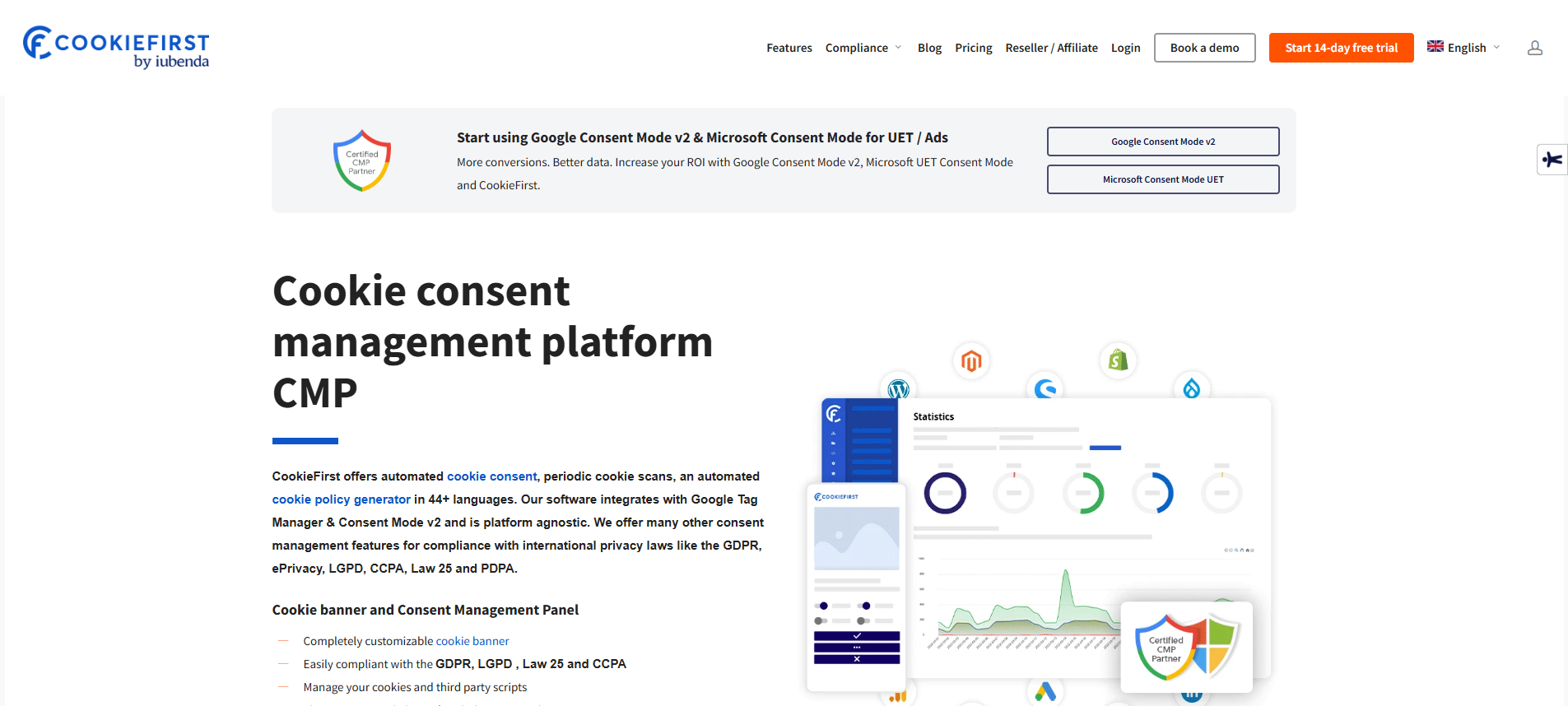
CookieFirst is a Netherlands-based, Google-certified consent management platform, now part of iubenda (team.blue). It scans a site for cookies, auto-blocks third-party scripts before consent, and shows a customizable banner in 40+ languages. It also logs consent and auto-generates a cookie policy.
CookieFirst launched in 2019 as a brand of Digital Data Solutions BV in Amsterdam. iubenda, part of the team.blue group, acquired it on January 20, 2025. It sits in the mid-market and SMB tier of the leading consent management platforms, alongside Cookiebot, CookieYes, and CookieScript. The product handles GDPR, ePrivacy, CCPA, LGPD, and similar regimes through one script.
Its credibility rests on real infrastructure, not just marketing. CookieFirst hosts data on DigitalOcean’s AMS3 datacenter in Amsterdam, per its data-security page. That datacenter holds ISO 27001, SOC 1 Type II, SOC 2 Type II, and PCI-DSS certifications. It is a Google Certified CMP Partner, carries roughly 5,000 customers, and shows enterprise logos including Vogue, Hyundai, InterContinental Hotels, Amnesty International, and Elsevier.
On Crozdesk it scores 84/100 in the Governance, Risk and Compliance category. That is a serious compliance posture for a company this size.
Who CookieFirst Is For
CookieFirst fits buyers who want certified, EU-hosted compliance without building it themselves. The strongest matches are below.
-
EU-focused SMBs and webshops that need GDPR and ePrivacy compliance on WordPress, Shopify, Shopware, or WooCommerce, and value a Google-certified tool.
-
Digital agencies and resellers that want to manage client sites from one portal, white-label the banner, and resell consent at roughly a 30% margin.
-
Multilingual and pan-European sites that need 40+ banner languages with geotargeting so each visitor sees the right notice in the right language.
-
Ad and analytics-driven sites that must pass Google Consent Mode v2 and, for ad-tech, IAB TCF 2.2 signals.
-
Buyers who weigh data residency and want ISO 27001, SOC, and PCI-DSS certifications behind their CMP.
Who CookieFirst Is Not For
CookieFirst is a poor fit in a few specific situations, and these are worth naming plainly.
-
Anyone running several sites on a tight budget. Pricing is per domain (one domain per plan), so cost stacks linearly as you add sites.
-
Buyers who also need a privacy policy or terms-and-conditions document. CookieFirst generates a cookie policy only; by its own documentation, no privacy policy or terms generator exists.
-
Teams that need a native mobile-app SDK or banner A/B testing. Neither is offered; CookieFirst ships a web React component, not an app SDK.
-
Budget-conscious SMBs who want the basics without paying up. IAB TCF, monthly scanning, and multi-language all sit above the free tier.
-
US-first teams that want a deep US community and support presence. CookieFirst is EU-weighted; its English-language community discussion is thin, and US developer threads name Complianz and CookieYes more often.
What Are CookieFirst’s Key Features?
CookieFirst’s core features cover four areas. The first is a monthly cookie scanner with an auto-updating cookie policy. The second is a customizable banner in 40+ languages with geotargeting. The third and fourth are third-party script auto-blocking and Google Consent Mode v2 signaling. It adds consent logging and an agency reseller program on top.
CookieFirst bundles the standard CMP toolkit. The parts worth evaluating are where it is genuinely strong (scanning, languages, ad-tech signaling, reseller economics) and where it is gated or missing. Each feature below is assessed on what it does, how well it does it, and what it costs you.
The Cookie Scanner and Auto-Updating Cookie Policy
The scanner is CookieFirst’s foundation, and it works the way the category expects. It periodically scans cookies and local storage (monthly on paid plans, one-time only on Free), then auto-updates an embeddable cookie policy from the results. The policy drops onto a page with a few lines of JavaScript and stays current as the monthly scan re-runs.
For a site owner who does not want to hand-maintain a cookie table, that automation is the point.
One limit belongs here, not buried later: the generator produces a cookie policy only. By CookieFirst’s own documentation, there is no privacy-policy generator and no terms-and-conditions generator. If your site needs all three documents, the scanner solves one of them and you reach for a separate tool for the other two.
The Consent Banner, Languages, and Geotargeting
The banner is customizable in the ways most buyers care about. It offers four layouts (bottom, top, boxed, centered), custom colors, fonts, buttons, and logo. It also covers accept, reject, and manage actions, plus granular category toggles. It is mobile-responsive and supports geotargeting, so EU visitors see an opt-in model and US visitors see opt-out automatically.
Language coverage is a real strength. CookieFirst supports 40+ banner languages with one-click add, which is broader than many budget CMPs offer. One honest caveat applies to the exact count, which is inconsistent across CookieFirst’s own pages.
Script Auto-Blocking Before Consent
CookieFirst blocks third-party scripts and cookies before consent through four documented methods. They are autoblocking all scripts, per-service configuration, a Google Tag Manager route, and hard-coded HTML blocking attributes. That covers both the non-technical user who wants automatic blocking and the developer who wants manual control.
The constraint is tiering: the Free plan blocks a single third-party script, while paid plans cover all scripts. For any real site running analytics, ads, and embeds together, blocking is effectively a paid feature.
Google Consent Mode v2, IAB TCF, and Ad-Tech Signaling
This is a genuine strength for ad and analytics sites. CookieFirst is a Google Certified CMP Partner and implements Google Consent Mode v2 through a GTM template and gtag. It sends the four consent signals: analytics_storage, ad_storage, ad_user_data, and ad_personalization. For programmatic ad-tech, it supports IAB TCF 2.2.
The gating matters and is easy to miss: IAB TCF 2.2 is on the Plus plan only. It is struck through on both Free and Basic. So a publisher who needs the IAB framework cannot get it at the EUR 9 Basic tier; that requires Plus at EUR 19. The Google Consent Mode support is broader and reaches lower down the plan ladder, but TCF specifically is a top-tier feature.
Consent Logs, Statistics, and the Reseller Program
CookieFirst logs every consent in an encrypted, pseudonymized audit trail, surfaces a consent-statistics dashboard, and emails consent reports.
For agencies, the reseller program is the standout. You add client sites to one account, white-label the banner, and resell consent at your own price, at roughly a 30% margin off recommended pricing. That is a real, well-built agency motion, not a bolt-on.
One calibrated caveat applies to the statistics specifically. A Capterra reviewer found the dashboard overstated their consent rate. It showed “a 80% consent rate” against 50% in their server analytics. That is a single detailed review, not a pattern across the base. Treat it as a flag to verify your own numbers, not a verdict on the feature.
How Easy Is CookieFirst to Use?
CookieFirst goes live in four moves. You create a site, customize the banner, add languages, and drop a one-line script (or GTM tag) into the page head. A Capterra reviewer reports roughly 30 minutes to live. Setup is consistently one of its strongest points.
Ease of setup is CookieFirst’s most consistent praise. Its Capterra Ease-of-Use sub-score is 4.5 out of 5, the highest of any sub-rating it earns. The walkthrough below reconstructs the documented path from signup to a live banner.
Getting Started: From Signup to a Live Banner
Getting CookieFirst live follows a short, documented path.
1. Start the 14-day trial. No credit card is required.
2. Add your domain and create the site in the dashboard.
3. Customize the banner. Pick a layout (bottom, top, boxed, or centered), set colors, fonts, buttons, and your logo, and choose the accept, reject, and manage actions.
4. Add languages from the predefined list with one-click add.
5. Install the script. Drop a one-line JavaScript snippet into the page
On WordPress specifically, CookieFirst’s plugin now integrates with the WordPress Consent API as of its 2.0.0 release, so consent state flows to other Consent-API-aware plugins. The plugin has around 400-plus active installs and is tested up to WordPress 6.8, a small but current footprint.
The banner is live once the script is in place. The cookie policy fills in after the scanner runs. Since the recurring scan is monthly on paid plans, the full auto-built policy finalizes on that cadence rather than instantly.
A Capterra reviewer puts the end-to-end setup at roughly 30 minutes. A Shopify App Store reviewer calls deploying and customizing the app “very easy,” with “responsive devs too.” That praise is CookieFirst’s to claim.
How Much Does CookieFirst Cost?
CookieFirst has a very limited free tier, then per-domain paid plans. Basic is EUR 9/mo (EUR 99/yr) and Plus is EUR 19/mo (EUR 209/yr), with Enterprise custom. Every plan is priced per domain, ex-VAT, with a 14-day no-card trial.
CookieFirst prices per domain, in EUR, ex-VAT. The trial is 14 days and needs no credit card. A soft limit of 250,000 page views applies per domain per month, with a 25% overuse allowance. Here is the current grid from CookieFirst’s own pricing.
| Plan | Price (per domain, ex-VAT) | Key inclusions | Notable exclusions (gated) |
|---|---|---|---|
| Free | EUR 0 | 1 third-party script, banner-only layout, one-time scan, 1 language, support under 96h | Banner customization, white-label, consent statistics, scan reports, audit trails, IAB TCF, monthly scan, multi-language, all scripts |
| Basic | EUR 9/mo (EUR 99/yr) | All scripts, banner or box layout, monthly scan, multiple languages, banner customization, white-label banner, consent statistics, scan reports, support under 72h | White-label preferences panel, audit trails, Re-Consent, scanner settings, IAB TCF 2.2 |
| Plus (“Recommended”) | EUR 19/mo (EUR 209/yr) | Everything in Basic, plus white-label panel, audit trails, Re-Consent, scanner settings, IAB TCF 2.2, support under 24h | Top self-serve tier |
| Enterprise | Custom | Tailored solution with extensive API integration support | Sales-led |
Prices are ex-VAT and quoted per domain. The trial is 14 days with no card. The soft limit is 250,000 page views per domain per month, plus a 25% overuse allowance.
For a single EU site, this is competitive. Basic at EUR 99/year is genuinely cheap for a Google-certified, EU-hosted CMP. The model becomes expensive at scale. Billing is per domain with no flat multi-domain bundle on self-serve, and several basics (IAB TCF, monthly scanning, multi-language) sit above the Free tier.
One reviewer also flags that prices are shown ex-VAT without prominent disclosure (“prices listed net without VAT disclosure”), which can surprise at checkout. The figures here come from CookieFirst’s pricing.
CookieFirst’s Free Plan: What You Actually Get
CookieFirst’s free plan is real (EUR 0) but deliberately thin. You get one third-party script, a banner-only layout, a single one-time cookie scan, one language, and support within 96 hours.
Almost everything else is struck through on the free grid: monthly scanning, multi-language, white-label, consent statistics, scan reports, audit trails, and IAB TCF. It is enough to see how the product looks on a simple site. It is not enough to run a real, multi-script site. Every meaningful feature sits behind Basic or Plus.
What Per-Domain Pricing Costs at Scale
The defining cost characteristic is per-domain billing: one domain per plan, with no flat multi-domain bundle on the self-serve plans. Adding sites means adding subscriptions. The illustrative math is simple. Five single sites on Basic run 5 times EUR 9/mo, about EUR 45/mo or roughly EUR 540/year.
On Plus, five sites run 5 times EUR 19/mo, about EUR 95/mo, or roughly EUR 1,140/year. The reseller program centralizes management by letting an agency add client sites to one portal. Even so, each site still bills at the per-site recommended price (EUR 9 Basic or EUR 19 Plus).
This per-domain structure is exactly what CookieFirst’s own pricing confirms (“CookieFirst pricing plans include only 1 domain”). It is the trade-off the cluster’s comparison pages center on.
What Are the Pros of CookieFirst?
CookieFirst’s genuine strengths are easy setup, broad language coverage, a real agency reseller program, EU certifications, and Google Certified CMP status. Each is specific and evidenced below, not a marketing echo.
-
Exceptionally easy to set up and customize: This is the most consistent praise, anchored by a 4.5 Ease-of-Use sub-score on Capterra and a Shopify reviewer calling deployment “very easy” with “responsive devs.”
-
Broad language coverage with geotargeting: 40+ banner languages with one-click add and opt-in/opt-out geotargeting, wider than many budget CMPs offer.
-
A genuine agency reseller program: One-portal multi-client management, white-label banner, and reselling at roughly a 30% margin make compliance a profitable service line for agencies.
-
Serious EU data residency and certifications: Amsterdam (DigitalOcean AMS3) hosting inside an ISO 27001, SOC 1 and SOC 2 Type II, and PCI-DSS certified environment, a credible enterprise trust signal.
-
Google Certified CMP Partner with strong ad-tech signaling: Consent Mode v2 with all four signals and IAB TCF 2.2 (on Plus), keep ads and analytics working under consent.
What Are the Cons of CookieFirst?
CookieFirst’s main limitations are per-domain pricing that scales linearly, cookie-policy-only generation, a thin free tier, and reported consent-API latency and statistics-accuracy concerns. Each is stated at the severity the evidence supports, with no exaggeration.
-
Per-domain pricing that scales linearly: One domain per plan, no multi-site bundle on self-serve; five sites run roughly EUR 540 to EUR 1,140/year depending on tier, per CookieFirst’s own pricing.
-
Cookie policy only, no privacy policy or terms: By CookieFirst’s own documentation, there is no privacy-policy generator and no terms-and-conditions generator; the “all-in-one” framing covers cookies, not the full document set.
-
A thin free tier with basics gated: IAB TCF, monthly scanning, multi-language, and white-label all require a paid plan, so the free tier is a preview rather than a usable footing.
-
Reported consent-API latency: A Capterra reviewer says saving consent “takes too long” and that it “ruins our AB Tests,” and another reports occasional banner bugs. These are reported user experiences on specific cases, not confirmed universal behavior.
-
Disputed consent-statistics accuracy: One detailed Capterra reviewer found the dashboard showed an 80% consent rate against 50% in their server analytics; treat this as a single-source flag to verify, not a settled fact.
-
Inconsistent support, plus two feature gaps: One reviewer reports being “ghosted” by support, though this sits against a fair 3.9 Customer Service sub-score, so it reads as an outlier rather than the norm. Separately, there is no native mobile-app SDK and no banner A/B testing.
What Do Real Users Say About CookieFirst?
User sentiment is broadly positive on a small, EU-weighted review base. The ratings are Capterra 3.7/5 (14), Trustpilot 4.3/5 (9), G2 4/5 (2), Shopify 5/5 (6), and Crozdesk 3.7/5 (16, GRC 84/100).
Praise centers on ease and value; criticism on per-domain cost and consent-API performance.
The review base is modest and weighted toward EU users, so read it as directional rather than statistically heavy.
CookieFirst scores 3.7/5 on Capterra across 14 reviews, with Ease of Use at 4.5 and Customer Service at 3.9. It also holds 4.3/5 on Trustpilot (9 reviews), 4/5 on G2 (2 reviews), and 5/5 on the Shopify App Store (6 votes).
On Crozdesk it holds 3.7/5 across 16 reviews and an 84/100 Governance, Risk and Compliance score. A representative mix follows.
“Easy to setup, easy to use.” (Capterra)
“Deploying and customising the app was very easy. Fantastic app! Loaded with features and super customizable to fit my store’s needs. Responsive devs too!” (Shopify App Store)
“After saving my consent it takes too long. This ruins our AB Tests.” (Capterra)
“Based on Server analytics we don’t have a 80% consent rate like the statistics page shows, but of 50%.” (Capterra)
The pattern is consistent with the feature read above. People like the setup and value, and the complaints concentrate on consent-API performance and reporting trust rather than on getting started.
Is CookieFirst Worth It?
CookieFirst is worth it for EU-focused single-site owners, multilingual sites, and agencies that value easy setup and language depth. It is harder to justify for multi-site buyers on a budget, or for anyone who also needs a privacy policy and terms document.
Choose CookieFirst if:
-
You run one or a few EU sites and want certified, easy, Google-recognized compliance at a low entry price.
-
You serve multilingual or pan-European audiences and value 40+ languages with geotargeting.
-
You run an agency that can absorb per-site cost and wants one-portal reselling at a margin.
-
You weight EU data residency and ISO 27001, SOC, and PCI-DSS certifications in your decision.
Look elsewhere if:
-
You manage several sites on a budget and cannot absorb per-domain cost scaling.
-
You need a privacy policy and/or a terms-and-conditions document generated in the same tool.
-
You need a native mobile-app SDK or banner A/B testing.
-
You want every feature, including IAB TCF and monthly scanning, without paying up from the free tier.
If any of these “look elsewhere” conditions describe you, compare the best CookieFirst alternatives before you commit. CookieFirst remains a strong, certified choice for the single-site, multilingual, and agency-reseller buyer. The friction is cost-at-scale and the cookie-only document set, not the core product quality.
Considering an Alternative to CookieFirst?
Consently addresses CookieFirst’s specific limitations in three ways. It offers flat multi-domain pricing instead of per-domain billing. It generates three policy documents, cookie, privacy, and terms, instead of cookie-only. And it includes every feature on every plan instead of a gated free tier.
If CookieFirst’s per-domain cost-at-scale is your main concern, Consently bundles domains flat: five domains for $199/year and ten for $499/year. If the cookie-policy-only gap is the blocker, Consently generates all three documents- cookie, privacy, and terms-and-conditions, in one tool.
And if the gated free tier frustrates you, Consently includes every feature on every plan. That means IAB TCF, Google Consent Mode v2, weekly scanning, geotargeting, and live chat at the entry tier.
In fairness, CookieFirst is genuinely stronger in places. It supports more banner languages (40+ versus Consently’s 35). It publishes deeper datacenter certifications (ISO 27001, SOC 1 and 2, PCI-DSS) than Consently evidences beyond EU hosting. It also carries more market maturity, with roughly 5,000 customers and iubenda backing. CookieFirst is the better pick if language count and certifications top your list. Consently is the better pick for the multi-site cost and all-in-one-policy buyer, not a like-for-like swap on every axis.
For a feature-by-feature breakdown, see Consently vs CookieFirst side by side, or you can see what Consently costs and start a free trial. Try Consently free for 14 days, no credit card required.
FAQs
Is CookieFirst free?
Yes, CookieFirst has a real free plan at EUR 0, but it is very limited. You get one third-party script, a banner-only layout, a single one-time scan, and one language, with support under 96 hours. Monthly scanning, multi-language, IAB TCF, and white-label are all gated to paid tiers. Most users move to Basic (EUR 9/mo) or Plus (EUR 19/mo).
Does CookieFirst generate a privacy policy and terms?
No. CookieFirst generates a cookie policy only, auto-built from its scan. By its own documentation, it has no privacy-policy generator and no terms-and-conditions generator. If you need all three documents, you will need a separate tool or an all-in-one platform that produces cookie, privacy, and terms documents together.
How does CookieFirst compare to Cookiebot?
Both automate cookie scanning, banners, and Google Consent Mode v2. Cookiebot is larger and scanning-led. CookieFirst is cheaper at entry (Basic EUR 9/mo), rated easier on setup, and reseller-friendly, but gates IAB TCF to its Plus plan. Both charge per domain, so cost scales with site count either way. For the fuller set, see the alternatives roundup.
Can I use CookieFirst for multiple websites?
Yes, but each domain is billed separately, one domain per plan, with no flat multi-domain bundle on self-serve. Five Basic sites run roughly EUR 540/year and five Plus sites roughly EUR 1,140/year. The reseller program centralizes management in one portal, but each site still bills at the per-site price.
Is CookieFirst good for agencies?
It has a genuine reseller program: add client sites to one portal, white-label the banner, and resell at roughly a 30% margin. The catch is the per-domain pricing underneath, since both your margin and your total cost scale with client-site count. Agencies managing many sites should run the cost math before committing.
Is CookieFirst GDPR compliant?
CookieFirst is built for GDPR and ePrivacy. It provides opt-in consent for the EU, auto-blocking before consent, and an auto-generated cookie policy. It also keeps encrypted EU-hosted consent logs in Amsterdam and is a Google Certified CMP with IAB TCF 2.2 (Plus) support. As with any CMP, actual compliance still depends on configuring it correctly for your site.
What are the best CookieFirst alternatives?
The alternatives most often surfaced are Cookiebot, CookieYes, CookieScript, Cookie Information, and Usercentrics. Consently is also worth a look for buyers who want flat multi-domain pricing and all three policy generators (cookie, privacy, and terms). The right pick depends on whether cost-at-scale, document breadth, or enterprise depth matters most to you.